Market Activity
One to keep a VERY close eye on...
September 1, 2026
Related Links
There are companies that beat expectations, and then there is Nvidia.
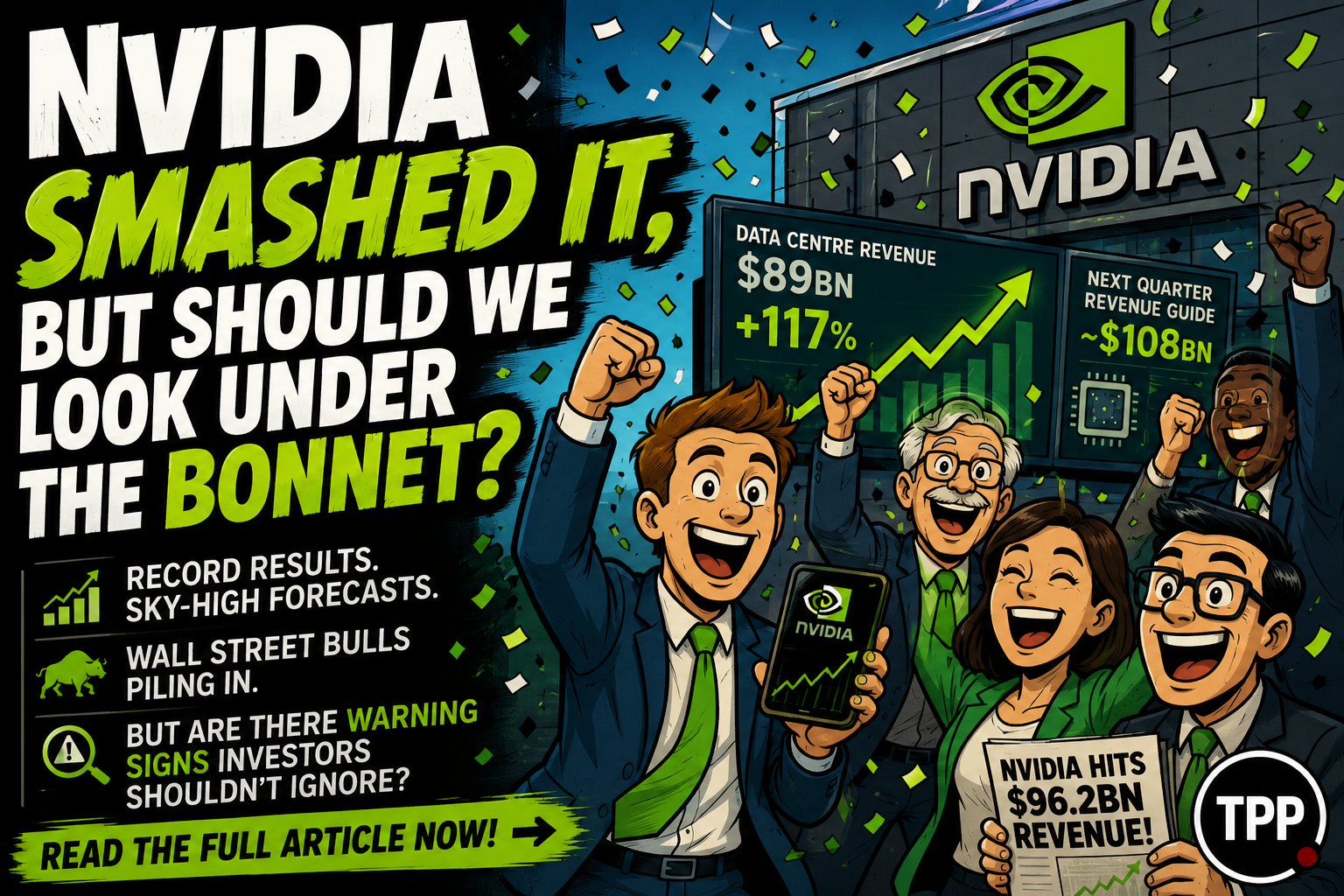
Last week, Nvidia delivered another extraordinary set of numbers.
Quarterly revenue hit $96.2 billion — up 106% year-on-year.
Data-centre revenue reached $89 billion — up 117%.
Operating income more than doubled.
And Nvidia guided to approximately $108 billion of revenue next quarter, while taking the highly unusual step of forecasting roughly 70% revenue growth for its next fiscal year.
The message from CEO Jensen Huang was unequivocal:
AI has reached an inflection point.
The infrastructure build-out is running at full speed.
And Nvidia's next-generation Vera Rubin platform is already moving into full production.
Wall Street loved it.
Nvidia shares surged, chip stocks rallied and at least 16 brokerages reportedly increased their Nvidia price targets.
So that's it then?
AI boom intact.
Nvidia unstoppable.
Everyone back on the merry-go-round.
Perhaps.
But before we get completely carried away, we think investors should probably do something unfashionable…
Because underneath some truly phenomenal numbers are some increasingly interesting questions.
This isn't some dot-com company selling a dream without revenues.
Nvidia is making staggering amounts of money.
Revenue has more than doubled in a year. Its gross margin was 75% last quarter. Data-centre demand remains enormous, and Nvidia expects Vera Rubin to represent around 20% of data-centre revenue as soon as this quarter.
It is difficult to overstate how impressive that is.
And that's important because scepticism should never become blindness in the opposite direction.
The bull case for Nvidia is very real.
AI adoption continues to expand. Compute demand is exploding. Nvidia has established an extraordinary ecosystem around its hardware and software.
The company may continue smashing expectations for years.
But investing isn't simply about asking:
"Is this a brilliant company?"
It's about asking:
"What expectations are already embedded in the story — and what could go wrong?"
And that's where things get interesting.
One concern is the extraordinary amount of money now circulating around the AI ecosystem.
Nvidia isn't simply selling chips anymore.
It is increasingly helping finance the infrastructure and businesses that ultimately consume those chips.
In August, Nvidia announced partnerships with some of the world's largest investment groups to establish financing platforms designed to mobilise more than $500 billion of third-party capital into AI infrastructure.
It has also provided an enormous potential backstop connected with OpenAI's data-centre expansion, while investing across the wider AI ecosystem. Reuters reports that these relationships have prompted questions among some investors about whether parts of AI demand are becoming increasingly intertwined with the financing supporting that demand.
This doesn't automatically make the arrangements problematic.
There is a perfectly credible explanation.
Nvidia is generating enormous amounts of cash and using some of that financial firepower to accelerate the development of an industry in which it has a dominant position.
Strategically, it could be genius.
But investors should still understand the feedback loop.
Capital funds AI infrastructure.
AI infrastructure buys Nvidia technology.
Nvidia benefits.
Nvidia then invests further into the ecosystem helping generate future demand.
The wheel keeps spinning.
The critical question is what happens if the wheel ever slows down.
Big Tech's data-centre spending spree is expected to exceed $730 billion this year.
Think about that number.
Hundreds of billions of dollars are being poured into chips, data centres, electricity, cooling, networking and AI infrastructure.
Right now, everyone wants more compute.
The hyperscalers want it.
AI laboratories want it.
Governments want it.
Businesses want it.
And Nvidia sits right in the middle selling the picks and shovels.
But history tells us something about investment booms.
Eventually somebody asks what return all that capital is actually generating.
AI could completely transform the global economy and still experience periods of massive overinvestment along the way.
Those two ideas are not contradictory.
The internet changed everything.
Railways changed everything.
Telecommunications changed everything.
But investors still managed to wildly overpay for infrastructure during various stages of their development.
Technology can be revolutionary.
Valuations and capital allocation can still get ahead of themselves.
Nvidia itself is preparing aggressively for the next stage.
Inventory reached $32 billion last quarter as the company prepared for the Vera Rubin launch. Its earnings call also revealed that days sales outstanding had increased to 60 days, partly reflecting extended payment terms for certain large customers.
Again, there is an obvious bullish interpretation.
Nvidia sees demand coming and is preparing for it.
If that demand materialises, the scale could be breathtaking.
But huge commitments create huge expectations.
If AI infrastructure spending continues accelerating, Nvidia looks exceptionally well positioned.
If customers suddenly postpone investment?
If hyperscalers decide they've built enough capacity temporarily?
If cheaper alternatives emerge?
If custom chips take meaningful share?
Or if investors finally start demanding clearer returns from hundreds of billions of dollars of AI capex?
The maths can change surprisingly quickly.
Nvidia is dominant.
It isn't invincible.
Its biggest customers have every incentive to reduce their reliance on one extraordinarily powerful supplier.
Custom AI silicon is developing.
AMD and others continue competing.
AI companies themselves are exploring alternatives.
Meanwhile, the cost of AI inference continues falling.
That could be enormously bullish for AI adoption, cheaper AI should encourage vastly greater usage.
It's essentially the Jevons paradox: greater efficiency can increase total consumption rather than reduce it.
That's potentially fantastic news for the AI revolution.
But there is another question:
Who ultimately captures the economics?
More AI usage doesn't automatically mean today's infrastructure providers capture today's margins forever.
That's a distinction investors need to remember.
Nvidia also remains exposed to geopolitical uncertainty surrounding China.
Indeed, its current outlook assumes no China data-centre compute revenue.
Component and memory costs are rising.
Management expects gross margins to come under pressure later this year.
Energy availability is becoming an increasingly important constraint on data-centre development.
And as AI infrastructure becomes bigger, more expensive and more visible, political and regulatory scrutiny will almost certainly grow.
None of those things destroys the Nvidia investment case.
But they remind us that trees don't grow to the sky.
That's probably the wrong question.
Nvidia has just produced $96 billion of quarterly revenue and nearly $60 billion of GAAP net income.
Those are real numbers.
This isn't smoke and mirrors.
But there is a difference between saying:
"Nvidia is an extraordinary company."
and saying:
"Nothing can possibly go wrong."
The first looks difficult to dispute.
The second is where investors tend to get hurt.
Because markets rarely collapse when everybody is worried.
They become dangerous when everyone becomes convinced there is nothing left to worry about.
And right now the AI narrative is becoming increasingly powerful.
More spending.
More chips.
More data centres.
More financing.
More demand.
Higher forecasts.
Higher price targets.
Repeat.
It could continue for years.
But merry-go-rounds don't accelerate forever.
It doesn't mean sell Nvidia.
It doesn't mean short AI.
And it certainly doesn't mean trying to predict the exact moment this extraordinary investment cycle eventually cools.
It means something much simpler.
Don't build an investment strategy that requires one outcome.
Markets could continue ripping higher.
AI could continue dominating.
Nvidia could continue smashing expectations.
Or something could change.
At TPP, our job isn't to sit around predicting the future with absolute certainty.
It's to adapt as the evidence changes.
We can participate when markets are rising.
We can reduce exposure when the probabilities deteriorate.
We can sit flat and wait for better opportunities.
And through active strategies, we can potentially seek opportunities created by falling and volatile markets too.
Whatever happens next, we've got you.
For existing clients, we continue to monitor the landscape, manage risk and adjust portfolios as conditions evolve.
And if you're reading this as an investor wondering whether markets are becoming increasingly difficult to navigate, AI valuations, bond yields, inflation, geopolitics, interest rates and everything else currently being thrown at us, perhaps it's worth a conversation.
Schedule a free portfolio consultation with TPP.
We'll look at where you are today, what you're trying to achieve, the risks you're currently taking and whether there may be a smarter way to position your portfolio for whatever comes next.
SCHEDULE A CALL WITH TPP: CLICK HERE.
TPP's year-to-date average return across participating client accounts is 24.11%*.
Interested in learning more? CONTACT OUR TEAM...
There is a substantial risk of loss in trading financial markets. Past performance is not indicative of future results. The examples in this article are illustrative and do not guarantee that any strategy will outperform a benchmark or avoid losses.
*Results as of 14th August 2026 and refer to the combined average of all client discretionary portfolio accounts (across all strategies), after fees, calculated on a Time Weighted Return basis.
Disclaimer: This document is issued by TPP, being provided for information purposes only. This document does not constitute legal, tax, accounting or investment advice, nor should it be relied upon when making investment decisions. This is not a personal recommendation or an offer or invitation to buy or sell any financial instrument. The market conditions and views expressed are as at the date of publication, which may change without notice. Unless otherwise stated, market data has been obtained from sources believed to be reliable. While believed to be accurate, no representation or warranty is given as to its completeness or accuracy.
TPP strategies invest in leveraged financial instruments, including equity index futures. Leverage can magnify both gains and losses, meaning losses may occur more quickly than in unleveraged investments. Investments involve risk and investors may lose some or all of their invested capital. Your capital is at risk.
Past performance is not necessarily a reliable indicator of future performance. The value of investments, and any income from them, can fall as well as rise, and investors may not recover the amount originally invested. Future returns are not guaranteed. Therefore, you should not assume that the future performance of any specific investment or investment strategy will be profitable or equal to the corresponding past performance.
TPP is a trading name of UCapital Asset Management LLP. UCapital Asset Management LLP is authorised and regulated by the Financial Conduct Authority (FCA No. 477155). 80 Coleman Street, London EC2R 5BJ.
“TPP might just be about to revolutionise investment for the retail market.”
- London Stock Exchange 2020


