Market Activity
The old model is slowly dying...
August 27, 2026
Related Links
The world has changed.
Markets have changed.
Technology has changed.
Investors have changed.
The speed at which information travels has changed beyond recognition.
Yet somehow, much of the wealth-management industry is still investing people's money using a model that would have looked perfectly familiar 30 years ago.
Buy.
Hold.
Diversify.
Pay your fees.
And hope that, eventually, markets go higher.
At TPP, we've spent years challenging that model.
And today I think the question is becoming increasingly difficult for the traditional investment industry to answer:
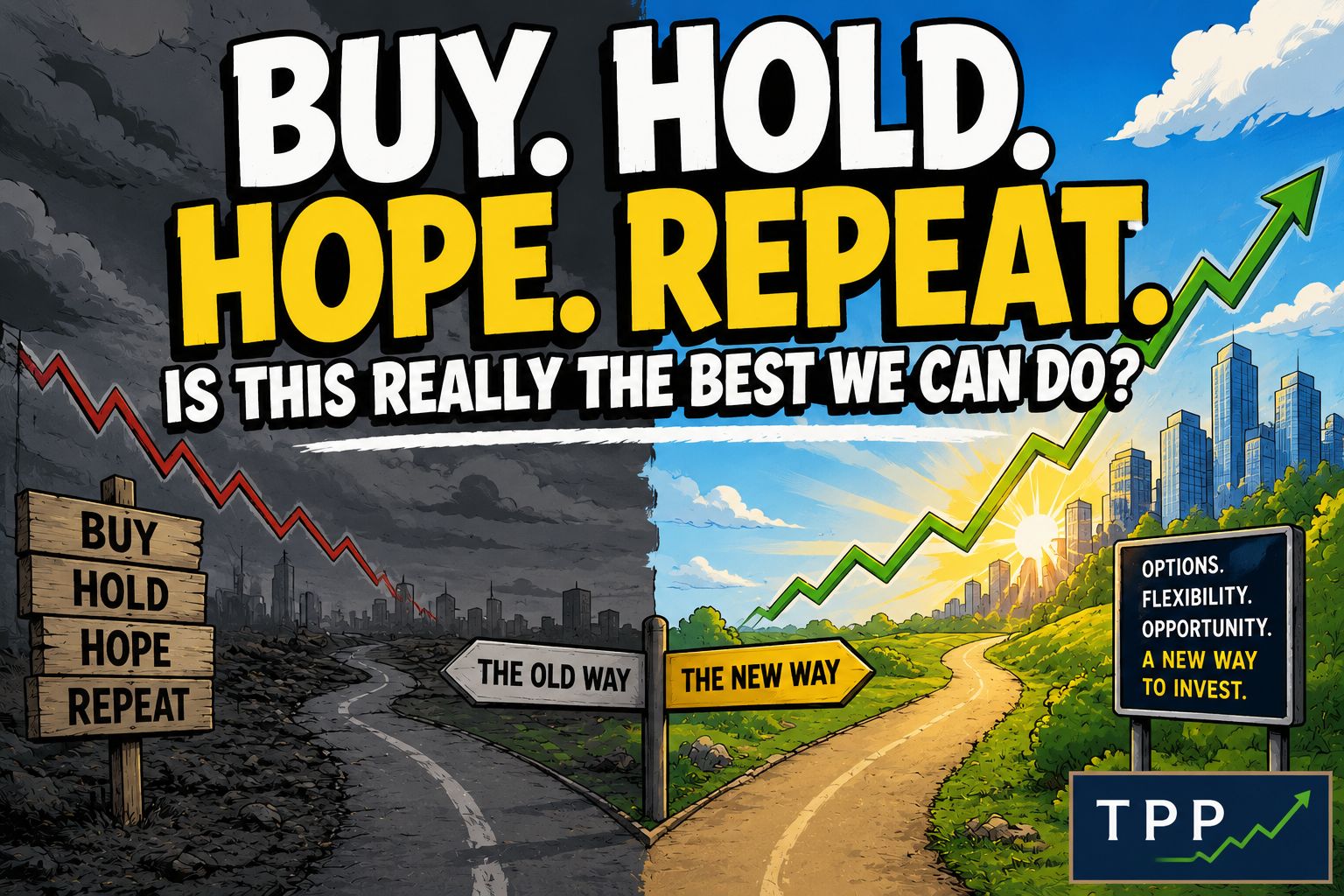
Is Buy. Hold. Hope. really the best we can do?
Because surely investing has evolved beyond that.
Think about how dramatically the investment landscape has changed.
We've lived through a global pandemic.
Inflation returned with a vengeance.
Interest rates went from virtually zero to levels many investors hadn't experienced for years.
Wars erupted.
Energy markets exploded.
Governments borrowed extraordinary amounts of money.
Bond markets became volatile.
Artificial intelligence created one of the most extraordinary investment themes we've seen in decades.
Technology companies reached astonishing valuations.
Politics became increasingly unpredictable.
Markets reached record highs.
Then fell.
Then recovered.
Then reached new highs again.
And all of this happens while information travels around the world instantaneously.
Markets don't wait for your annual review anymore.
They don't particularly care that your adviser has booked you in for a coffee three months next Thursday.
The investment environment can change in hours.
Sometimes minutes.
Yet for millions of investors, their portfolio response remains remarkably consistent.
Do nothing.
Markets are rising?
Excellent.
Stay invested.
Don't worry.
Stay invested.
Remain calm.
Remember, investing is long term.
Definitely don't panic.
Stay invested.
😂
It's an incredibly simple philosophy.
And to be fair, over sufficiently long periods, rising global markets have made a lot of people wealthy.
We're not disputing that.
The problem is that the entire model is overwhelmingly dependent upon one thing.
Markets eventually going higher.
And increasingly, investors are asking:
Surely there has to be another way?
This is one of the fundamental reasons we built TPP differently.
We don't have one approach to markets.
We have four.
And importantly, only one of those approaches is blindly dependent upon markets continuing to rise.
That distinction matters.
Because markets aren't always the same.
Sometimes valuations look attractive.
Sometimes they're expensive.
Sometimes momentum is extraordinary.
Sometimes risk is elevated.
Sometimes markets are trending beautifully.
Sometimes they're violently retracing.
So why should the investment response always be identical?
It shouldn't.
This is probably the closest we get to the traditional model.
We identify markets where we believe the opportunity justifies being fully exposed and potentially use modest leverage to increase that exposure.
If the market rises, great.
If it falls, we participate in the fall too, and a small amount of leverage can magnify losses as well as gains.
Which is precisely why we don't believe this approach should simply be deployed everywhere, all the time, regardless of valuation or market conditions.
Sometimes the best trade is being invested.
Sometimes it isn't.
This is where things start becoming considerably more interesting.
Our Long or Flat strategies can participate when conditions favour being invested.
But when we don't like the probabilities?
They can step aside.
Flat.
Cash.
Waiting.
Not panicking.
Not predicting Armageddon.
Simply saying:
“At this price, with this risk/reward, we'd rather wait.”
Then if markets retrace and the opportunity becomes more attractive, they can look to re-enter at better levels.
Will they always time that perfectly?
Absolutely not.
They can move flat too early.
They can re-enter too early.
Markets can continue higher after we've stepped aside.
But we have something the traditional model often doesn't.
A choice.
Hybrids sit somewhere between being fully invested and fully defensive.
They allow us to maintain market participation while also retaining capital that can potentially be deployed when opportunities appear.
Think about that psychologically.
A traditional investor watches markets fall and thinks:
“Oh no. My portfolio is falling.”
An adaptive investor can potentially look at the same market and think:
“Interesting. Things are getting cheaper.”
That's a completely different relationship with volatility.
Instead of volatility automatically being the enemy...
It can potentially become the opportunity.
Again, no guarantees.
Markets can continue falling after we buy.
But at least we're not completely reliant on sitting there waiting for everything to recover.
And then we have our Active strategies.
These have even greater flexibility.
They can buy.
They can sell.
They can alter exposure.
And when appropriate, they can potentially short markets.
That's an important distinction.
Because suddenly a falling market isn't merely something you're trying to survive.
It can potentially become something you're trying to exploit.
Short selling carries significant risk and certainly doesn't mean we automatically profit when markets fall.
We can be wrong.
We will be wrong.
But again...
We have another option.
This isn't about claiming we're clairvoyant.
We're not.
It isn't about saying TPP never loses money.
We do.
It isn't about claiming we'll call every market top.
We won't.
Or every bottom.
We won't do that either.
Markets have an incredible ability to make fools of anybody who believes they've completely mastered them.
What we're saying is much simpler:
Why voluntarily invest with one hand tied behind your back?
Why should your only response to every market environment be exactly the same?
Why should:
Expensive markets...
Cheap markets...
Bull markets...
Bear markets...
High-volatility markets...
Low-volatility markets...
...all receive the same answer?
BUY. HOLD. HOPE.
We think investing can do better than that.
Something else has changed.
The investor.
Today's investor has access to more information than at any point in history.
They can see markets live.
They can see their portfolio live.
They can compare performance.
They can understand fees.
They can research alternatives.
They can see exactly what the S&P 500, FTSE 100 or Nasdaq has returned.
And increasingly, they're asking uncomfortable questions.
What am I actually paying for?
If my portfolio falls whenever markets fall...
And rises whenever markets rise...
And substantially tracks the same underlying markets I could access elsewhere...
Where exactly is the value being added?
That's a very different conversation from the one wealth managers were having with clients 20 or 30 years ago.
And I think it's only just beginning.
Traditional wealth management has another interesting characteristic.
The wealth manager generally gets paid...
regardless of what happens to your wealth.
Markets up?
Fee.
Markets sideways?
Fee.
Markets down?
Fee.
Portfolio down 20%?
Still a fee.
And then potentially additional underlying fund costs, platform costs and other charges depending on the arrangement.
I'm not suggesting investment professionals shouldn't be paid.
Of course they should.
We charge for what we do at TPP.
Building investment strategies, infrastructure, technology, monitoring portfolios and managing risk costs money.
The question is whether the investor believes they're receiving genuine value in return.
And increasingly, I believe investors will demand considerably more.
We can talk philosophy all day long.
We can talk about innovation.
Flexibility.
Technology.
Risk management.
Different strategies.
Different market environments.
But eventually there is a rather inconvenient question:
Does it work?
That's why performance matters.
Not over a week.
Not because one strategy made a clever trade yesterday.
But over meaningful periods.
Against appropriate benchmarks.
After fees.
Because ultimately, investors aren't moving away from traditional wealth management because they want something that merely sounds innovative.
They want something that aims to produce a better outcome.
At TPP, that has always been the objective.
Don't simply track the benchmarks. Aim to beat them.
There can never be a guarantee that we will.
Past performance cannot tell us what happens tomorrow.
But having that ambition matters.
And so does being accountable for the outcome.
Here's what I find particularly exciting.
When we started building TPP, we weren't trying to create another slightly different wealth-management company.
The world didn't need another one.
Another expensive office.
Another glossy brochure.
Another portfolio containing broadly the same collection of funds.
We wanted to challenge the model itself.
And slowly...
Then quickly...
We're seeing that message resonate.
More investors.
More accounts.
More introductions.
More conversations.
More people questioning what they've historically accepted as normal.
That's momentum.
And momentum creates movements.
I've written recently about the idea of a wealth transfer.
Not simply wealth transferring between generations.
But wealth transferring between investment models.
From old to new.
From passive acceptance to greater accountability.
From:
“That's just what wealth management costs.”
To:
“Why?”
From:
“Markets fell, so naturally my portfolio fell.”
To:
“What did my investment manager actually DO about it?”
Those questions matter.
And once investors start asking them, they're difficult to unask.
Let's be realistic.
Traditional wealth management isn't about to vanish.
There are trillions invested through these models.
Some excellent businesses operate within the industry.
Some excellent advisers work within them.
And there will always be investors who simply want somebody to build a diversified portfolio, leave it alone and hold their hand through the inevitable market cycles.
There's absolutely nothing wrong with that.
We're just building TPP for the investor who wants something different.
The investor who wants more flexibility.
More transparency.
More accountability.
More ambition.
And more than one way of approaching a market.
This might be the most important point.
Nobody knows what happens next.
Maybe markets continue relentlessly higher.
Maybe AI delivers productivity improvements beyond anything currently expected.
Maybe inflation disappears.
Maybe interest rates fall.
Maybe geopolitical tensions ease.
Maybe economic growth accelerates.
Fantastic.
But perhaps the next decade is considerably messier.
Higher government debt.
More geopolitical conflict.
More volatile inflation.
Higher-for-longer interest rates.
Political instability.
Currency volatility.
Expensive equity markets.
Rapid technological disruption.
Potential bubbles.
Potential crashes.
Potential opportunities.
We don't know.
And neither does your wealth manager.
Which is exactly why I find the idea of having only one response to every possible outcome increasingly difficult to understand.
Banking moved online.
Trading moved online.
Communication became instant.
Artificial intelligence is transforming entire industries.
Information became almost universally available.
Consumers became more demanding.
Fees became more transparent.
Everything evolved.
And yet one of the most important industries in the world still frequently comes back to:
Buy.
Hold.
Hope.
Repeat.
Surely we can do better.
At TPP...
We believe we can.
If you're reading this and wondering whether your existing portfolio belongs to the old world or the new one, let's find out.
We'll arrange a completely free portfolio consultation.
We'll look at what you currently own.
How much you're paying.
How you're diversified.
How your portfolio has performed.
How dependent it is on markets continually rising.
And then we'll show you how we'd approach things differently.
No obligation.
No hard sell.
Just an opportunity to compare the two models.
Because if you've spent years being told to...
BUY. HOLD. HOPE. REPEAT.
...perhaps it's time to see what else is possible.
You already know.
You've watched us buy.
You've watched us wait.
You've watched us reduce exposure.
You've watched strategies go flat.
You've watched us buy into weakness.
And you've watched our Active strategies potentially take the opposite side of falling markets.
We haven't got every decision right.
We never will.
But that's never been the promise.
The promise is that we're watching.
We're thinking.
We're adapting.
We're looking for opportunities.
And we're not blindly dependent upon markets continually reaching new highs.
Whatever markets throw at us next...
We've got you covered.
The old model had its time.
The new model is gathering momentum.
The wealth transfer has started.
The movement is growing.
And at TPP...
SCHEDULE A CALL WITH TPP: CLICK HERE.
TPP's year-to-date average return across participating client accounts is 24.11%*.
Interested in learning more? CONTACT OUR TEAM...
There is a substantial risk of loss in trading financial markets. Past performance is not indicative of future results. The examples in this article are illustrative and do not guarantee that any strategy will outperform a benchmark or avoid losses.
*Results as of 14th August 2026 and refer to the combined average of all client discretionary portfolio accounts (across all strategies), after fees, calculated on a Time Weighted Return basis.
Disclaimer: This document is issued by TPP, being provided for information purposes only. This document does not constitute legal, tax, accounting or investment advice, nor should it be relied upon when making investment decisions. This is not a personal recommendation or an offer or invitation to buy or sell any financial instrument. The market conditions and views expressed are as at the date of publication, which may change without notice. Unless otherwise stated, market data has been obtained from sources believed to be reliable. While believed to be accurate, no representation or warranty is given as to its completeness or accuracy.
TPP strategies invest in leveraged financial instruments, including equity index futures. Leverage can magnify both gains and losses, meaning losses may occur more quickly than in unleveraged investments. Investments involve risk and investors may lose some or all of their invested capital. Your capital is at risk.
Past performance is not necessarily a reliable indicator of future performance. The value of investments, and any income from them, can fall as well as rise, and investors may not recover the amount originally invested. Future returns are not guaranteed. Therefore, you should not assume that the future performance of any specific investment or investment strategy will be profitable or equal to the corresponding past performance.
TPP is a trading name of UCapital Asset Management LLP. UCapital Asset Management LLP is authorised and regulated by the Financial Conduct Authority (FCA No. 477155). 80 Coleman Street, London EC2R 5BJ.
“TPP might just be about to revolutionise investment for the retail market.”
- London Stock Exchange 2020


