Market Activity
From the old model to the new (in more than one way)...
August 24, 2026
Related Links
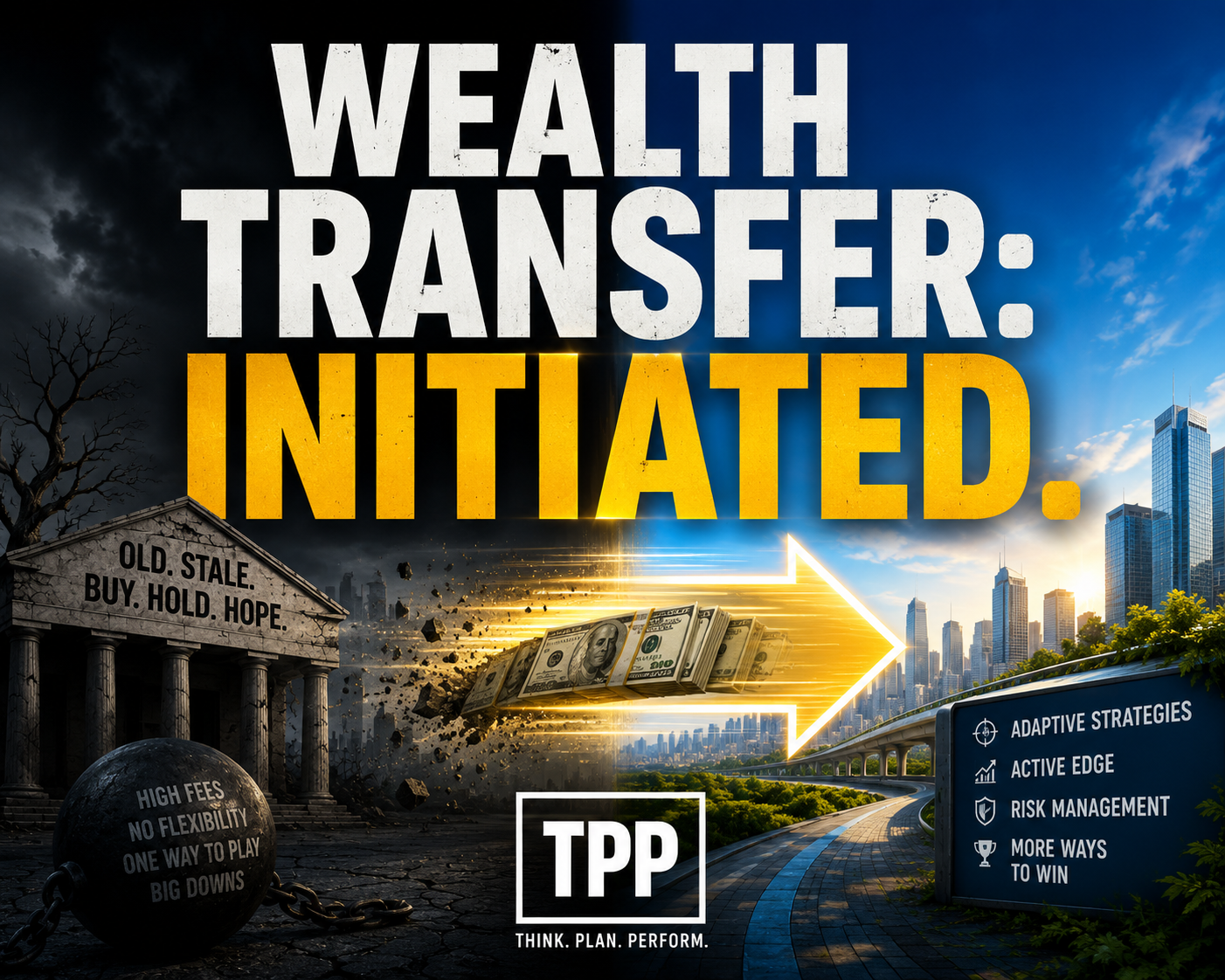
The transfer from the old world of wealth management to the new is already happening. But last week, another type of wealth transfer may have begun.
For years now, we've talked about a transfer of wealth.
Not simply from one generation to another.
But from one way of investing to another.
From the traditional.
To the innovative.
From expensive, stale wealth-management models built decades ago…
To investment strategies designed for the markets we actually live in today.
And from…
BUY. HOLD. HOPE.
To something considerably more active.
At TPP, we've been watching that transfer gather momentum for years.
Clients arrive every week having spent years, sometimes decades, with traditional wealth managers.
Different logos. Different brochures. Different offices.
But when you strip everything away?
Often remarkably similar portfolios.
Buy a collection of funds.
Hold them.
Charge a fee.
And wait for markets to rise.
That's wealth transfer number one.
And it's already well underway.
But there's another type of wealth transfer that interests me even more.
A few weeks ago, US technology markets were hitting record highs.
Cue the celebrations. Headlines everywhere. Markets at record levels. Portfolios at record levels.
And plenty of traditional advisers and fund managers understandably giving themselves a little pat on the back.
But think about what a new market high actually means.
If an index beats its previous record by 0.1%, technically it's another ALL-TIME HIGH.
Great headline.
But has it transformed the client's wealth?
Of course not.
The number has barely moved.
And once the traditional layers of fees have been deducted, the difference becomes even less exciting.
More importantly, there's a bigger problem.
What happens next?
Because the traditional model needs something very specific to keep delivering.
Markets need to keep going:
HIGHER.
HIGHER.
HIGHER.
Another record.
Then another.
Then another.
If markets fall instead?
Their clients generally fall with them.
That's the fundamental weakness of buy, hold and hope.
This is where TPP operates differently.
We have four broad approaches to markets.
Only one is blindly dependent on markets continuing to rise (and we're barely using that approach right now).
The other three give us considerably more flexibility.
And when markets were sitting around those highs, we weren't throwing a party.
We were getting ready.
Why?
Because we believed the potential reward from chasing markets higher was becoming less attractive relative to the risk of a meaningful move lower.
So we positioned accordingly.
Our Long or Flat strategies were largely flat, waiting for better opportunities.
Our Hybrid strategies maintained more limited market exposure.
And some of our Active strategies actually began short selling.
That's quite a contrast.
Traditional portfolios were effectively saying:
“PLEASE KEEP GOING UP.”
We were saying:
“If you do, fine. But if you don't, we're ready.”
That's the difference.
And suddenly the opportunity we'd been waiting for began to appear.
Markets pulled back across the US and Europe.
For traditional buy-and-hold portfolios, that means something very simple.
Their portfolios fall with the market.
But at TPP, something very different was happening.
Some of our Active strategies had already positioned short and were therefore seeking to profit from falling prices.
At the same time, our other strategies began seeing something we'd been patiently waiting for.
Discounts.
Assets we'd refused to chase at higher prices were becoming cheaper.
Markets were coming back towards us.
And last week…
WE STARTED BUYING.
That doesn't mean we've magically called the bottom.
We may not have.
Markets could fall again.
Our shorts won't always work.
Our buys won't always be timed perfectly.
And active management cannot eliminate losses or guarantee that we'll outperform a falling market.
But that's not the point.
The point is that we have options.
When markets look expensive, we can reduce exposure.
When opportunities appear on the downside, our Active strategies can potentially short them.
When prices fall and the probabilities become more attractive, we can begin buying.
And when markets eventually recover?
We're aiming to have bought at considerably better levels than those who simply remained fully invested throughout.
That's why I describe periods like this as a potential wealth transfer.
Imagine two investors.
Investor A owns the traditional portfolio.
Markets hit record highs.
They're fully invested.
Markets fall.
Their portfolio falls.
Then they wait for markets to recover just to get back to where they started.
Investor B has a more adaptive portfolio.
Exposure was reduced near the highs.
Some strategies potentially benefited from the fall.
Capital was then redeployed at lower prices.
And if markets subsequently recover?
Investor B isn't simply hoping to recover the money they lost.
They're trying to participate in the recovery from a stronger starting position.
That is the transfer we're trying to engineer.
Not through prediction.
Not through perfection.
And certainly not by pretending we know exactly where markets go tomorrow.
But through positioning, patience and flexibility.
After beginning to increase exposure last week, Friday gave us exactly the type of move we'd been waiting for.
Markets bounced.
Good.
But we're not getting carried away.
One good day doesn't make a trend.
And just as we refused to suffer from FOMO near the highs, we're not suddenly going to abandon discipline because markets have bounced.
We'll continue doing what we've always done.
Watching.
Waiting.
Buying when probabilities favour us.
Reducing exposure when they don't.
And using every tool available across our four approaches.
Let's see what this week brings.
Because the next stage of the wealth transfer may only just have begun.
If you're reading this while your portfolio still follows the traditional buy, hold and hope model, ask yourself a simple question:
What is your portfolio actually designed to do if markets don't keep reaching new highs?
If the answer is essentially “wait for them to recover”, perhaps it's worth seeing what the alternative looks like.
We're offering a completely free portfolio consultation.
We'll look at how you're currently invested, discuss the risks and opportunities we see, and show you how TPP could build a diversified portfolio designed to aim to outperform relevant benchmarks rather than simply track them.
No obligation.
Just a conversation.
Schedule your free consultation and see what the other side of wealth management looks like.
You've seen this movie before.
You've been there.
You've got the T-shirt.
You've watched us sit patiently while markets climbed.
You've watched us refuse to chase.
You've watched strategies move flat.
You've watched Active strategies take the other side.
And now you've watched us begin putting money back to work as opportunities emerged.
None of us knows exactly what happens next.
That's markets.
But thank you, as always, for trusting the process and giving us the freedom to do what we believe gives your portfolio the best opportunity over the long term.
Now we wait.
And hopefully- the next wealth transfer is already underway......
HAVE A GREAT WEEK...
SCHEDULE A CALL WITH TPP: CLICK HERE.
TPP's year-to-date average return across participating client accounts is 24.11%*.
Interested in learning more? CONTACT OUR TEAM...
There is a substantial risk of loss in trading financial markets. Past performance is not indicative of future results. The examples in this article are illustrative and do not guarantee that any strategy will outperform a benchmark or avoid losses.
*Results as of 14th August 2026 and refer to the combined average of all client discretionary portfolio accounts (across all strategies), after fees, calculated on a Time Weighted Return basis.
Disclaimer: This document is issued by TPP, being provided for information purposes only. This document does not constitute legal, tax, accounting or investment advice, nor should it be relied upon when making investment decisions. This is not a personal recommendation or an offer or invitation to buy or sell any financial instrument. The market conditions and views expressed are as at the date of publication, which may change without notice. Unless otherwise stated, market data has been obtained from sources believed to be reliable. While believed to be accurate, no representation or warranty is given as to its completeness or accuracy.
TPP strategies invest in leveraged financial instruments, including equity index futures. Leverage can magnify both gains and losses, meaning losses may occur more quickly than in unleveraged investments. Investments involve risk and investors may lose some or all of their invested capital. Your capital is at risk.
Past performance is not necessarily a reliable indicator of future performance. The value of investments, and any income from them, can fall as well as rise, and investors may not recover the amount originally invested. Future returns are not guaranteed. Therefore, you should not assume that the future performance of any specific investment or investment strategy will be profitable or equal to the corresponding past performance.
TPP is a trading name of UCapital Asset Management LLP. UCapital Asset Management LLP is authorised and regulated by the Financial Conduct Authority (FCA No. 477155). 80 Coleman Street, London EC2R 5BJ.
“TPP might just be about to revolutionise investment for the retail market.”
- London Stock Exchange 2020


