Market Activity
Sometimes the hardest investment decision is doing absolutely nothing.
August 14, 2026
Related Links

Sometimes the hardest investment decision is doing absolutely nothing.
And, trust me…
We’ve had plenty of practice recently. 😂
Over the last few weeks, we’ve been patient.
Very patient.
Global markets have been sitting close to their highs.
US technology has been strong.
The headlines around the Iran conflict have become more optimistic.
The future suddenly feels a little rosier.
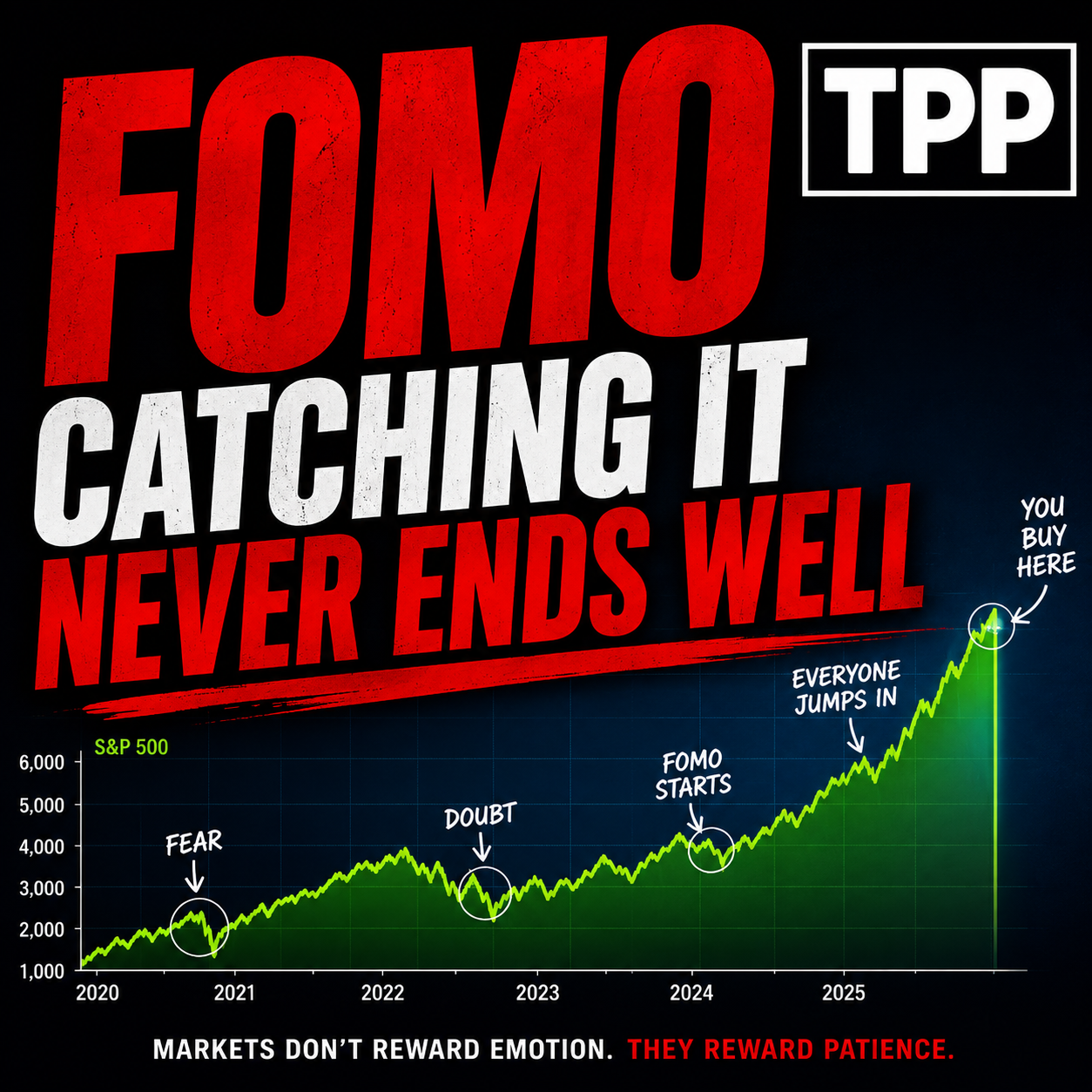
And when markets are rising and everyone around you appears to be making money, a very dangerous investment condition begins to spread…
You know the symptoms.
Markets go up.
You watch them go up.
They go up again.
You start thinking:
“Maybe I should have more invested.”
Another green day.
“Perhaps I’m being too cautious.”
Another headline about AI.
“US tech is unstoppable.”
Another suggestion that geopolitical tensions might be easing.
“What am I waiting for?”
And eventually…
“Sod it. I’m getting in.”
😂😂😂
That is FOMO-ITIS.
And investors have been catching it for generations.
We like markets.
We like US technology.
We like equities.
We believe that, over the long term, global businesses will continue to innovate, grow and create enormous amounts of wealth.
But there is a massive difference between believing in an asset for the long term, and believing today is the right day to load up on it.
That's where discipline comes in.
Because right now there are plenty of perfectly reasonable arguments for being bullish.
The Iran conflict could continue to de-escalate.
Inflation could continue to improve.
Interest rates could eventually fall.
AI investment could continue booming.
Corporate earnings could remain strong.
Markets could keep going higher.
They absolutely could.
But here's the bit people forget:
And the more markets rise, the more seductive that story becomes.
Human beings are wonderfully predictable investors.
When markets fall sharply, we become frightened.
When markets rise sharply, we become greedy.
So we frequently end up wanting to sell when assets are cheaper, and desperate to buy when they're expensive.
It's completely backwards.
Yet you see it during virtually every market cycle.
The higher markets climb, the safer people feel.
The more expensive something becomes, the more comfortable they become buying it.
Why?
Because everyone else is making money.
Nobody wants to be the person sitting on the sidelines while their mate tells them how much their Nvidia shares have gone up. 😂
But investing isn't about keeping up with your mate.
It isn't about having something exciting to talk about at dinner.
And it certainly isn't about making sure you're fully invested every second of every day.
It's about probabilities.
What am I being paid for the risk I'm taking?
And right now, in some markets, we don't think those probabilities justify throwing everything at them.
So we haven't.
This is perhaps the strangest thing about active investing.
People assume that being active means constantly doing something.
Buying.
Selling.
Trading.
Changing.
Moving.
It doesn't.
Sometimes being genuinely active means having the ability to look at a market and say:
“Not yet.”
We have strategies capable of taking significant exposure when we believe the opportunity warrants it.
We have Long or Flat strategies that can reduce exposure or sit flat.
We have Hybrid strategies that can retain partial exposure without committing everything.
And we have Active strategies capable of adjusting exposure in either direction.
That flexibility matters.
But having the ability to do something doesn't mean you should always use it.
Sometimes the smartest use of flexibility is simply:
The beginning of the Iran conflict springs immediately to mind.
Markets were nervous.
Headlines were ugly.
Volatility increased.
And suddenly the investment world looked very different.
Because we'd retained flexibility beforehand, we had choices when conditions changed.
We weren't sitting there thinking:
“Bugger. We're already fully invested.”
😂
We could respond to what markets were actually doing.
That doesn't mean every decision will be perfectly timed. It won't.
Nobody consistently picks exact tops and bottoms.
Nor does flexibility remove investment risk.
But we'd rather accept occasionally being early, late or underexposed…
than abandon our process because everyone else suddenly has FOMO.
Our clients have been here before.
You've been there.
You've got the T-shirt.
And that's why you'll probably understand our current patience better than most.
Good.
Seriously.
We're not sitting here hoping markets collapse so we can say “TOLD YOU SO.”
😂
If conditions improve and the opportunities justify increasing exposure, we can increase exposure.
If markets continue higher while we're underexposed, we may leave some returns on the table.
That's the price of discipline.
Because the alternative is far worse:
Changing your investment philosophy because you're frightened somebody else might be making more money than you this week.
That's not investing.
That's emotion wearing a Bloomberg terminal.
It always does.
Maybe it's next week.
Maybe next month.
Maybe markets give us a better entry after a relatively modest pullback.
Maybe something changes fundamentally and we become comfortable increasing exposure without a major correction.
We don't know.
And pretending we do would be ridiculous.
What we do know is this:
We don't have to chase.
There are thousands of markets, instruments and opportunities around the world.
Our job isn't to catch every single move.
Our job is to decide which risks we believe are worth taking.
Sometimes we'll be aggressive.
Sometimes defensive.
Sometimes long.
Sometimes partially invested.
Sometimes flat.
And sometimes, we'll sit on our hands while everyone else catches FOMO-ITIS.
Thank you for your patience.
You understand the process.
You've seen why flexibility can matter when markets suddenly change.
And if the evidence tells us we should increase exposure, we'll do it.
If it tells us we should carry on waiting?
We'll wait.
No ego.
No FOMO.
No pressure to manufacture activity simply so it looks like we're doing something.
If your current investment strategy is essentially:
BUY.
HOLD.
HOPE.
…and cross your fingers when markets become expensive or volatile, there is another way to think about investing.
At TPP, we're interested in managing exposure, not simply remaining invested regardless of what is happening around us.
Sometimes that means participating.
Sometimes it means reducing risk.
And sometimes it means having the patience to wait for a better opportunity.
If you'd like to understand how that approach could differ from your existing portfolio, schedule a free portfolio consultation with us.
Because markets will eventually present another opportunity.
Have a great Friday.
SCHEDULE A CALL WITH TPP: CLICK HERE.
TPP's year-to-date average return across participating client accounts is 23.42%*.
Interested in learning more? CONTACT OUR TEAM...
There is a substantial risk of loss in trading financial markets. Past performance is not indicative of future results. The examples in this article are illustrative and do not guarantee that any strategy will outperform a benchmark or avoid losses.
*Results as of 1st August 2026 and refer to the combined average of all client discretionary portfolio accounts (across all strategies), after fees, calculated on a Time Weighted Return basis.
Disclaimer: This document is issued by TPP, being provided for information purposes only. This document does not constitute legal, tax, accounting or investment advice, nor should it be relied upon when making investment decisions. This is not a personal recommendation or an offer or invitation to buy or sell any financial instrument. The market conditions and views expressed are as at the date of publication, which may change without notice. Unless otherwise stated, market data has been obtained from sources believed to be reliable. While believed to be accurate, no representation or warranty is given as to its completeness or accuracy.
TPP strategies invest in leveraged financial instruments, including equity index futures. Leverage can magnify both gains and losses, meaning losses may occur more quickly than in unleveraged investments. Investments involve risk and investors may lose some or all of their invested capital. Your capital is at risk.
Past performance is not necessarily a reliable indicator of future performance. The value of investments, and any income from them, can fall as well as rise, and investors may not recover the amount originally invested. Future returns are not guaranteed. Therefore, you should not assume that the future performance of any specific investment or investment strategy will be profitable or equal to the corresponding past performance.
TPP is a trading name of UCapital Asset Management LLP. UCapital Asset Management LLP is authorised and regulated by the Financial Conduct Authority (FCA No. 477155). 80 Coleman Street, London EC2R 5BJ.
“TPP might just be about to revolutionise investment for the retail market.”
- London Stock Exchange 2020

