Market Activity
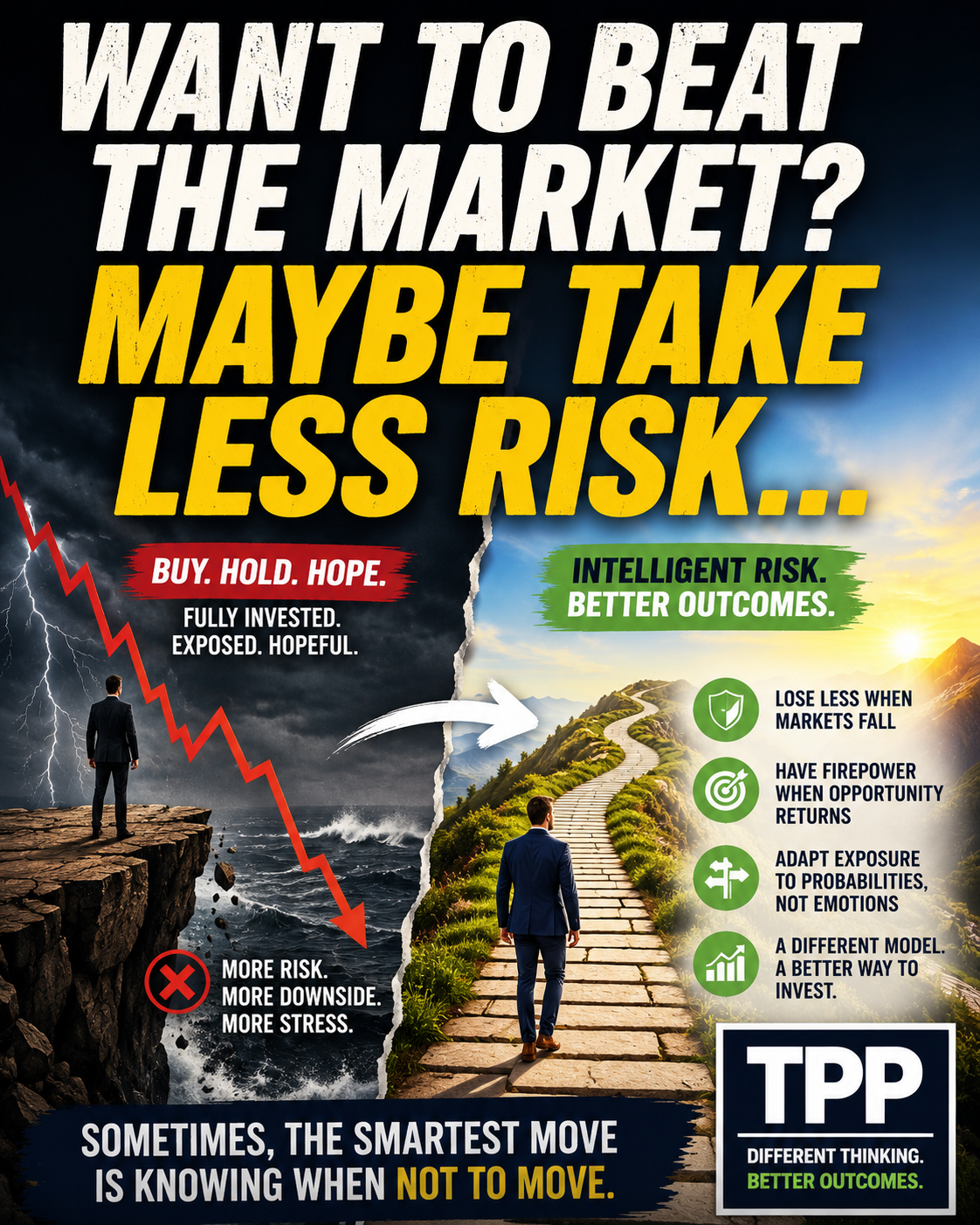
Outperformance doesn’t have to come from taking bigger risks. Sometimes it comes from knowing when NOT to take them.
August 10, 2026
Related Links
There is a question we get asked surprisingly often at TPP:
“If your objective is to outperform the market, surely you must be taking more risk than the market?”
It sounds logical.
Higher return = higher risk.
That is, after all, one of the oldest assumptions in investing.
But there’s a problem.
It isn't necessarily true.
In fact, there are periods when our approach to outperforming a benchmark can involve taking less market risk, not more.
Sometimes substantially less.
Because we don't believe the secret to generating outsized returns is simply taking outsized risks.
We think that can be a recipe for disaster.
Instead, our philosophy is very different:
If the opportunity isn't there, we don't need to be there.
If the probabilities aren't there, neither are we.
And that distinction sits at the heart of what makes TPP different from traditional wealth management.
Traditional investment management is largely built around one central premise:
Markets go up over the long term.
And historically, they have.
So you buy a diversified portfolio, remain invested through the ups and downs, rebalance occasionally and wait.
There's nothing inherently wrong with that approach.
For many investors, it has worked perfectly well.
But here's the question we asked when we created TPP:
Could there be a better way?
Why should an investor have the same exposure when markets look expensive as they do after markets have fallen 15%?
Why should you remain fully invested when the probabilities appear to be deteriorating?
Why shouldn't you hold back capital when markets look top-heavy?
And why shouldn't you deploy MORE capital after a significant correction when valuations and probabilities potentially become more attractive?
Traditional investing tends to focus enormously on what you own.
We think there is another equally important question:
That changes everything.
At TPP, we broadly use four different approaches.
And here's the important bit:
Only ONE of them is blindly linked to markets rising.
This is the most traditional of our four approaches.
If the benchmark rises, the strategy is designed to participate, with increased exposure.
Naturally, that also means increased downside risk.
This is precisely why we don't believe these strategies should simply be deployed indiscriminately.
If markets have just suffered a significant correction and we believe the probabilities have moved in our favour?
They can become extremely interesting.
At record highs after a huge run?
Different conversation entirely.
This is where things become much more interesting.
Our Long or Flat strategies don't HAVE to remain invested.
If the market environment looks attractive, they can be long.
If markets become stretched, expensive or the probabilities deteriorate, they can move partially or completely flat.
Think about the difference.
A traditional investor might effectively say:
“I own the market. Let's hope it keeps rising.”
A Long or Flat strategy can say:
“We don't like the risk/reward here. We'll wait.”
That doesn't mean we'll always get the decision right.
We won't.
Nobody does.
But it means we're not forced to participate in every part of every market cycle.
And sometimes…
Our Hybrid strategies take that concept another step further.
Rather than making a binary decision between fully invested and flat, they can maintain partial exposure.
Imagine a market where we remain broadly positive over the medium term but become increasingly uncomfortable with short-term valuations.
Instead of being 100% exposed, a strategy might be significantly underexposed.
Why?
Because we're waiting.
Waiting for volatility.
Waiting for better prices.
Waiting for the risk/reward equation to change.
Waiting for the probabilities to move back in our favour.
Then, if markets correct, we potentially have the ability to increase exposure at lower prices.
That can create an interesting asymmetry.
We may participate less in the initial fall…
…and potentially participate more aggressively in the subsequent recovery.
Which brings us to an important point.
Suppose a benchmark falls 1%.
A fully invested portfolio might fall broadly in line with it.
But imagine we're significantly underexposed and fall only 0.2%.
We haven't made money.
But we've preserved relative capital.
Now imagine markets fall further and our models suggest the probabilities have materially improved.
We increase exposure.
The market subsequently rebounds 1%.
Depending on the strategy, instruments and exposure involved, our portfolio might potentially participate disproportionately in that recovery.
That's the concept.
Lose less when the odds look poor.
Participate more when the odds improve.
We've seen versions of this during periods of geopolitical uncertainty, including around the Iran conflict.
When uncertainty rises, we don't necessarily want maximum exposure.
But if markets subsequently sell off and our assessment of the opportunity changes, suddenly the probabilities can become much more attractive.
This is why simply measuring risk as:
“How aggressively are you invested?”
…misses the point.
For us, risk management is dynamic.
Then we have our Active strategies.
These have even greater flexibility.
They can go long.
They can reduce exposure.
And, where appropriate, they can even take short positions.
That means they aren't necessarily dependent on markets rising at all.
If our analysis suggests markets are vulnerable to a retracement, an Active strategy may be positioned to potentially benefit from that decline.
Again, we're not claiming to predict every market move.
Far from it.
But we don't have to.
And that is perhaps one of the most important elements of the entire TPP philosophy.
Investing isn't about perfection.
Anyone claiming they can perfectly call every top, bottom, correction and rally should probably be treated with considerable scepticism.
We certainly can't.
Our objective is different.
Not 100%.
If we're wrong, we want the consequences to be manageable.
If we're right, we want the portfolio positioned to benefit.
Do that consistently enough, and we believe we give ourselves a strong opportunity to outperform benchmarks over time.
And our performance to date is why we're increasingly confident in the model.
Our composite performance was +31.2% net of fees in 2025, and our longer-term results have continued to demonstrate what this different approach can potentially achieve.
Of course, past performance is not a guarantee of future returns.
There will be periods when we underperform.
There will be decisions we get wrong.
There will be markets that surprise us.
That's investing.
But what matters is the process.
This is the misconception we want to challenge.
If somebody produces a strong return, people naturally assume:
“They must have taken huge risks.”
But imagine two investors.
Investor A remains 100% invested throughout every market environment.
Markets become expensive?
Fully invested.
Geopolitical crisis?
Fully invested.
20% correction?
Fully invested.
Recovery?
Fully invested.
Investor B changes exposure depending on the opportunity.
Markets look stretched?
Reduce risk.
Volatility increases?
Protect capital.
Markets correct?
Start deploying capital.
Probabilities improve?
Increase exposure.
Opportunity disappears?
Reduce again.
Which investor is actually taking more intelligent risk?
That's the question.
Because risk and return aren't simply about how much exposure you take.
They're also about WHEN you take it.
This might be the simplest explanation of our philosophy.
There are times when markets fall and everybody else becomes terrified…
…but we become increasingly interested.
There are other times when markets are flying, records are being broken and everybody wants more exposure…
…but we become increasingly cautious.
That's uncomfortable.
But investing often is.
Because one of the strange things about markets is that the point at which something feels safest can sometimes be when the risk has actually increased.
And the point at which something feels most frightening can sometimes be when the opportunity is improving.
Price matters.
Valuation matters.
Momentum matters.
Macro conditions matter.
Technical conditions matter.
And most importantly:
We didn't build TPP to create another traditional wealth manager.
The world already has plenty of those.
We wanted to question the fundamental assumptions behind the model.
Why remain fully invested if the probabilities don't justify it?
Why not go flat?
Why not be half invested?
Why not hold back capital?
Why not add exposure after markets fall?
Why shouldn't certain strategies have the ability to profit from falling markets?
Why should the investor adapt to the portfolio…
rather than the portfolio adapt to the market?
That is the difference.
Our four approaches give us different tools for different environments.
Leveraged Trackers can increase participation when we believe the opportunity warrants it.
Long or Flat strategies can step away when conditions deteriorate.
Hybrids can maintain partial exposure while keeping firepower available.
Active strategies can potentially profit from both rising and falling markets.
It isn't about being bearish.
It isn't about being bullish.
Investors have been conditioned to believe that doing nothing isn't a decision.
We disagree.
Moving flat is a decision.
Reducing exposure is a decision.
Waiting is a decision.
Refusing to chase a market is a decision.
And sometimes those decisions can be every bit as valuable as buying something.
Because capital you protect today is capital you can deploy tomorrow.
You don't have to make money every day to outperform over time.
Sometimes you simply need to lose less.
Thank you for trusting us to do things differently.
There will inevitably be moments when markets rise and we're not fully exposed.
There will be moments when we're cautious and the market keeps climbing.
There will be trades that don't work.
We can't and won't get everything right.
But hopefully you can see the difference in the philosophy.
We're not trying to blindly chase markets.
We're trying to manage probabilities.
Manage exposure.
Manage downside.
And then become more aggressive when we believe the opportunity justifies it.
Ultimately, we're trying to achieve one thing:
If you're completely happy with the traditional model…
Buy.
Hold.
Remain fully invested.
Hope markets continue higher.
And accept every correction that comes with it.
Good luck. Genuinely.
But if you're looking at markets around record highs and wondering whether there might be a more intelligent way to manage your wealth…
If you think investment exposure should change when the opportunity changes…
If you believe protecting capital can sometimes be just as important as growing it…
And if you think outperforming markets should be about better decisions rather than simply bigger risks…
Welcome to a different way of investing.
Welcome to TPP.
SCHEDULE A CALL WITH TPP: CLICK HERE.
TPP's year-to-date average return across participating client accounts is 23.42%*.
Interested in learning more? CONTACT OUR TEAM...
There is a substantial risk of loss in trading financial markets. Past performance is not indicative of future results. The examples in this article are illustrative and do not guarantee that any strategy will outperform a benchmark or avoid losses.
*Results as of 1st August 2026 and refer to the combined average of all client discretionary portfolio accounts (across all strategies), after fees, calculated on a Time Weighted Return basis.
Disclaimer: This document is issued by TPP, being provided for information purposes only. This document does not constitute legal, tax, accounting or investment advice, nor should it be relied upon when making investment decisions. This is not a personal recommendation or an offer or invitation to buy or sell any financial instrument. The market conditions and views expressed are as at the date of publication, which may change without notice. Unless otherwise stated, market data has been obtained from sources believed to be reliable. While believed to be accurate, no representation or warranty is given as to its completeness or accuracy.
TPP strategies invest in leveraged financial instruments, including equity index futures. Leverage can magnify both gains and losses, meaning losses may occur more quickly than in unleveraged investments. Investments involve risk and investors may lose some or all of their invested capital. Your capital is at risk.
Past performance is not necessarily a reliable indicator of future performance. The value of investments, and any income from them, can fall as well as rise, and investors may not recover the amount originally invested. Future returns are not guaranteed. Therefore, you should not assume that the future performance of any specific investment or investment strategy will be profitable or equal to the corresponding past performance.
TPP is a trading name of UCapital Asset Management LLP. UCapital Asset Management LLP is authorised and regulated by the Financial Conduct Authority (FCA No. 477155). 80 Coleman Street, London EC2R 5BJ.
“TPP might just be about to revolutionise investment for the retail market.”
- London Stock Exchange 2020


