Market Activity
They could drag the UK into a recession.
August 17, 2026
Related Links
Sometimes the biggest warning signs in markets aren't found in the stock market.
They're found somewhere far less glamorous.
The bond market.
And right now, I think every serious investor should be watching what's happening in U.S. Treasuries VERY closely.
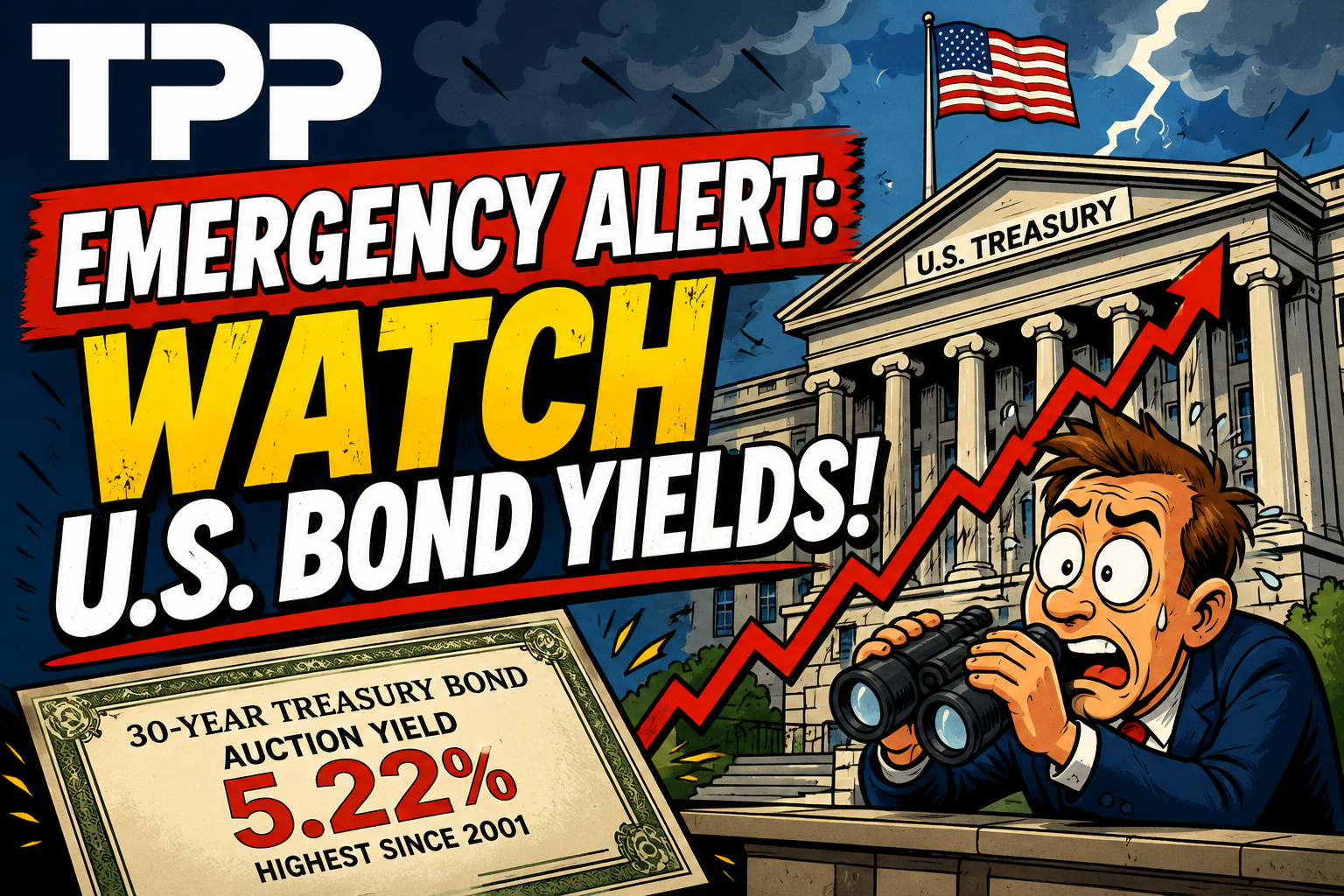
Last week, the United States sold $25bn of 30-year government bonds.
The yield?
5.22%.
That's the highest borrowing cost at a 30-year Treasury auction since 2001.
Think about that for a second.
The world's largest economy is effectively being told by investors:
If you want us to lend you money for 30 years, you're going to have to pay us a LOT more for the privilege.
And that matters.
Not just for America.
For everyone.
There are a few things happening at once.
America's national debt is approaching $40 TRILLION.
Government deficits remain enormous.
Inflation is still above target.
There's huge demand for capital from governments and companies.
And investors increasingly want better compensation for lending money over long periods.
In simple English?
There is a LOT of debt looking for buyers.
And buyers are demanding a higher return.
Now, one auction does not constitute a crisis.
In fact, recent Treasury auctions have still attracted solid demand.
That's important.
But the PRICE America is having to pay for that demand is getting interesting.
The 30-year auction yield has moved from around 4.91% before Trump's second term began, to 5.06% in July...
And now 5.22%.
Meanwhile, 30-year inflation-adjusted U.S. yields are around their highest levels in almost two decades.
That's something investors should be paying attention to.
Because U.S. Treasuries aren't just another investment market.
They sit at the heart of the global financial system.
Treasury yields influence the price of money across the world.
Mortgages.
Corporate borrowing.
Government debt.
Currencies.
Equity valuations.
Private markets.
Infrastructure.
Property.
Pretty much everything ultimately feels the gravitational pull.
Which means if investors begin demanding materially higher returns to lend to the United States...
The shock doesn't stop at America's borders.
It travels.
And Britain could be particularly exposed.
We've already got our own problems.
High government borrowing.
Elevated gilt yields.
Weak economic growth.
Persistent inflation concerns.
And a government that desperately needs the bond market to keep funding its spending.
UK 10-year gilt yields are currently around 5%.
So imagine U.S. Treasury yields continue climbing.
Global investors suddenly have an increasingly attractive alternative:
Why take additional risk elsewhere when Uncle Sam is paying you 5%+ for long-term money?
Capital starts demanding better returns everywhere.
That can put upward pressure on gilt yields.
Which increases the cost of servicing UK government debt.
Which puts more pressure on public finances.
Which potentially means spending cuts...
Higher taxes...
Or more borrowing.
None of those are particularly attractive when economic growth is already weak.
And that's why what happens in Washington and New York matters enormously in Westminster.
Possibly.
But let's be very clear.
We're not saying a recession is inevitable.
Markets don't work like that.
What we're saying is that persistently high borrowing costs increase the probability of something eventually breaking.
Think about what higher yields actually mean in the real economy.
Businesses borrow at higher rates.
Mortgages remain expensive.
Property becomes harder to finance.
Investment projects become less attractive.
Governments spend more servicing debt.
Consumers have less disposable income.
Companies face higher refinancing costs.
Eventually...
Higher borrowing costs can become their own economic brake.
And there are already some cracks worth watching.
U.S. retail sales unexpectedly fell 0.6% in July.
Consumer sentiment has weakened.
And while markets have been celebrating softer inflation and a potentially more cautious Federal Reserve...
The long end of the bond market is telling a rather different story.
That's what makes this so fascinating.
And THIS is where things become really interesting.
The S&P 500 recently hit another record.
Technology remains incredibly strong.
AI enthusiasm continues.
Investors are still buying.
FOMO is alive and kicking.
Yet at almost exactly the same time...
The bond market is demanding some of the highest long-term borrowing costs we've seen in decades.
Those two things can coexist.
They already are.
But the question is:
For how long?
Because the higher the risk-free return available from government bonds becomes, the harder equities have to work to justify their valuations.
Why take significant equity risk if government bonds suddenly offer increasingly attractive returns?
And why pay enormous multiples for future corporate profits when the rate used to value those future profits keeps rising?
That doesn't mean stocks HAVE to crash.
It doesn't mean a crisis IS coming.
But it absolutely changes the maths.
Debt.
America's debt pile is approaching $40 trillion.
And here's the uncomfortable bit.
As old debt matures, it has to be refinanced.
If that refinancing happens at significantly higher interest rates...
The interest bill rises.
Which increases government expenditure.
Which potentially increases the deficit.
Which means more borrowing.
Which means more bonds need selling.
And if investors demand higher yields to absorb those bonds...
You can see how the circle begins to form.
More debt.
Higher yields.
Higher interest costs.
More borrowing.
More debt.
That is the scenario the market is beginning to think about.
Not panic about.
Think about.
There's an important difference.
Absolutely not.
Panic is rarely a successful investment strategy.
But neither is burying your head in the sand.
This is precisely why we've been so patient recently.
Markets have been sitting close to record highs.
Investors are suffering from FOMO.
Everyone wants to make sure they're not missing the party.
Meanwhile we're watching the things happening underneath the surface.
Bond yields.
Oil.
Inflation.
Valuations.
Geopolitics.
Economic data.
Because sometimes the greatest risks emerge when everything LOOKS fantastic.
And sometimes the greatest opportunities emerge immediately afterwards.
You've been here before.
You've got the T-shirt.
You've watched us sit patiently when we didn't like the odds.
You've watched us reduce exposure.
You've watched us go flat.
You've watched us take profit.
You've watched us wait while everyone else piled in.
And you've watched what happens when markets finally give us the opportunity we've been waiting for.
So if bond markets remain calm?
Great.
We'll adapt accordingly.
If yields keep rising?
We'll adapt.
If equity markets correct?
We'll look for opportunities.
And if volatility explodes?
That's when things can get VERY interesting for an active investment approach.
We don't need to predict exactly what happens next.
We need to be ready for whatever does.
That's the difference.
If you're sitting in a traditional portfolio right now...
Fully invested.
Markets near record highs.
Bond yields elevated.
Oil volatile.
Geopolitical risk everywhere.
And your investment strategy is essentially:
“Don't worry. Markets always go up eventually.”
You might want to ask yourself a question.
Is that really enough?
Because if the bond market IS beginning to tell us something...
You don't want to discover what it was saying after the event.
At TPP, we don't simply buy, hold and hope.
We actively manage exposure.
Sometimes we're long.
Sometimes we're flat.
Sometimes our active strategies can take short positions.
And sometimes...
We simply WAIT.
Because preserving ammunition for the right opportunity can be just as important as pulling the trigger.
So keep watching U.S. bond yields.
Very closely.
This could turn out to be nothing more than another market wobble.
Or...
It could become one of the most important investment stories of the next 12 months.
And if you're worried about what it could mean for your portfolio...
You know where we are.
Talk to TPP.
SCHEDULE A CALL WITH TPP: CLICK HERE.
TPP's year-to-date average return across participating client accounts is 23.42%*.
Interested in learning more? CONTACT OUR TEAM...
There is a substantial risk of loss in trading financial markets. Past performance is not indicative of future results. The examples in this article are illustrative and do not guarantee that any strategy will outperform a benchmark or avoid losses.
*Results as of 1st August 2026 and refer to the combined average of all client discretionary portfolio accounts (across all strategies), after fees, calculated on a Time Weighted Return basis.
Disclaimer: This document is issued by TPP, being provided for information purposes only. This document does not constitute legal, tax, accounting or investment advice, nor should it be relied upon when making investment decisions. This is not a personal recommendation or an offer or invitation to buy or sell any financial instrument. The market conditions and views expressed are as at the date of publication, which may change without notice. Unless otherwise stated, market data has been obtained from sources believed to be reliable. While believed to be accurate, no representation or warranty is given as to its completeness or accuracy.
TPP strategies invest in leveraged financial instruments, including equity index futures. Leverage can magnify both gains and losses, meaning losses may occur more quickly than in unleveraged investments. Investments involve risk and investors may lose some or all of their invested capital. Your capital is at risk.
Past performance is not necessarily a reliable indicator of future performance. The value of investments, and any income from them, can fall as well as rise, and investors may not recover the amount originally invested. Future returns are not guaranteed. Therefore, you should not assume that the future performance of any specific investment or investment strategy will be profitable or equal to the corresponding past performance.
TPP is a trading name of UCapital Asset Management LLP. UCapital Asset Management LLP is authorised and regulated by the Financial Conduct Authority (FCA No. 477155). 80 Coleman Street, London EC2R 5BJ.
“TPP might just be about to revolutionise investment for the retail market.”
- London Stock Exchange 2020


