>
Insights>
Market Activity>
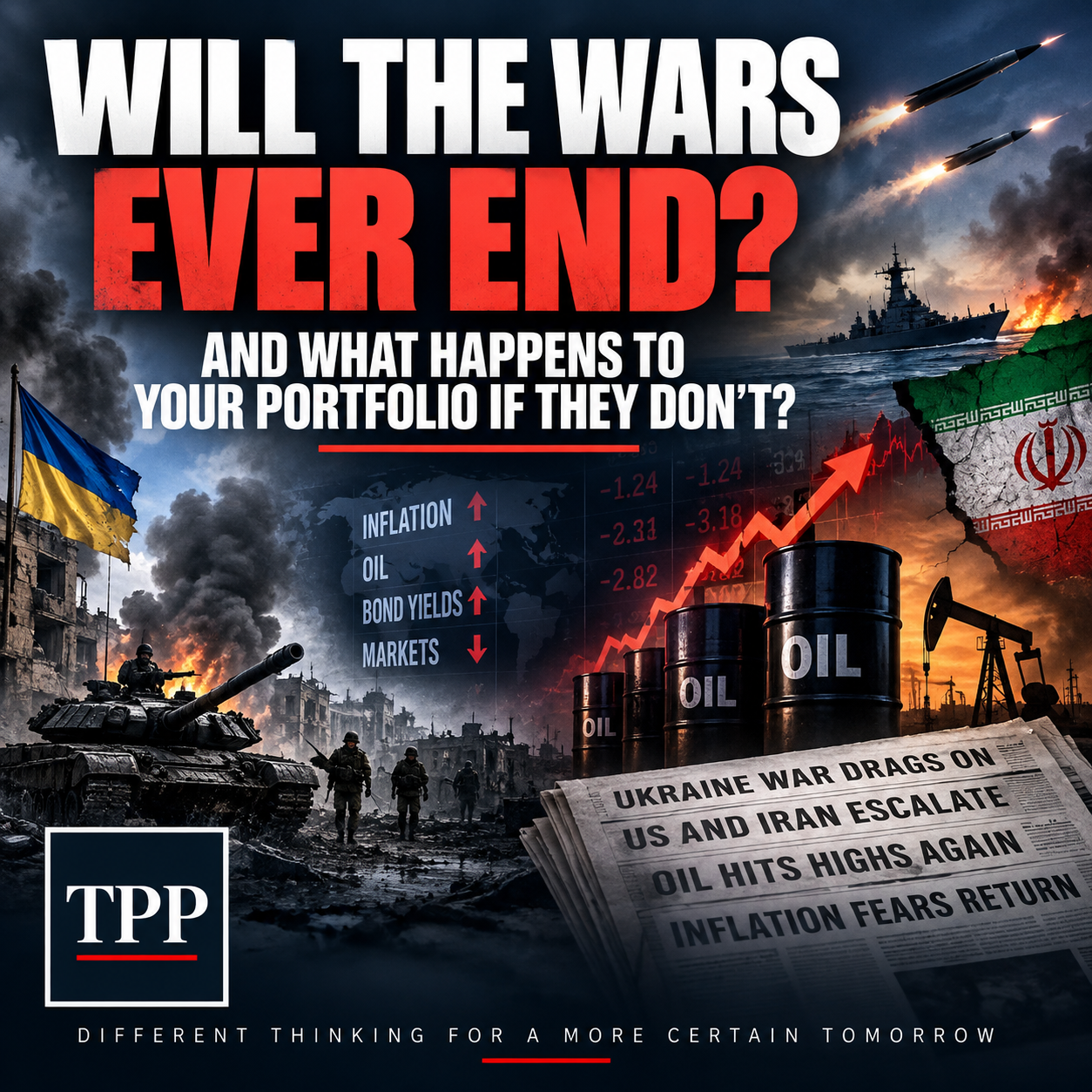
WILL THE WARS EVER END? And what happens to your portfolio if they don’t?
Market Activity
This might make you ponder....
September 7, 2026
Related Links
There are mornings when you look across the geopolitical landscape and wonder where the good news is supposed to come from.
Ukraine and Russia remain locked in a war that has already dragged on for years. The US and Iran are escalating again.
Oil is climbing. Inflation fears are returning. Government bond yields are sitting around multi-year and, in some cases, multi-decade highs.
And investors are once again being reminded of an uncomfortable truth:
Geopolitics doesn’t stay in geopolitics. Eventually, it arrives in your portfolio.
That is what investors need to be thinking about now.
Because while we would all like these conflicts to end, and the human cost of war dwarfs anything happening on a Bloomberg screen, from an investment perspective we also have to deal with the world as it is, rather than the world we would like it to be.
And right now, lasting peace still looks some distance away.
There has at least been renewed diplomatic activity.
US envoys Steve Witkoff and Jared Kushner have been holding discussions with both Moscow and Kyiv. According to the reports over the weekend, there have been “new ideas” and talk of further negotiations.
But the fundamental problem remains.
Russia continues to demand territorial concessions, including Ukrainian-controlled parts of the Donetsk region.
Ukraine continues to reject handing over territory it still controls.
In other words, the two sides remain separated by the very issues that matter most.
Unless somebody makes a substantial concession, it is difficult to see the route towards a rapid settlement.
For investors hoping the Ukraine risk premium might simply disappear, that matters.
Energy infrastructure remains vulnerable. Defence spending remains elevated. European governments face greater fiscal pressure. And uncertainty over Russian energy supply continues to hang over the continent.
Peace would undoubtedly remove one layer of uncertainty from global markets.
But right now, investors cannot build a portfolio on the assumption that peace is imminent.
If Ukraine is frustrating, the situation involving the US and Iran is arguably becoming even more dangerous for markets.
The weekend brought another escalation.
US forces struck three Iranian oil tankers after Iranian forces targeted US naval vessels. Iran subsequently said it had attacked US-linked ships around the Strait of Hormuz. Shipping traffic through the Strait has fallen sharply.
And this isn't some obscure stretch of water that financial markets can ignore.
Hormuz is one of the most important energy arteries on the planet.
Which explains what happened next.
Oil moved higher again this morning, with Brent trading around $97 a barrel as markets digested the latest escalation.
Goldman Sachs has reportedly warned that a more serious disruption to Middle Eastern shipping could potentially push oil towards $120 a barrel. That is a scenario, not a forecast — but it illustrates the size of the tail risk markets are trying to price.
And this is where the investment implications become much bigger than oil.
This is the chain investors need to understand.
Higher oil prices mean higher transport costs.
Higher diesel prices mean higher distribution costs.
Higher shipping costs eventually work their way through supply chains.
Businesses either absorb those costs, hurting margins, or pass them on to customers.
And that creates further inflationary pressure.
Reuters reported last week that Brent and WTI rose around 7.6% and 10% respectively in a single week, while US retail diesel prices reached record levels. The combination is already raising concerns about inflation, borrowing costs and economic growth.
That creates an ugly dilemma for central banks.
Just when markets want lower interest rates, another inflation shock makes cutting rates more difficult.
And we are seeing that tension in bond markets already.
Government borrowing costs across major developed economies are at or near multi-decade highs, reflecting concerns about inflation, interest rates and enormous government debt burdens.
In Britain, 10-year gilt yields recently reached their highest level in almost two decades, while longer-dated borrowing costs reached levels last seen in 1998.
None of this happens in isolation.
Higher government bond yields mean governments pay more to borrow.
Companies pay more.
Mortgage borrowers pay more.
Equity valuations face pressure because investors can suddenly earn attractive returns elsewhere.
Highly valued growth stocks become particularly sensitive to movements in discount rates.
And investors who assumed bonds would always provide the perfect counterweight to equities can discover that stocks and bonds can fall together.
That is when the traditional portfolio starts to feel uncomfortable.
For years, many investors have effectively been sold variations of the same idea:
Buy a diversified collection of assets.
Stay invested. Ride out volatility. And wait.
There is nothing inherently wrong with long-term investing.
But there is a rather large assumption sitting underneath much of traditional wealth management:
Markets need to keep going up.
Perhaps they will.
Nobody at TPP is predicting some inevitable market collapse.
But look at the ingredients investors are currently dealing with.
Two major wars with no obvious conclusion.
Oil approaching $100.
Persistent inflation.
Higher interest rates.
Government borrowing costs around historic highs.
Enormous sovereign debt.
Expensive equity markets.
And geopolitical events capable of changing the picture overnight.
Against that backdrop, simply saying “stay invested and hope everything works itself out” doesn't feel like much of an investment strategy.
It feels like an assumption.
We cannot stop wars.
We cannot control oil.
We cannot control inflation.
And we certainly cannot control what Putin, Trump, Zelenskyy or Iran decides to do next.
But we can control how we invest around it.
That distinction matters.
At TPP, our entire investment philosophy is built around the idea that investors should not be blindly dependent on markets rising every year.
We can reduce exposure.
We can sit flat.
We can wait for better probabilities.
We can re-enter markets following meaningful retracements.
We can run hybrid approaches that combine market participation with defensive positioning.
And through our active strategies, we can look for opportunities on both sides of markets.
We are proactive.
We are reactive.
And we are prepared to change.
That does not mean we'll get every decision right.
We won't.
Nobody will.
We won't be right every day, every month or every quarter.
Anyone promising otherwise should probably be avoided.
Our objective is different.
Build portfolios capable of navigating different market environments rather than portfolios that require one particular outcome.
This is perhaps the biggest difference in mindset.
Traditional investors often fear volatility. We look at it differently. Volatility can create opportunity.
A 5%, 10% or 15% market correction is painful if your only strategy is to sit fully invested and watch your portfolio fall.
But if part of your portfolio has reduced exposure?
If capital is waiting?
If strategies can re-enter markets at lower levels?
If active exposure can respond to changing conditions?
Suddenly volatility can become something to exploit rather than simply endure.
Our aim in normal conditions is to outperform markets over time.
But when markets become more volatile, we're constantly looking for those additional opportunities — those extra percentage points that active portfolio management can potentially create.
Not by predicting the future.
By responding to it.
There is a huge difference.
Of course they will eventually.
The more important question for investors is:
When?
Ukraine could still be fighting through another winter.
A Russia-Ukraine settlement may require political and territorial compromises that neither side currently appears willing to make.
The US-Iran conflict could de-escalate quickly, or another attack around Hormuz could send energy markets sharply higher.
Nobody knows.
And that is precisely the point.
Your financial future shouldn't require you to know.
The next 12 months could bring peace agreements, falling oil prices and another powerful equity rally.
They could equally bring $120 oil, another inflation shock, higher-for-longer interest rates and a significant market correction.
A sensible investment strategy should at least contemplate both.
You know the message.
Don't panic.
Don't chase headlines.
And don't allow emotion to dictate investment decisions.
We've navigated volatility before and we'll navigate it again.
We will continue monitoring markets, adjusting where appropriate and looking for opportunities created by uncertainty.
This is exactly why your portfolio isn't built around one simple bet that markets must rise.
Ask yourself one question.
What happens to my portfolio if this gets worse?
Not if everything works out.
Not if peace arrives.
Not if oil falls.
Not if central banks cut rates.
What happens if the uncomfortable scenario happens?
If the answer is essentially…
“My wealth manager tells me to sit tight and wait for markets to recover”, perhaps it's worth seeing another way.
War is horrific.
We hope these conflicts end as quickly as possible.
But hope isn't an investment strategy.
And neither is buy, hold and pray.
At TPP, we're building portfolios designed for the world we actually live in, uncertain, volatile and constantly changing.
If you're concerned about what the next chapter could mean for your wealth, perhaps now is the time to find out how differently your portfolio could be managed.
Schedule a free portfolio consultation with TPP.
Let's look at what you own, how exposed you really are, and what happens to your portfolio if the world gets more volatile before it gets better.
Because right now, uncertainty isn't going anywhere.
And your investment strategy needs to be ready for it.....
We're ready when you are......
Have a great week in the markets.
SCHEDULE A CALL WITH TPP: CLICK HERE.
TPP's year-to-date average return across participating client accounts is 24.11%*.
Interested in learning more? CONTACT OUR TEAM...
There is a substantial risk of loss in trading financial markets. Past performance is not indicative of future results. The examples in this article are illustrative and do not guarantee that any strategy will outperform a benchmark or avoid losses.
*Results as of 14th August 2026 and refer to the combined average of all client discretionary portfolio accounts (across all strategies), after fees, calculated on a Time Weighted Return basis.
Disclaimer: This document is issued by TPP, being provided for information purposes only. This document does not constitute legal, tax, accounting or investment advice, nor should it be relied upon when making investment decisions. This is not a personal recommendation or an offer or invitation to buy or sell any financial instrument. The market conditions and views expressed are as at the date of publication, which may change without notice. Unless otherwise stated, market data has been obtained from sources believed to be reliable. While believed to be accurate, no representation or warranty is given as to its completeness or accuracy.
TPP strategies invest in leveraged financial instruments, including equity index futures. Leverage can magnify both gains and losses, meaning losses may occur more quickly than in unleveraged investments. Investments involve risk and investors may lose some or all of their invested capital. Your capital is at risk.
Past performance is not necessarily a reliable indicator of future performance. The value of investments, and any income from them, can fall as well as rise, and investors may not recover the amount originally invested. Future returns are not guaranteed. Therefore, you should not assume that the future performance of any specific investment or investment strategy will be profitable or equal to the corresponding past performance.
TPP is a trading name of UCapital Asset Management LLP. UCapital Asset Management LLP is authorised and regulated by the Financial Conduct Authority (FCA No. 477155). 80 Coleman Street, London EC2R 5BJ.
Capital is at risk. Investments can fall as well as rise and you may get back less than you invest. TPP strategies may use leverage and short selling, which can magnify losses as well as gains. Past performance is not a reliable indicator of future results. Nothing above constitutes a personal recommendation.
“TPP might just be about to revolutionise investment for the retail market.”
- London Stock Exchange 2020


