>
Insights>
Market Activity>
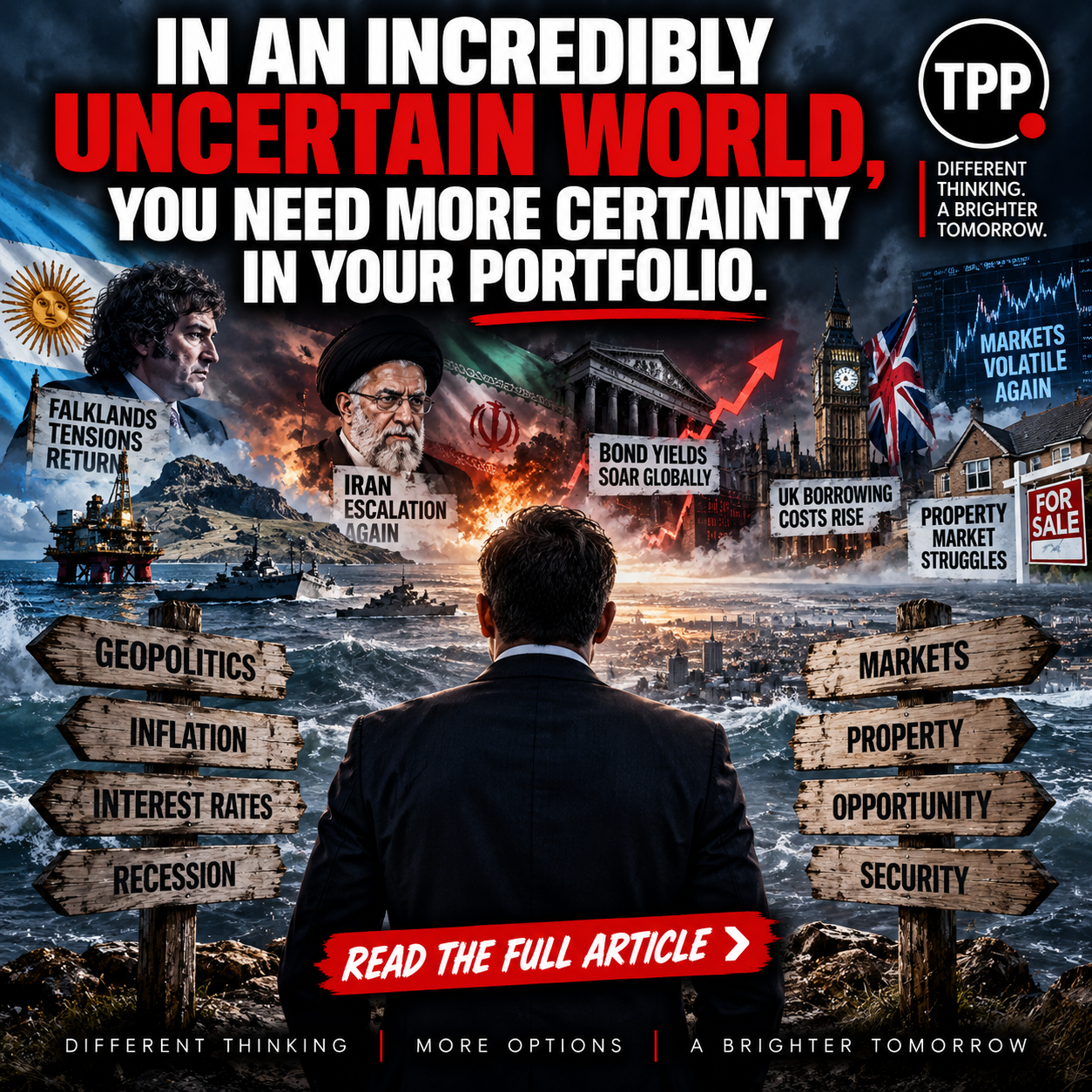
IN AN INCREDIBLY UNCERTAIN WORLD, YOU NEED MORE CERTAINTY IN YOUR PORTFOLIO..
Market Activity
The headlines change every day. The uncertainty doesn’t.
September 4, 2026
Related Links

The headlines change every day. The uncertainty doesn’t.
Today it’s Argentina.
Javier Milei is ramping up the rhetoric over the Falkland Islands, threatening sanctions around oil development and declaring that Argentina “will prevail”.
Suddenly, a dispute many people thought belonged to another era is back in the headlines.
Yesterday?
Iran.
Escalation. Oil prices. Geopolitical risk. Markets wondering what happens next.
The day before?
Global bond yields surging to levels we haven’t seen since around the financial crisis.
Before that?
UK gilt yields jumping, borrowing costs climbing and the new Burnham Government rapidly discovering that whatever politicians promise, the bond market ultimately has a vote too.
And tomorrow?
Who knows.
That, perhaps, is the point.
Look around.
Wars.
Geopolitical tensions.
Government debt.
Inflation.
Higher interest rates.
Bond-market volatility.
Political uncertainty.
AI valuations.
Oil.
Currency moves.
Property prices struggling.
Equity markets sitting close to record levels in parts of the world.
And an increasingly nervous question hanging over everything:
What happens next?
Nobody knows.
Not me.
Not Ed.
Not Goldman Sachs.
Not your wealth manager.
Not the bloke on CNBC confidently telling you where the S&P 500 will finish the year.
Nobody.
And yet, bizarrely, millions of investment portfolios are still constructed as though we do know.
They effectively make one enormous assumption:
Over time, markets will go higher. So stay invested and wait.
Buy.
Hold.
Hope.
Repeat.
That philosophy has worked extraordinarily well at various points in history.
But in a world like this?
Surely investors should at least have more options.
For years, property was almost the default answer for many British investors.
Cheap money.
Low mortgage rates.
Rising prices.
Leverage.
Rental income.
It was a wonderful combination.
But that environment has changed dramatically.
Higher financing costs have changed the economics. Parts of the property market have struggled. And the days when you could borrow extremely cheaply, buy almost anything and watch its value steadily appreciate look a lot less certain.
Again…
The world changed.
So should the investment response remain exactly the same?
This is where things get particularly interesting.
Despite everything happening around us, many global equity markets have remained remarkably resilient.
That’s fantastic.
We want markets to rise.
We want economies to prosper.
We want companies to grow.
But strong markets also create another problem:
What price are you paying?
When valuations are elevated and markets have already enjoyed substantial gains, the risk/reward equation changes.
And when the geopolitical backdrop is this unpredictable, sometimes all it takes is one headline.
One escalation.
One political shock.
One inflation print.
One central-bank surprise.
One unexpected event.
And suddenly markets are repricing risk again.
Does that mean we should sell everything?
Absolutely not.
Does it mean a crash is coming?
We have no idea.
It means something much simpler:
Why would you voluntarily restrict yourself to only one possible response?
At TPP, we’ve always believed that investing should be more adaptive.
More proactive.
More reactive when necessary.
And, crucially…
Less dependent upon markets continually rising.
Our objective in normal market conditions is straightforward:
Aim to beat the relevant benchmarks over meaningful periods, after fees.
There is no guarantee that we will.
There will be periods when we don’t.
But that’s the ambition.
And in an environment like the one we’re experiencing now?
It almost feels like the reason TPP was built in the first place.
Because we don’t have one way of approaching markets.
We have four.
And right now, the approach most similar to simply tracking a rising market is the one we're deploying very sparingly.
Why?
Because we don't believe we need to blindly chase markets at any price.
This is one of the biggest differences in philosophy.
Imagine a market has risen significantly.
Valuations look stretched.
Risk is increasing.
We don't particularly like the probability of deploying more capital at that level.
Why must we buy?
We don't.
Some of our strategies can reduce exposure or go flat.
Cash.
Waiting.
Watching.
There is nothing clever about it.
We're simply saying:
“We don't like the risk/reward here. We'll wait.”
Could markets continue rising without us?
Of course.
Could we step aside too early?
Absolutely.
But we have something extremely valuable:
A choice.
Now things become interesting.
Imagine we didn't chase a market at its highs.
Then volatility hits.
Markets retrace 4%.
5%.
7%.
10%.
Suddenly we're looking at the same businesses and the same underlying market at a lower price.
Why wouldn't we consider deploying capital then?
Could markets fall another 5% after we buy?
Absolutely.
That's investing.
Nobody consistently catches the exact bottom.
But I'd rather have the ability to assess deploying after a meaningful retracement than automatically have every pound fully exposed at the top.
That's a fundamentally different relationship with volatility.
Instead of automatically thinking:
“Oh no, markets are falling.”
You can start thinking:
“Interesting. Opportunities may be appearing.”
This is where our Active strategies provide another option.
They can buy.
They can sell.
They can alter exposure.
And, where appropriate, they can potentially short markets.
That doesn't mean we automatically make money when markets fall.
Far from it.
Short selling carries significant risk.
We can get it wrong.
We will get it wrong.
But once again, the important word is:
OPTIONS.
Why should a falling market automatically be something an investor simply has to endure?
If the probabilities look sufficiently attractive, why shouldn't an active strategy at least have the ability to take the other side?
This is important.
We're not trying to predict every market move.
Impossible.
We're not trying to call every top.
Impossible.
We're not trying to catch every bottom.
Also impossible.
Our aim is to make good decisions more often than we make bad ones.
We might aspire to get somewhere around 80% of decisions right over time, but that is an objective, not a promise or expected hit rate.
And crucially, investment outcomes aren't determined simply by the percentage of winning decisions. The size of gains and losses matters enormously too.
The principle, though, is straightforward.
You don't need perfection.
You need a repeatable process.
You need discipline.
You need risk management.
And you need enough flexibility to respond when the probabilities change.
That is how we aim to produce benchmark-beating performance over meaningful periods.
This is the bit I think more investors need to understand about TPP.
Broadly, we have four approaches.
Slightly Leveraged Trackers.
The closest thing we have to traditional market exposure. When we believe valuations and conditions justify it, we can participate fully and potentially use modest leverage. Of course, leverage magnifies losses as well as gains.
Long or Flat.
Participate when we like the market.
Step aside when we don't.
Wait.
Then potentially re-enter when the probabilities improve.
Hybrids.
Part invested. Part defensive.
Maintain some participation while retaining capital that can potentially be deployed into weakness.
Active.
Greater flexibility.
Long.
Short.
Alter exposure.
Potentially seek opportunities on either side of the market.
Only the first is fundamentally reliant upon the underlying market rising to generate its intended return.
The other three give us considerably more flexibility.
And in a world like this, I think flexibility is incredibly valuable.
That's one thing we can probably guarantee.
Maybe tomorrow Iran escalates again.
Maybe the Falklands story disappears.
Maybe bond yields fall.
Maybe inflation surprises.
Maybe AI stocks explode higher.
Maybe markets drop 10%.
Maybe absolutely nothing happens.
We don't know.
And that's exactly why I don't believe an investment portfolio should require one particular version of the future to occur.
Don't build an investment strategy that requires the world to behave itself.
Because increasingly, it doesn't.
Build one that has the ability to adapt.
Technology changed.
Markets changed.
Information changed.
Investors changed.
The speed of markets changed.
And the world itself certainly changed.
Yet huge parts of wealth management still essentially come back to:
Buy. Hold. Hope. Repeat.
I think investors are going to demand more.
More flexibility.
More transparency.
More accountability.
More active risk management.
More options.
And ultimately…
better outcomes.
The game is changing.
The world is changing.
And I believe the way people invest their wealth is going to change with it.
That's exactly why we built TPP.
For those of you who backed us early, and those who have joined us along the way, thank you.
We genuinely appreciate it.
You've already watched us operate through some extraordinary market environments.
And this current period is another one.
We're watching.
We're assessing.
We're waiting when we think waiting makes sense.
We're deploying when opportunities appear.
And when this latest storm eventually dissipates, we'll be looking for the opportunities it leaves behind.
We won't get everything right.
Nobody does.
But we won't simply sit there and hope either.
That's the difference.
Every day, new investors discover TPP.
Some have watched us for months.
Some for years.
They read the articles.
Watch the performance.
Follow what we're doing.
And keep thinking:
“Maybe I should have a conversation with these guys.”
So perhaps today is that day for you.
Book a completely free portfolio consultation with us.
We'll look at what you're currently doing.
How you're invested.
What you're paying.
How you've performed.
How much of your portfolio depends upon markets continually rising.
And then we'll show you exactly what we do differently, how we do it and why.
No obligation.
No need to move anything.
Just compare the approaches.
And after that conversation?
Who knows.
Maybe you'll change the way you invest forever.
SCHEDULE YOUR FREE TPP PORTFOLIO CONSULTATION BELOW...
The world is uncertain.
Your investment strategy doesn't have to be one-dimensional.
SCHEDULE A CALL WITH TPP: CLICK HERE.
TPP's year-to-date average return across participating client accounts is 24.11%*.
Interested in learning more? CONTACT OUR TEAM...
There is a substantial risk of loss in trading financial markets. Past performance is not indicative of future results. The examples in this article are illustrative and do not guarantee that any strategy will outperform a benchmark or avoid losses.
*Results as of 14th August 2026 and refer to the combined average of all client discretionary portfolio accounts (across all strategies), after fees, calculated on a Time Weighted Return basis.
Disclaimer: This document is issued by TPP, being provided for information purposes only. This document does not constitute legal, tax, accounting or investment advice, nor should it be relied upon when making investment decisions. This is not a personal recommendation or an offer or invitation to buy or sell any financial instrument. The market conditions and views expressed are as at the date of publication, which may change without notice. Unless otherwise stated, market data has been obtained from sources believed to be reliable. While believed to be accurate, no representation or warranty is given as to its completeness or accuracy.
TPP strategies invest in leveraged financial instruments, including equity index futures. Leverage can magnify both gains and losses, meaning losses may occur more quickly than in unleveraged investments. Investments involve risk and investors may lose some or all of their invested capital. Your capital is at risk.
Past performance is not necessarily a reliable indicator of future performance. The value of investments, and any income from them, can fall as well as rise, and investors may not recover the amount originally invested. Future returns are not guaranteed. Therefore, you should not assume that the future performance of any specific investment or investment strategy will be profitable or equal to the corresponding past performance.
TPP is a trading name of UCapital Asset Management LLP. UCapital Asset Management LLP is authorised and regulated by the Financial Conduct Authority (FCA No. 477155). 80 Coleman Street, London EC2R 5BJ.
Capital is at risk. Investments can fall as well as rise and you may get back less than you invest. TPP strategies may use leverage and short selling, which can magnify losses as well as gains. Past performance is not a reliable indicator of future results. Nothing above constitutes a personal recommendation.
“TPP might just be about to revolutionise investment for the retail market.”
- London Stock Exchange 2020

