>
Insights>
Market Activity>
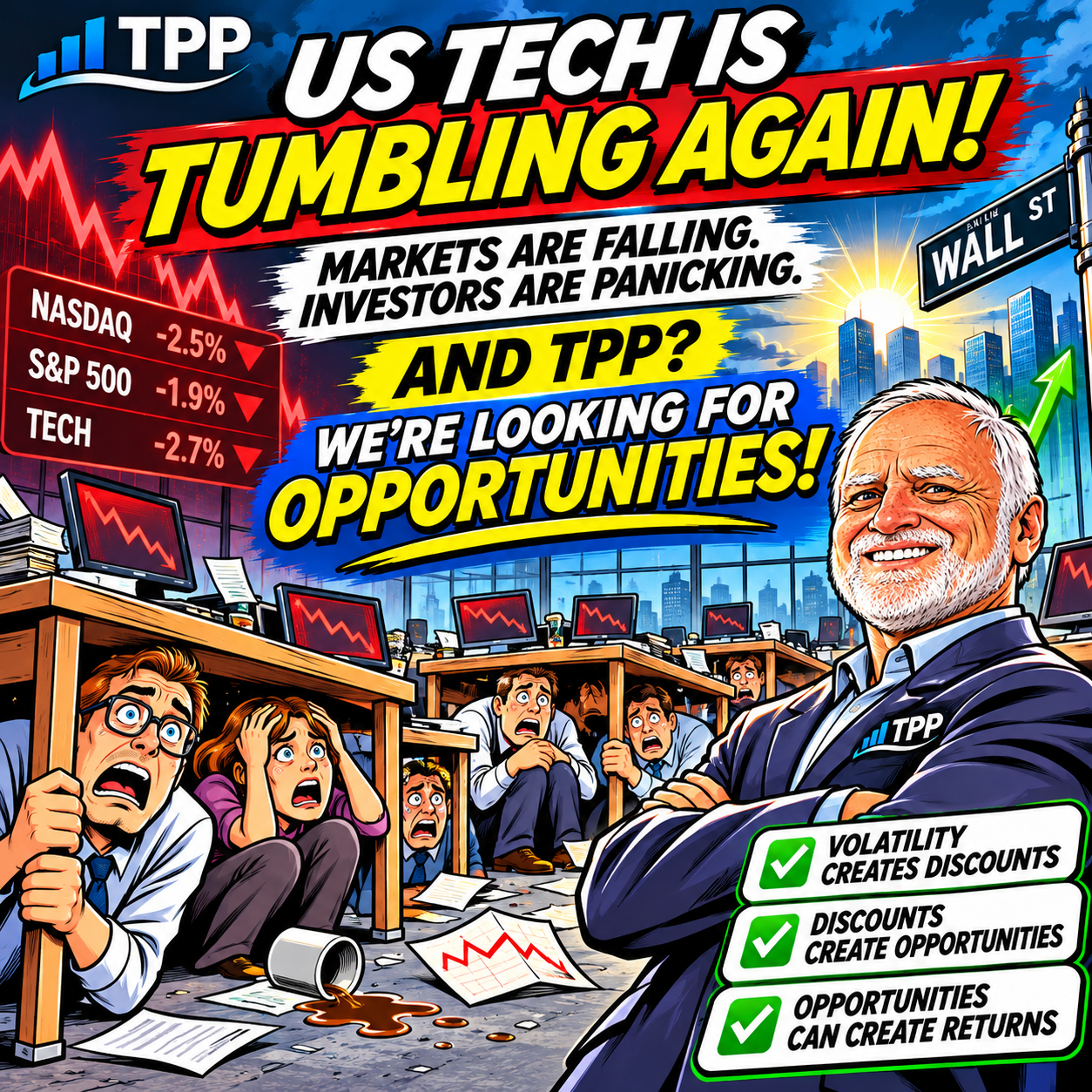
US TECH IS TUMBLING AGAIN. SO WHAT ARE TPP DOING? LOOKING FOR OPPORTUNITIES!
Market Activity
Are we spotting further discount?
November 17, 2026
Related Links
17 November 2026 | Market Commentary
Markets falling. Investors nervous. Technology stocks under pressure. Billions wiped off valuations.
Here we go again!
If you're an investor, you'll know exactly what I'm talking about.
One minute markets are rallying, confidence is returning and everyone is feeling rather pleased with themselves.
The next minute, US technology stocks are tumbling, global markets are following them lower and the financial headlines are full of doom and gloom.
And if there's one thing we've experienced plenty of throughout 2026, it's volatility.
Lots of it.
Trade wars. Inflation. Interest rates. Geopolitical tensions. AI valuations. Corporate scandals. Sudden market rallies. Equally sudden reversals.
Just when investors think things are settling down, something else comes along to shake everything up again.
But here's the question I think investors should be asking.
When markets start falling, what exactly is your investment manager doing?
Because at TPP, I can assure you of one thing.
We're not sitting around feeling sorry for ourselves.
We're looking for opportunities.
And potentially some very interesting ones.
The latest bout of volatility has once again centred on US technology stocks.
The Nasdaq fell approximately 2.5% on Monday, with the S&P 500 declining around 1.9%.
Semiconductor stocks were hit particularly hard, as investors reassessed valuations, artificial intelligence expectations and the uncertainty surrounding some of the industry's biggest companies.
And it hasn't stopped there.
When US technology stocks sneeze, the rest of the world often catches a cold.
European equities have come under pressure. Asian markets have struggled. And investors everywhere are once again questioning what comes next.
The technology sector has become such an important component of global equity markets that weakness in a relatively small number of enormous companies can have consequences far beyond Wall Street.
It's something we've discussed repeatedly.
Markets have become increasingly concentrated.
Expectations have become increasingly ambitious.
And when those expectations are challenged, the reaction can be dramatic.
But here's the interesting thing.
A falling share price doesn't necessarily mean a company has suddenly become a worse business.
Sometimes expectations have simply got ahead of reality.
Sometimes investors become nervous.
Sometimes an entire sector gets caught up in a wave of selling.
And sometimes, quite simply, markets overreact.
That's when things can become particularly interesting.
Let's be clear about something.
I'm not going to pretend that market corrections are enjoyable.
They're not.
Nobody likes opening their investment account and seeing that the value has fallen.
Nobody likes watching several months of gains disappear over a handful of trading sessions.
And nobody enjoys the uncertainty that accompanies sudden market declines.
We certainly don't.
At TPP, we care enormously about the performance of our clients' portfolios.
We know how hard people have worked to build their wealth.
We understand the importance of protecting capital, managing exposure and making sensible investment decisions.
And we understand the frustration that volatility can create.
But there's an enormous difference between being uncomfortable with falling markets and being frightened of them.
We're not frightened of volatility.
We respect it.
We manage our exposure to it.
And when the conditions are right, we look to take advantage of it.
Because volatility isn't always the enemy.
Sometimes, it can be the opportunity.
Think about it.
Imagine a business you admire.
A business with strong revenues, excellent prospects and a compelling long-term future.
Yesterday, investors were prepared to pay £100 for its shares.
Today, following a broad market sell-off, those same shares are trading at £90.
Has the business fundamentally changed overnight?
Perhaps.
But perhaps not.
Perhaps the market has simply become more nervous.
Perhaps investors are reducing exposure.
Perhaps fear is temporarily overwhelming rational decision-making.
And perhaps the same investment opportunity is now available at a 10% discount.
That's where an active investment approach can potentially add value.
Not by blindly buying everything that falls.
Not by assuming every correction will reverse.
And certainly not by pretending we can predict the exact bottom.
But by recognising that falling markets can create opportunities to establish or increase exposure at more attractive levels.
Here's a simple illustration.
If an index falls from 100 to 90 and subsequently recovers to 100, an investor entering at 90 would achieve an 11.1% gain from that entry point, before costs.
The investor who was already fully invested at 100 simply returns to where they started.
Now, that assumes the recovery happens, and of course there's no guarantee that it will.
The index could fall to 80. Or 70.
That's precisely why timing, position sizing and risk management matter.
But the principle is important.
The price at which you enter an investment can make an enormous difference to your eventual return.
And this is why we're constantly looking for opportunities during periods of market weakness.
Here's where I think the traditional wealth management model deserves another serious challenge.
For decades, investors have been encouraged to adopt a relatively simple philosophy.
Buy a diversified portfolio.
Remain invested.
Ignore the noise.
And wait.
Now, there's nothing inherently wrong with long-term investing.
In fact, remaining invested through market cycles can be an extremely effective strategy.
But we've always believed investors should have access to something more.
Something that doesn't rely exclusively on markets going higher.
Something that considers whether current exposure is appropriate for prevailing conditions.
Something that allows investment decisions to change when circumstances change.
Because if markets become extremely expensive, why shouldn't an investment manager consider reducing exposure?
If conditions deteriorate, why shouldn't they consider becoming more defensive?
And if markets subsequently fall to more attractive levels, why shouldn't they consider increasing exposure again?
Why should the only available response be to sit tight and hope for the best?
It's a question Ed and I asked ourselves repeatedly before establishing TPP.
And it's one of the fundamental reasons we built the business.
We believed there had to be a smarter way.
This is where our approach becomes particularly relevant.
At TPP, we don't operate with one investment strategy designed for every market environment.
We have developed multiple approaches, each with different characteristics and objectives.
Our Long or Flat strategies, for example, can participate in market advances or move to a neutral position when conditions warrant it.
Our Hybrid strategies combine market exposure with a more defensive element.
Our Active Long/Short strategies provide additional flexibility, including the ability to take both long and short positions.
And our Leveraged Trackers offer another way of participating in market movements, although leverage introduces additional risks and requires particularly careful management.
These approaches give us choices.
And in volatile markets, having choices can be extremely valuable.
We can assess exposure.
We can evaluate whether conditions justify remaining invested.
We can consider whether risk should be reduced.
And importantly, we can look for opportunities to increase exposure when valuations or market conditions become more attractive.
That doesn't mean we're constantly trading.
It doesn't mean every correction produces an opportunity.
And it certainly doesn't mean we always get the timing right.
But it does mean we're not restricted to one approach.
We can react. We can adapt. We can adjust.
And that's a fundamental part of the TPP investment philosophy.
There's an important distinction here.
Anyone can buy something because its price has fallen.
That doesn't make them a sophisticated investor.
Sometimes an investment falls 10% and then another 20%.
Sometimes what appears to be a bargain turns out to be anything but.
And sometimes markets remain depressed far longer than investors anticipate.
That's why we don't believe the answer is simply to rush into every correction.
The objective is to identify when the potential reward justifies the risk.
To assess whether the selling has created an attractive entry point.
To consider how much exposure is appropriate.
And to determine whether the broader market environment supports taking additional risk.
This is particularly important in technology.
The long-term outlook for artificial intelligence, automation and digital transformation may be extraordinary.
But even extraordinary businesses can become overvalued.
And even exceptional industries can experience painful corrections.
We can believe in the future of technology without believing every technology share is worth buying at any price.
That's the difference between conviction and blind optimism.
Potentially, yes.
And that's exactly what makes the current environment interesting.
We're now well into November.
The end of the year is approaching.
And once again, markets are presenting investors with a mixture of uncertainty, nervousness and potentially more attractive entry levels.
Could some of the recent declines reverse before the end of December?
Absolutely.
Could technology shares recover strongly if confidence returns?
Certainly.
Could we see further selling before that happens?
Of course.
Nobody knows.
And anybody claiming to know exactly where the Nasdaq will finish the year is guessing.
But here's what we do know.
If markets create attractive opportunities, we want to be in a position to recognise them and act appropriately.
That might involve increasing exposure to an index following a significant correction.
It might involve adjusting the balance between defensive and growth-oriented strategies.
It might involve taking advantage of an oversold market.
Or it might involve doing absolutely nothing until the risk/reward becomes more compelling.
The important thing is that we're evaluating the opportunities rather than simply reacting emotionally to the headlines.
And if we're able to capture part of a subsequent recovery from more attractive levels, that could potentially add valuable percentage points to portfolio returns.
Not guaranteed.
Not without risk.
But very much part of what we're trying to achieve.
Volatility creates potential discounts.
Discounts create potential opportunities.
And successfully capturing those opportunities can create additional returns.
That's the thinking.
It's worth putting the current volatility into perspective.
Because despite all the uncertainty, 2026 has been a very encouraging year for TPP.
As at 14th ofNovember 2026, the combined average performance across all our discretionary client portfolio accounts was:
Year to date: +19.53%
Rolling 12 months: +25.99%
Rolling 24 months: +50.84%
All after fees.
And importantly, those results have been achieved across a period characterised by considerable market uncertainty.
We're immensely proud of the progress we've made.
Not simply because of the numbers.
But because they reflect the investment philosophy we've spent years developing.
An approach built around flexibility, active decision-making and risk management.
Of course, individual client returns vary, and past results cannot tell us what the future holds.
But they demonstrate why we remain so enthusiastic about what we're building.
We can't control markets. But we can control how we react to them.
And that's something we've always believed.
Performance figures as at the close on 14th November 2026 and refer to the combined average of all client discretionary portfolio accounts (across all strategies), after fees, calculated on a Time Weighted Return basis. Year-to-date 19.53%; 1 year 25.99%; 2 year 50.84%. Individual client returns vary. Past performance is not a reliable indicator of future results. Capital is at risk.
To everyone already investing with TPP, I want to reinforce something.
We're watching. We're analysing. And we're looking for opportunities.
We know the latest market declines aren't particularly enjoyable.
We know the headlines can be unsettling.
And we know that, after such an eventful year, another bout of volatility is probably the last thing many investors wanted.
But this is exactly why we developed the investment approaches we use.
Not simply to participate when markets are rising.
But to have the flexibility to respond when conditions change.
We're assessing whether the recent sell-off creates opportunities to improve entry levels and potentially add to returns as we approach the end of the year.
That doesn't mean we'll rush to increase exposure.
It doesn't mean we'll take unnecessary risks.
And it certainly doesn't mean we can promise a year-end rally.
But we'll continue doing what we've always done.
Monitoring.
Evaluating.
Adapting.
And making decisions based on our assessment of the opportunities and risks.
We're not here simply to ride the markets. We're here to actively manage your investment exposure.
Thank you, as always, for the trust you place in us.
We're incredibly proud of what we're building together.
And we're looking forward to seeing what the final weeks of 2026 bring.
Now, if you're reading this and you're not yet a TPP client, I'd like to ask you something.
When markets fall sharply, what does your wealth manager actually do?
Do they contact you?
Do they explain what's happening?
Do they assess whether exposure should change?
Do they look for opportunities?
Or do you simply receive another reassuring message explaining that markets go up and down and you should remain invested for the long term?
There's nothing wrong with patience.
And there's nothing wrong with a long-term investment strategy.
But we believe investors deserve the opportunity to consider a more active approach.
Particularly if they're frustrated with disappointing performance, high fees or a lack of flexibility.
At TPP, we've challenged the traditional model.
No percentage-based management fees.
No performance fees.
Just a straightforward subscription.
Multiple investment approaches.
Active risk management.
And an investment philosophy built around adapting to market conditions rather than simply accepting them.
We're not promising that every decision will be right.
We're not promising that we'll outperform every benchmark in every period.
And we're certainly not promising that markets won't fall.
But we are offering something genuinely different.
A different investment philosophy. A different fee structure. A different approach to managing wealth.
And if you're serious about exploring whether there's a smarter way to invest, we'd love to show you what we're building.
No obligation.
No pressure.
Just a conversation about your existing portfolio, your objectives, your frustrations and whether TPP could be an appropriate alternative.
Ready to challenge the traditional buy, hold and hope model?
BOOK YOUR FREE TPP CONSULTATION: Click here.
Markets will continue to rise.
Markets will continue to fall.
And there will always be another crisis, another correction and another headline designed to make investors nervous.
That's investing.
But what matters is how you approach those changing conditions.
At TPP, we don't believe volatility should automatically be a reason to panic.
We believe it should be a reason to pay attention.
To reassess.
To look for opportunities.
And to make informed decisions.
US technology stocks are tumbling again.
Global equities are feeling the pressure.
Investors are getting nervous.
And TPP?
We're looking for opportunities.
Because sometimes, the most interesting investment opportunities emerge when everyone else is looking the other way.
TPP — A smarter way to invest.
Important information: This article is for general information only and does not constitute personal investment advice or a recommendation to buy or sell any financial instrument. All investments involve risk, including loss of capital. TPP strategies may use derivatives, leverage and short positions, which can amplify losses as well as gains. Moving to a neutral position may mean missing a market recovery. Risk management cannot eliminate investment risk or guarantee outperformance. Past performance is not a reliable indicator of future results.
Disclaimer: This document is issued by TPP, being provided for information purposes only. This document does not constitute legal, tax, accounting or investment advice, nor should it be relied upon when making investment decisions. This is not a personal recommendation or an offer or invitation to buy or sell any financial instrument. The market conditions and views expressed are as at the date of publication, which may change without notice. Unless otherwise stated, market data has been obtained from sources believed to be reliable. While believed to be accurate, no representation or warranty is given as to its completeness or accuracy.
TPP strategies invest in leveraged financial instruments, including equity index futures. Leverage can magnify both gains and losses, meaning losses may occur more quickly than in unleveraged investments. Investments involve risk and investors may lose some or all of their invested capital. Your capital is at risk.
Past performance is not necessarily a reliable indicator of future performance. The value of investments, and any income from them, can fall as well as rise, and investors may not recover the amount originally invested. Future returns are not guaranteed. Therefore, you should not assume that the future performance of any specific investment or investment strategy will be profitable or equal to the corresponding past performance.
TPP is a trading name of UCapital Asset Management LLP. UCapital Asset Management LLP is authorised and regulated by the Financial Conduct Authority (FCA No. 477155). 80 Coleman Street, London EC2R 5BJ.
“TPP might just be about to revolutionise investment for the retail market.”
- London Stock Exchange 2020


