>
Insights>
Market Activity>
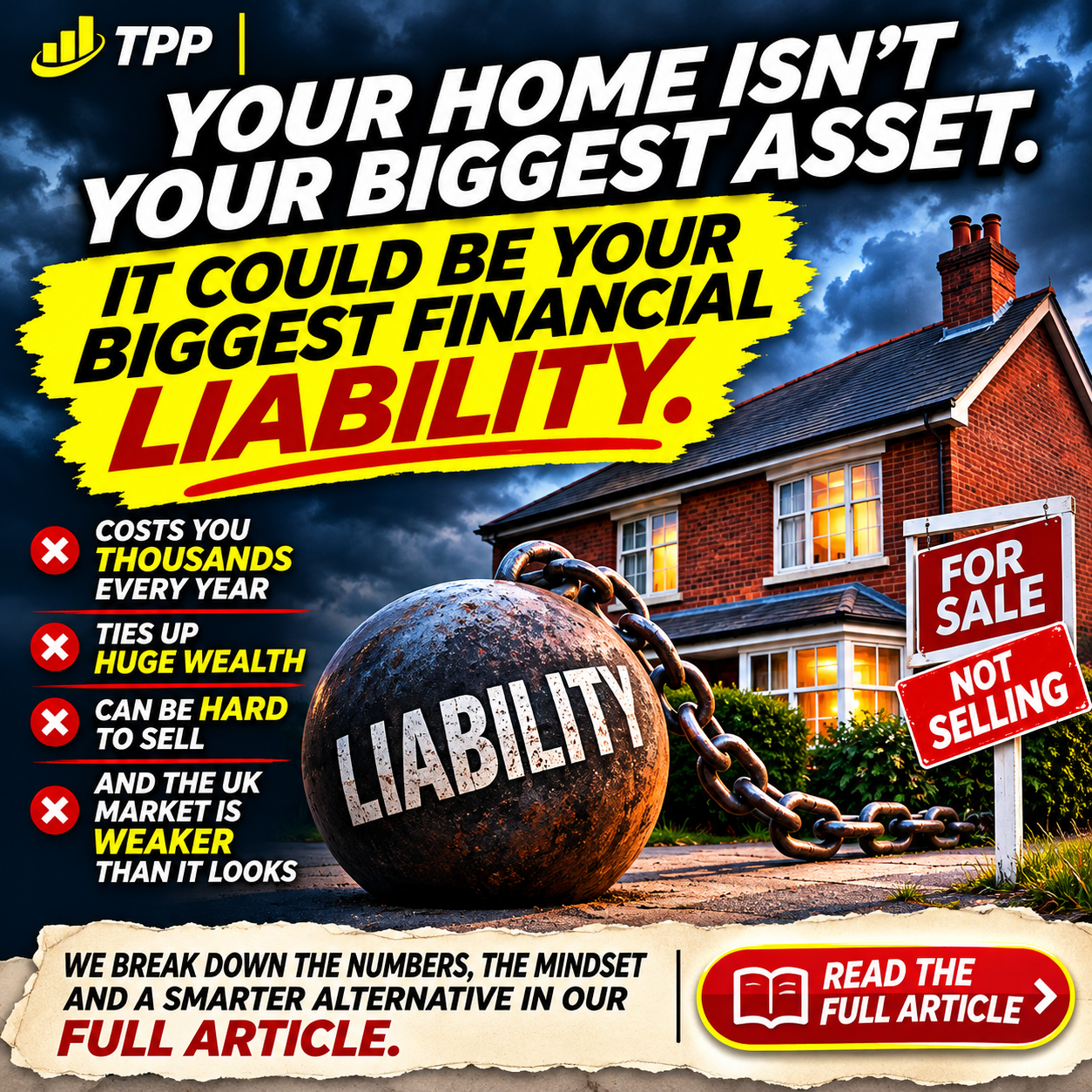
YOUR HOME ISN'T YOUR BIGGEST ASSET. IT COULD BE YOUR BIGGEST FINANCIAL LIABILITY.
Market Activity
Why the UK obsession has to end....
November 12, 2026
Related Links

Britain has a property obsession. And I think it's costing millions of people a fortune.
For generations, we've been brought up to believe that buying a house, paying down the mortgage and climbing the property ladder is the ultimate measure of financial success.
Buy the biggest house you can afford.
Stretch yourself for the next one.
Put every spare pound into it.
And one day, apparently, you'll be wealthy.
But what if we've been looking at wealth completely the wrong way?
What if the very thing millions of Britons consider their greatest financial asset is actually holding them back from building serious wealth?
Let's challenge a few assumptions.
Let's simplify things.
From a wealth-building and cash-flow perspective, I like to think of an asset as something that has the potential to put money into your pocket.
Something that works for you.
Something that generates income, grows in value, or ideally does both.
A liability, meanwhile, takes money out of your pocket.
It needs feeding.
It needs maintaining.
It creates ongoing financial obligations.
Now, technically, your home is an asset on your balance sheet. It has a market value, and any mortgage is a separate liability.
But here's my question.
Is your home working for you? Or are you working for your home?
Because those are two very different things.
And when you start looking at property through that lens, the great British obsession begins to look rather less attractive.
Let's imagine two people.
Both have £500,000 of wealth.
Person A has £500,000 of equity tied up in their main residence.
Person B has £500,000 invested in a diversified portfolio of global equities.
Now, before the property enthusiasts get excited, I'm not suggesting everyone should sell their home and live in a tent.
We all need somewhere to live.
I'm talking about how we allocate wealth, and the financial consequences of those decisions.
Person A: £500,000 tied up in their home.
They may feel wealthy.
They may even be sitting in a beautiful property that has appreciated considerably over the years.
But every month, that property demands money.
Council tax.
Insurance.
Maintenance.
Repairs.
Heating.
Utilities.
Service charges, perhaps.
And potentially mortgage interest on top.
Let's take a hypothetical annual cost of ownership:
Total: £13,000 per year.
That's more than £1,000 a month.
And it excludes any mortgage payments, major renovations or unexpected disasters.
A new roof? More money.
Boiler replacement? More money.
Subsidence? Let's not even go there.
Of course, some of these costs would also exist if you rented, and the homeowner receives something extremely valuable in return: somewhere to live.
But the crucial point remains.
That £500,000 of equity isn't producing spendable investment income.
It's locked inside a property.
To access a substantial amount of it, you generally need to sell, downsize or borrow against it.
And none of those options is necessarily quick, cheap or convenient.
So yes, you're asset-rich.
But are you financially free?
Not necessarily.
Person B has £500,000 invested in global equities.
Rather than being concentrated in one property, their money is exposed to businesses around the world.
Companies innovating.
Companies generating profits.
Companies expanding into new markets.
Companies creating products and services that millions, sometimes billions, of people use.
Some pay dividends.
Others reinvest profits to drive future growth.
And crucially, the investor has the opportunity to benefit from that growth.
Let's assume, purely for illustration, an average annual compounded return of 8%, with all returns reinvested.
Here's what happens to £500,000:
Portfolio value
Starting investment £500,000
After 5 years £734,664
After 10 years £1,079,462
After 15 years £1,586,085
That's more than £1 million of potential investment growth over 15 years.
Without contributing another penny.
Now, 8% is an illustration, not a prediction or guarantee. Markets don't rise in straight lines. Some years will be excellent, others disappointing, and losses are inevitable along the way. Taxes, charges and inflation also matter.
And the homeowner's property could appreciate too.
But the example demonstrates something incredibly important.
Compounding is one of the most powerful forces in wealth creation. And every pound unnecessarily locked away in an expensive home is a pound that cannot simultaneously be invested elsewhere.
That's the opportunity cost.
And I think far too many people underestimate it.
This is the part I've never quite understood.
Why are we so conditioned to believe that owning increasingly expensive property is the ultimate financial achievement?
Why do we celebrate someone moving from a £700,000 home to a £1.2 million home?
Why do we automatically assume they're becoming wealthier?
They might be.
But they may also have exchanged liquidity, flexibility and investment potential for more space, bigger bills and greater financial commitments.
A bigger house doesn't automatically mean a bigger financial future.
And yet in Britain, property is often treated almost like a religion.
People will happily stretch themselves financially to buy another bedroom.
But suggest putting the same money into a diversified global equity portfolio and suddenly they're worried about risk.
Think about that.
A single property, in a single location, exposed to one housing market, is often perceived as safe.
Yet ownership of hundreds or thousands of businesses across multiple countries and industries is considered risky.
That strikes me as a rather extraordinary contradiction.
Of course, equities are volatile. Their prices change every second.
But property values change too.
You simply don't have a screen in your kitchen telling you what your house is worth every 15 seconds.
The absence of a flashing price doesn't mean the absence of risk.
Recent reporting on the British housing market makes uncomfortable reading.
According to analysis, official house-price estimates have repeatedly been revised downwards.
Now, these figures don't mean every house is falling in value or that every homeowner is in trouble.
But they certainly challenge the comforting idea that property is a one-way bet.
A property is only worth what somebody is prepared to pay for it.
Not what the estate agent suggests.
Not what your neighbour hopes to achieve.
And certainly not what you think it ought to be worth because you've owned it for 15 years.
And when you want to sell?
You need a buyer.
You need solicitors.
You need surveys.
You need a chain that doesn't collapse.
You need patience.
Compare that with the ability to sell a portion of a liquid, publicly traded equity portfolio.
They're two very different propositions.
Here's where I think the real financial mistake lies.
It's not necessarily owning property.
It's allowing property to dominate your entire financial life.
Imagine someone with a net worth of £1 million.
£850,000 of that is equity in their main residence.
£100,000 is in pensions.
£50,000 is in savings and investments.
On paper, they're a millionaire.
But 85% of their wealth is tied up in one illiquid asset.
One property.
One location.
One market.
And their readily accessible investment capital is relatively small.
Now compare that with somebody whose wealth is spread across property, equities, pensions, businesses and cash.
Who's better positioned to respond to opportunities?
Who's more diversified?
Who's potentially better equipped to generate investment income?
And who's less dependent on the performance of one particular asset?
I know which financial structure I'd rather have.
I've spent more than 25 years in financial markets.
And one belief has only strengthened over that time.
Wealth isn't simply about what you own. It's about what your wealth can do for you.
Can it generate income?
Can it compound?
Can it provide liquidity?
Can it give you choices?
Can it help you stop working when you want to, rather than when you have to?
A beautiful home can deliver tremendous lifestyle benefits.
Security.
Comfort.
Family memories.
Pride.
Those things have real value, and I'm certainly not dismissing them.
But they're not the same as financial returns.
And I think far too many people confuse the two.
There's absolutely nothing wrong with owning a wonderful home.
Just don't confuse an expensive lifestyle asset with an investment strategy.
My preference has always been to have meaningful exposure to global businesses and the wealth they create.
Not because equities rise every year.
They don't.
Not because markets are predictable.
They aren't.
But because over long periods, ownership of productive businesses offers a compelling route to capital growth.
You participate in innovation.
Productivity.
Entrepreneurship.
Global expansion.
And the reinvestment of corporate profits.
You can diversify across markets, sectors and currencies.
You can access your capital without needing to sell your family home.
And you can potentially benefit from the extraordinary mathematics of compounding.
That's a very attractive proposition.
And it's one I've believed in throughout my career.
Ed and I built TPP because we believed the traditional approach to investment management was overdue for disruption.
And our belief goes beyond simply owning equities.
We don't believe investors should have only one approach to markets.
Buy.
Hold.
Hope.
And cross your fingers.
We believe in adapting.
Managing risk.
Changing exposure when conditions change.
And having different strategies for different market environments.
That's why we've developed four distinct approaches to markets, supported by a track record that investors can examine for themselves.
Our objective is straightforward.
To deliver stronger risk-managed investment outcomes than a traditional passive approach over time.
That doesn't mean every strategy will outperform every benchmark in every period.
No investment strategy can promise that.
But it does mean we're constantly looking for ways to improve the way capital is invested, managed and protected.
And for anyone considering moving capital out of property, reducing their exposure to an illiquid asset, or simply diversifying their wealth, we think that's a conversation worth having.
I'm not expecting to change the British obsession with property overnight.
It's been ingrained in us for generations.
And I'm certainly not suggesting that everybody should sell their home.
But I am suggesting that investors ask themselves a few uncomfortable questions.
How much of my net worth is tied up in property?
How much of my wealth is genuinely working for me?
How much liquidity do I have?
And what opportunities might I be missing because so much of my capital is locked away?
If this article makes even a handful of people reconsider their next financial decision, that's a good outcome.
Because ultimately, the goal shouldn't be to die owning the most expensive house on the street.
The goal should be to build wealth that gives you freedom, flexibility and choices while you're still here to enjoy them.
And in my view, global equities deserve a much bigger place in that conversation.
If you're an investor, or you're considering releasing capital from your property portfolio and exploring a different approach to investing, we'd welcome a conversation.
Let's talk about what your wealth could be doing for you.
SCHEDULE A CALL BY CLICKING HERE.
TPP: A Smarter Way to Invest.
If you're already a TPP client, hopefully you've started building a financial structure that extends well beyond your main residence.
That doesn't mean you shouldn't enjoy your home or invest in your lifestyle.
It simply means understanding the difference between the wealth you live in and the wealth that's working for you.
Diversification, liquidity, flexibility and long-term growth all matter.
And we're delighted to be helping you put those principles into practice.
Have a fantastic week, and if you need us, you know where we are!!!
mportant information: Capital at risk. Investments can fall as well as rise. Past performance is not indicative of future results. Active management, scaling into falling markets and taking profits do not guarantee positive returns or benchmark outperformance. Trading strategies may involve leverage and significant losses. Testimonials reflect individual experiences and are not representative of all investors. Market figures are approximate and should be verified against the relevant closing prices before publication.
Disclaimer: This document is issued by TPP, being provided for information purposes only. This document does not constitute legal, tax, accounting or investment advice, nor should it be relied upon when making investment decisions. This is not a personal recommendation or an offer or invitation to buy or sell any financial instrument. The market conditions and views expressed are as at the date of publication, which may change without notice. Unless otherwise stated, market data has been obtained from sources believed to be reliable. While believed to be accurate, no representation or warranty is given as to its completeness or accuracy.
TPP strategies invest in leveraged financial instruments, including equity index futures. Leverage can magnify both gains and losses, meaning losses may occur more quickly than in unleveraged investments. Investments involve risk and investors may lose some or all of their invested capital. Your capital is at risk.
Past performance is not necessarily a reliable indicator of future performance. The value of investments, and any income from them, can fall as well as rise, and investors may not recover the amount originally invested. Future returns are not guaranteed. Therefore, you should not assume that the future performance of any specific investment or investment strategy will be profitable or equal to the corresponding past performance.
TPP is a trading name of UCapital Asset Management LLP. UCapital Asset Management LLP is authorised and regulated by the Financial Conduct Authority (FCA No. 477155). 80 Coleman Street, London EC2R 5BJ.
“TPP might just be about to revolutionise investment for the retail market.”
- London Stock Exchange 2020

