Market Activity
Lane Clark of TPP breaks it down.
September 28, 2026
Related Links
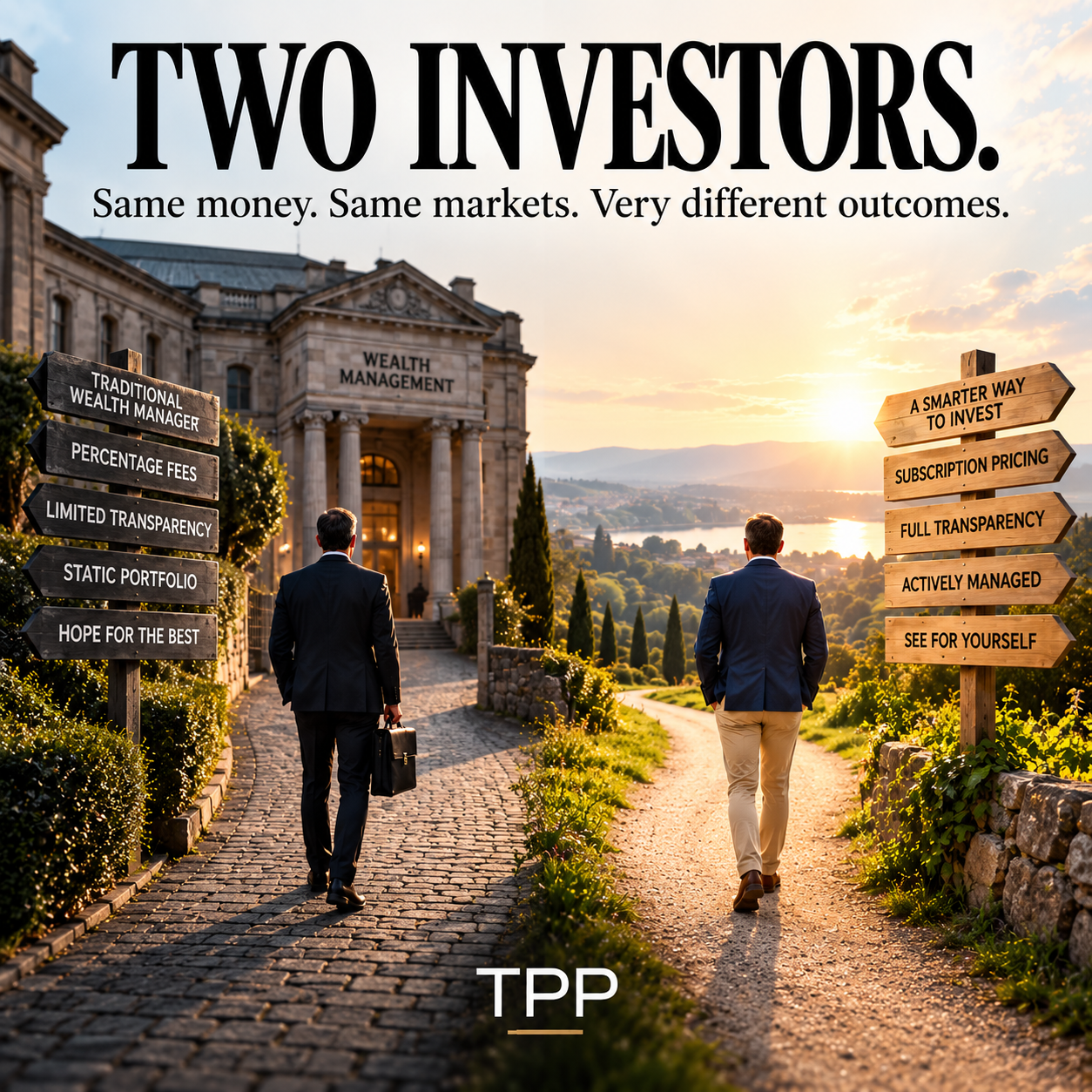
Imagine two successful investors.
Let's call them James and David.
They're roughly the same age.
They've both spent decades building successful careers and businesses.
They've both accumulated £500,000 that they want professionally invested.
And they both want broadly the same thing.
Grow their wealth.
Protect it when markets become difficult.
And eventually turn what they've built into financial freedom for themselves and their families.
So they each make what seems like a sensible decision.
They get professional help.
That's where their stories begin to separate.
He meets a traditional wealth manager.
Nice offices.
Nice suit.
Nice coffee.
Beautifully presented brochures.
There's a discussion about risk.
Some colourful charts.
A diversified portfolio is constructed.
And James agrees to pay a percentage of his wealth every year to have it managed.
It all feels reassuringly professional.
So James signs.
And largely forgets about it.
After all...
Isn't that what you're paying a wealth manager for?
David meets a wealth manager too.
But something bothers him.
He starts looking at the numbers.
And the more he looks, the more questions he has.
Why should the amount he pays for investment management automatically increase simply because his portfolio gets bigger?
If his £500,000 eventually becomes £1 million...
Why should managing it suddenly cost so much more?
If it becomes £2 million?
More again?
Has the amount of work really quadrupled?
Then he asks another question.
What exactly happens when markets fall?
He's told his portfolio is diversified.
But that wasn't quite what he asked.
He wants to know whether somebody is actually monitoring the investments and making active decisions as conditions change.
Then another question occurs to him.
What am I actually paying for?
And that's when David starts looking for an alternative.
Both investors have experienced the same markets.
The same crashes.
The same rallies.
The same inflation scares.
The same interest-rate changes.
The same political dramas.
The same newspaper headlines predicting everything from boom times to financial Armageddon.
But they approached those markets very differently.
James remained with the traditional model.
David decided he wanted something different.
He wanted transparency.
He wanted to know where his money was.
He wanted investment strategies that could be actively monitored rather than simply buying a portfolio and hoping for the best.
He didn't want long lock-ins.
And he certainly didn't understand why the cost of managing his investments should automatically rise simply because he became wealthier.
One thing is for sure: there returns were very very very different!!!!
Which brings us to an important question...
Because something interesting is happening in wealth management.
For decades, investors have largely accepted the same basic formula.
Build wealth.
Hand it to a wealth manager.
Pay them a percentage of it every year.
And hope the portfolio performs sufficiently well to justify the cost.
We think there's another way.
TPP was created by former financial traders who believed investment management could be done differently.
Our philosophy is remarkably simple.
We want our clients' money working harder.
And we don't believe we should charge them more simply because they have more of it.
That's why TPP operates on a subscription model rather than the traditional percentage-of-wealth management fee.
Whether your portfolio grows...
Whether you add more capital...
Whether your wealth increases significantly over the years, we don't suddenly decide we deserve a bigger slice of it simply because you've become more successful.
But pricing was only one part of what we wanted to change.
Markets change.
Valuations change.
Risk changes.
Opportunities change.
So why should an investment portfolio remain largely static?
At TPP, we use a range of investment strategies with different jobs to do.
Some are designed to participate in rising markets.
Some can reduce exposure when conditions become less attractive.
Some look to take advantage of market retracements.
Others provide exposure to areas where we believe the opportunity remains attractive.
The important point is this: we don't believe investment management should simply mean buying a portfolio, crossing your fingers and checking it again in twelve months.
Our strategies are monitored daily.
Risk matters.
Valuation matters.
Market conditions matter.
And when we believe circumstances justify a change, we can make one.
This is another part of traditional investing we've always disliked.
Investors should know where their money is.
TPP clients hold their investment accounts with Interactive Brokers.
Their holdings remain visible.
Their portfolio remains transparent.
Their money remains accessible subject to normal market settlement.
TPP manages the investment strategy.
And clients can see what's happening.
No smoke.
No mirrors.
No mysterious black box.
This might be the most important part of this letter.
Because every investment company can tell you how wonderful it is.
Every wealth manager has a glossy brochure.
Every fund manager can produce a beautiful PowerPoint.
We'd rather you see what we do.
That's why prospective investors can follow a TPP demo portfolio before making a decision.
See the strategies.
Understand the philosophy.
Watch how we respond to markets.
And decide for yourself whether our approach makes sense.
Because ultimately, your money is too important to invest based on a sales pitch.
If you're happy with your wealth manager...
If you're delighted with your investment performance...
If you understand exactly what you're paying...
And you wouldn't change a thing...
Then TPP probably isn't for you.
But if you've ever looked at your portfolio and thought:
"Surely my money could be working harder than this?"
Or...
"Why am I paying this much?"
Or...
"What exactly are they doing when markets become difficult?"
Or simply...
"There must be a smarter way to invest."
Then perhaps it's worth seeing what we've built.
Not investing.
Not transferring your portfolio.
Not signing anything.
Just looking.
Follow the strategies.
See how the portfolio is positioned.
Understand how we manage risk.
Watch how we react as markets change.
And compare our approach with what you're doing today.
It costs nothing.
There's no obligation.
And you might discover that the way you've always invested isn't necessarily the way you have to invest tomorrow.
Because James and David started in exactly the same place.
The difference wasn't how much money they had.
It was the questions they asked about what happened to it next.
TPP
A smarter way to invest.
Capital at risk. Investments can fall as well as rise. Past performance is not indicative of future results.
Alternatively if you would rather have a conversation with our team, and ask the probing questions in your mind then SCHEDULE A CALL WITH TPP: CLICK HERE.
We look forward to hearing from you.
TPP's year-to-date average return across participating client accounts is 22.89%*.
Interested in learning more? CONTACT OUR TEAM...
There is a substantial risk of loss in trading financial markets. Past performance is not indicative of future results. The examples in this article are illustrative and do not guarantee that any strategy will outperform a benchmark or avoid losses.
*Results as of 14th September 2026 and refer to the combined average of all client discretionary portfolio accounts (across all strategies), after fees, calculated on a Time Weighted Return basis.
Disclaimer: This document is issued by TPP, being provided for information purposes only. This document does not constitute legal, tax, accounting or investment advice, nor should it be relied upon when making investment decisions. This is not a personal recommendation or an offer or invitation to buy or sell any financial instrument. The market conditions and views expressed are as at the date of publication, which may change without notice. Unless otherwise stated, market data has been obtained from sources believed to be reliable. While believed to be accurate, no representation or warranty is given as to its completeness or accuracy.
TPP strategies invest in leveraged financial instruments, including equity index futures. Leverage can magnify both gains and losses, meaning losses may occur more quickly than in unleveraged investments. Investments involve risk and investors may lose some or all of their invested capital. Your capital is at risk.
Past performance is not necessarily a reliable indicator of future performance. The value of investments, and any income from them, can fall as well as rise, and investors may not recover the amount originally invested. Future returns are not guaranteed. Therefore, you should not assume that the future performance of any specific investment or investment strategy will be profitable or equal to the corresponding past performance.
TPP is a trading name of UCapital Asset Management LLP. UCapital Asset Management LLP is authorised and regulated by the Financial Conduct Authority (FCA No. 477155). 80 Coleman Street, London EC2R 5BJ.
Capital is at risk. Investments can fall as well as rise and you may get back less than you invest. TPP strategies may use leverage and short selling, which can magnify losses as well as gains. Past performance is not a reliable indicator of future results. Nothing above constitutes a personal recommendation.
“TPP might just be about to revolutionise investment for the retail market.”
- London Stock Exchange 2020


