Market Activity
The start of something bigger?
September 17, 2026
Related Links
What a difference a day can make.
For the last few weeks, investors have been bombarded with reasons to be negative.
Geopolitical tensions. Oil prices above $100. Government bond yields pushing to levels we haven't seen for years. Concerns about inflation. Sluggish economic growth. Questions around AI. And, just when many investors had spent years waiting for interest rates to come down, the Federal Reserve has gone the other way and raised rates for the first time since 2023.
You could be forgiven for looking at the headlines and thinking:
Why on earth would anyone want to own stocks right now?
And yet, today, they're bouncing.
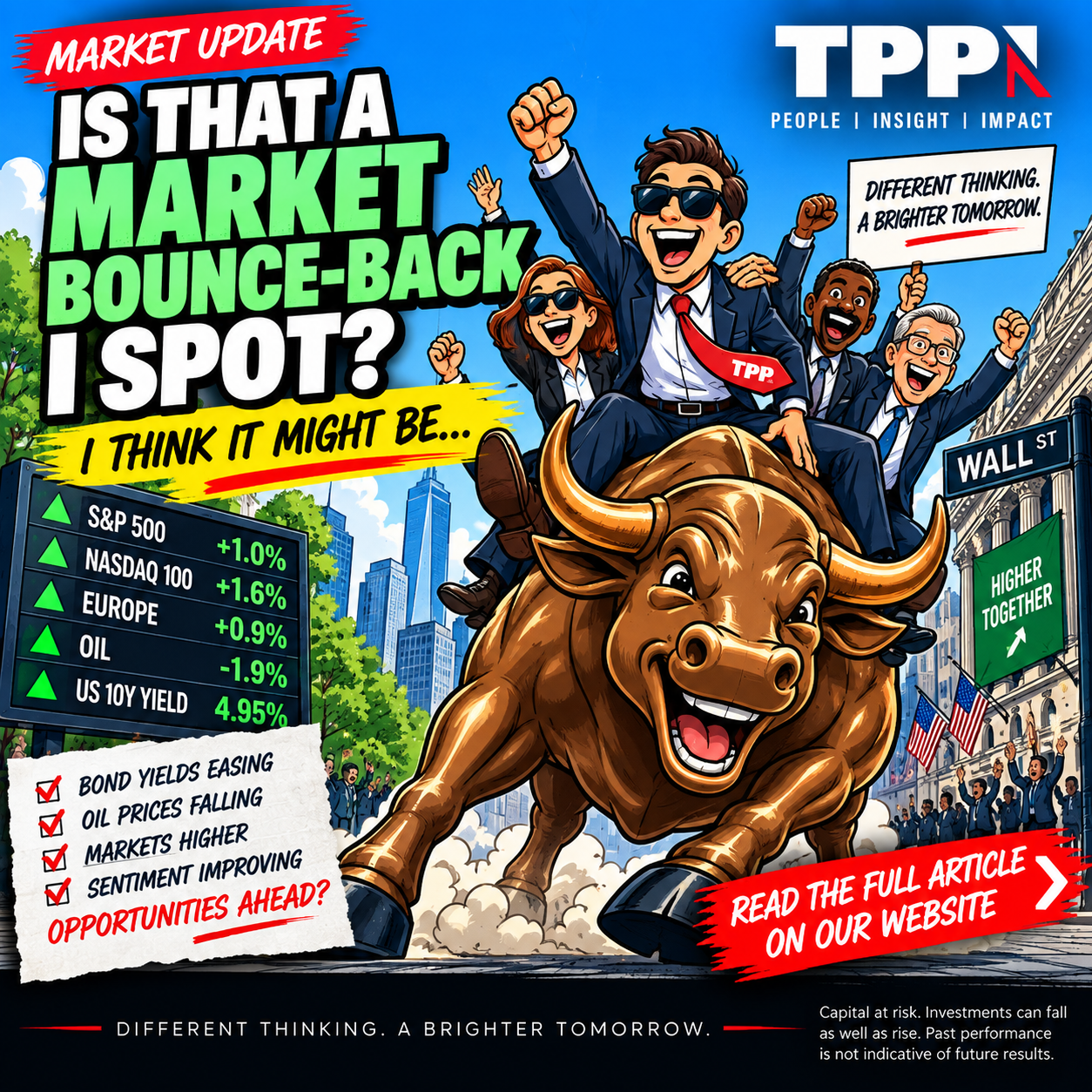
At the time of the Bloomberg market update on Thursday, the S&P 500 was up around 1%, the Nasdaq 100 1.6%, the STOXX Europe 600 0.9% and the MSCI World Index 0.9%.
At the same time, the US 10-year Treasury yield had fallen eight basis points to 4.95%, breaking back below 5%, while oil was retreating, with WTI down around 1.9% to roughly $100.48 a barrel.
In other words, some of the pressure that has been sitting on markets suddenly eased.
Is this the beginning of the next big rally?
Possibly.
Could markets turn around tomorrow and head lower again?
Absolutely.
And that distinction is incredibly important.
This is something we've been talking about repeatedly at TPP over the last couple of weeks.
Markets don't normally wait until every problem has disappeared before they recover.
They don't wait for the newspaper headlines to become positive.
They don't send investors an email saying:
"Everything is fine now. You may buy stocks again."
Markets are forward-looking.
Sometimes the catalyst isn't that everything suddenly becomes good.
It's simply that things become less bad.
That's arguably what we're seeing today.
The Fed's rate rise initially caused another wobble. But as markets digested the decision, stocks and bonds rebounded. Bloomberg reported that falling oil prices helped sentiment, while the decline in Treasury yields relieved some of the pressure that higher borrowing costs had been putting on equities.
One investment manager quoted by Bloomberg described the post-Fed decline as an "overreaction" that had created a buying opportunity.
Sound familiar?
At TPP, we've spent the last week or so saying something relatively simple:
We believe a lot of the bad news is already reflected in prices.
That's why we haven't been running away from the volatility.
We've been scaling into it.
We've bought into falling markets. We've accepted that we almost certainly won't pick the precise bottom, because nobody consistently does, and we've looked instead for what we believe are attractive entry points created by the sell-off.
Today, we're beginning to see some reward for that positioning.
Let's not get carried away.
A 1% move in the S&P 500 isn't exactly the beginning of the next Roaring Twenties.
😂
But the psychology can change incredibly quickly.
A few days ago the conversation was dominated by oil, inflation, 5%+ Treasury yields, geopolitical risk and higher rates.
Today?
Oil is falling. Bond prices are recovering. Yields are easing. Technology is bouncing. Stocks are rising.
Same world. Very different mood.
And that's precisely why we don't believe investment decisions should simply follow newspaper headlines.
This is one of the great contradictions of investing.
When everything feels comfortable, markets have often already moved.
When everything feels terrifying, the opportunities can be much more interesting.
The difficult part is acting somewhere in between.
We said previously that we weren't trying to catch the exact bottom. If a market falls 10%, we don't need to magically buy at precisely -10.00%.
If we can progressively build exposure at better prices and capture a meaningful proportion of the eventual recovery, that's potentially extremely valuable.
We're good. We're not superheroes. 😂
And today doesn't prove that we've called the bottom either.
There are still significant risks.
Oil remains around $100. Inflation hasn't disappeared. Bond yields remain elevated. The Fed has tightened policy. The Bank of Japan may tighten further. Geopolitical tensions haven't suddenly vanished because the S&P had a good morning.
So there could absolutely be more volatility ahead.
But that's the point.
We don't require uncertainty to disappear before we invest.
We want to manage it, and, where appropriate, attempt to exploit the opportunities it creates.
For TPP clients, hopefully the last few weeks have demonstrated why patience matters.
We've spent decades operating in financial markets.
We've lived through crashes, recessions, wars, inflation scares, rate cycles, political crises, technology bubbles and plenty of supposedly unprecedented events.
We've got the T-shirt.
Probably several of them.
😂
The last few weeks have been uncomfortable in places. Some of the positions we've built into falling markets naturally moved against us initially.
But from our perspective, this has been a bump in the road, not a reason to abandon the process.
We continued monitoring.
We continued managing risk.
And where we believed prices had become more attractive, we continued buying.
Whether today's rebound becomes something bigger remains to be seen.
But if it does, we're already on the bus.
Come on.
It's 2026.
The world has changed.
Markets have changed.
Technology has changed.
The information available to investors has changed beyond recognition.
So why are so many portfolios still being managed like it's 1987?
Buy a portfolio.
Hold it.
Pay the fees.
Markets fall 15%?
Keep holding.
Markets fall 25%?
"Stay invested."
Then wait and hope everything eventually comes back.
Gordon Gekko isn't managing your portfolio anymore.
And perhaps it's time the investment industry moved on too.
At TPP, we believe modern investing should be more dynamic.
Sometimes that means being exposed to rising markets.
Sometimes reducing exposure.
Sometimes sitting flat.
Sometimes taking profits.
And sometimes, as we've been doing recently, buying into fear when we believe markets are offering us a discount.
That's the philosophy behind what we're building.
Not buy, hold and hope.
Different thinking. A brighter tomorrow.
And perhaps, just perhaps, that market bounce-back we've been waiting for is beginning.
Here we go. 📈
Interested in seeing how TPP invests differently?
If you're frustrated with the traditional wealth-management model and want to understand how we build and manage portfolios across different market environments, schedule a call with us today.
Come and join the investment revolution.
If you would like to have a conversation with our team, and ask the probing questions in your mind then SCHEDULE A CALL WITH TPP: CLICK HERE.
We look forward to hearing from you.
TPP's year-to-date average return across participating client accounts is 24.11%*.
Interested in learning more? CONTACT OUR TEAM...
There is a substantial risk of loss in trading financial markets. Past performance is not indicative of future results. The examples in this article are illustrative and do not guarantee that any strategy will outperform a benchmark or avoid losses.
*Results as of 14th August 2026 and refer to the combined average of all client discretionary portfolio accounts (across all strategies), after fees, calculated on a Time Weighted Return basis.
Disclaimer: This document is issued by TPP, being provided for information purposes only. This document does not constitute legal, tax, accounting or investment advice, nor should it be relied upon when making investment decisions. This is not a personal recommendation or an offer or invitation to buy or sell any financial instrument. The market conditions and views expressed are as at the date of publication, which may change without notice. Unless otherwise stated, market data has been obtained from sources believed to be reliable. While believed to be accurate, no representation or warranty is given as to its completeness or accuracy.
TPP strategies invest in leveraged financial instruments, including equity index futures. Leverage can magnify both gains and losses, meaning losses may occur more quickly than in unleveraged investments. Investments involve risk and investors may lose some or all of their invested capital. Your capital is at risk.
Past performance is not necessarily a reliable indicator of future performance. The value of investments, and any income from them, can fall as well as rise, and investors may not recover the amount originally invested. Future returns are not guaranteed. Therefore, you should not assume that the future performance of any specific investment or investment strategy will be profitable or equal to the corresponding past performance.
TPP is a trading name of UCapital Asset Management LLP. UCapital Asset Management LLP is authorised and regulated by the Financial Conduct Authority (FCA No. 477155). 80 Coleman Street, London EC2R 5BJ.
Capital is at risk. Investments can fall as well as rise and you may get back less than you invest. TPP strategies may use leverage and short selling, which can magnify losses as well as gains. Past performance is not a reliable indicator of future results. Nothing above constitutes a personal recommendation.
Capital at risk. Investments can fall as well as rise. Past performance is not indicative of future results.
“TPP might just be about to revolutionise investment for the retail market.”
- London Stock Exchange 2020


