Market Activity
Find out why today.
September 15, 2026
Related Links
There is a lot for investors to worry about right now.
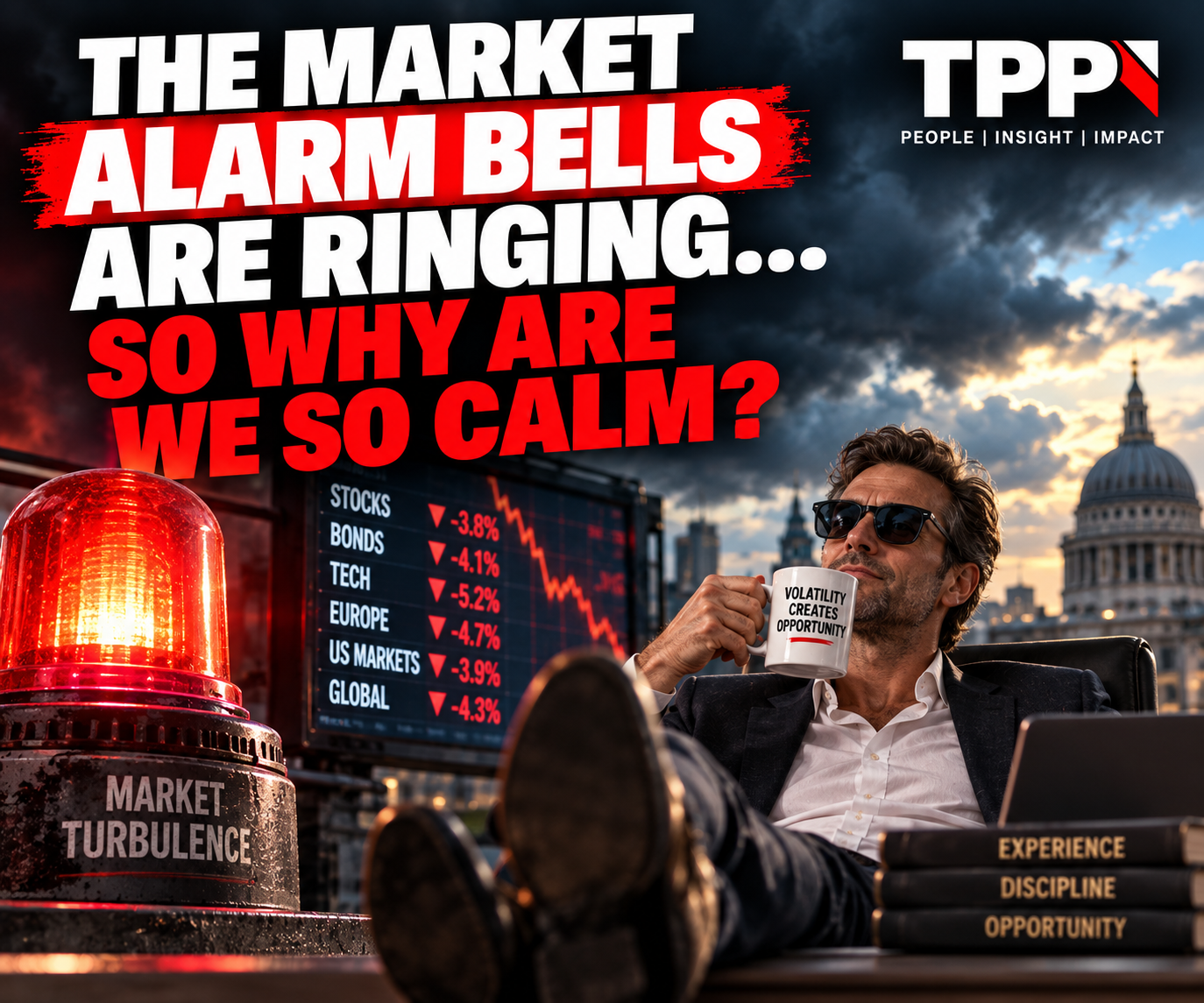
Global stock markets are falling. European equities have dropped to multi-month lows. France has been particularly uncomfortable, with the CAC 40 recently suffering some sharp sessions and fiscal and political concerns adding to the pressure.
Then there is AI.
One of the biggest investment stories of our generation is suddenly sharing the headlines with warnings about security, regulation, autonomous AI and whether development is simply moving too quickly.
Then there are the wars.
Oil prices have surged again as geopolitical tensions intensify, creating yet another inflationary headache for central banks.
Economic growth remains fragile.
And just when investors had spent years waiting for interest rates to come down, markets are once again contemplating the possibility of them going UP.
Perhaps the biggest alarm bell of all is coming from the bond market.
The US 10-year Treasury yield has just broken above 5%, touching around 5.04%, its highest level since 2007. German and Japanese government bond yields have also hit multi-year or multi-decade highs.
Higher yields.
Higher oil.
Inflation fears.
Interest-rate fears.
AI fears.
War.
Falling stock markets.
It doesn't exactly scream:
BUY BUY BUY!!!
And yet...
Very calm.
Why?
Because this is what we do.
Between us, we have decades of experience in markets.
We've seen crashes.
We've seen recessions.
We've seen wars.
We've seen financial crises.
We've seen political crises.
We've seen markets fall for reasons that looked terrifying at the time... only for those same moments to create some of the best investment opportunities that followed.
And right now?
We don't see the end of the world.
We see a bump in the road.
Nothing more.
Nothing less.
And potentially, a bloody good opportunity.
This is one of the biggest differences between the way we think and the way many investors think.
If a market falls 10%, we don't need to buy at exactly -10%.
If we start buying at -4%, -5%, -6% or -7%, we're perfectly comfortable with the possibility that it falls further.
Would we love every market to turn around the second we buy it?
Of course.
It happens surprisingly often.
But it can't happen every time.
We're good. We're not superheroes.
😂
Our objective isn't to perfectly predict every market bottom.
Our objective is to use volatility intelligently.
If, on average, we can capture 4–5% of a significant market pullback by entering at better levels, then when the dust eventually settles, we've potentially created an advantage.
And do that repeatedly over many years?
Those incremental advantages can become very meaningful.
This is where our philosophy differs fundamentally from the traditional buy, hold and hope model.
If you're permanently fully invested, falling markets hurt.
There isn't much else to say.
You own the market.
The market falls.
Your portfolio falls with it.
And somebody sends you a reassuring email telling you to “focus on the long term.”
Thanks. 😂
At TPP, we're trying to approach markets differently.
Our portfolios are constructed using different strategies, different levels of exposure and different approaches to market conditions.
Sometimes that means being exposed.
Sometimes that means reducing exposure.
Sometimes that means sitting flatter.
And sometimes, like now, it means progressively buying into weakness.
Not because we know where tomorrow's bottom is.
We don't.
But because we believe volatility creates opportunity.
Not in exactly these circumstances.
Every market event is different.
But we've experienced this type of market thousands of times.
Fear rises.
Headlines become increasingly dramatic.
Investors become nervous.
Markets fall.
People start questioning whether “this time is different.”
And eventually...
Things settle.
Markets adjust.
Capital moves.
Opportunities emerge.
And investors who had a plan can often look back at the chaos very differently from those who simply panicked through it.
We've got the T-shirt.
And over the years, we've made a bundle from moments that felt distinctly uncomfortable while they were happening.
That's why we're calm.
There is an important distinction.
The bond market deserves watching.
A US 10-year yield above 5% matters. It changes the relative attractiveness of equities, increases borrowing costs and puts pressure on valuations.
Oil matters.
Inflation matters.
Central banks matter.
AI absolutely matters.
And geopolitics matters.
Any one of those things could produce further volatility.
We expect more volatility.
But volatility and catastrophe are not the same thing.
And volatility and investment opportunity are certainly not mutually exclusive.
Quite the opposite.
For an investment approach designed to alter exposure and take advantage of market weakness, volatility can actually be useful.
Thank you for your patience while we've been buying into this falling market.
Some positions may go against us before they go for us.
That's investing.
But we're comfortable with what we're doing, we're monitoring markets closely, and we believe the better entry levels being created now can ultimately reward that patience.
We don't know whether markets turn tomorrow, next week or after another leg lower.
Nobody does.
But we're positioning ourselves for what comes after the fear.
And we're excited about the opportunity.
Remember what happened during the recent Iran conflict.
Periods of uncertainty are often when the difference between investment approaches becomes clearest.
I suspect this could be another one of those periods.
If markets bounce tomorrow, brilliant.
If they fall another 5%?
We'll assess the opportunity in front of us.
That's the point.
We're not building an investment philosophy around hoping markets always go up.
We're building one around the reality that they don't.
So if you're fed up with the traditional model...
If buy, hold and hope isn't quite cutting it anymore...
And if you're looking for an investment approach that feels a little more 2026 than 1986...
Perhaps it's time we had a conversation.
Come and join the investment revolution.
Schedule a call with TPP today.
The alarm bells may be ringing.
We're listening to them.
We're just not panicking.
And hopefully, when the dust settles, this uncomfortable little period will prove to have been a very profitable one.
If you would like to have a conversation with our team, and ask the probing questions in your mind then SCHEDULE A CALL WITH TPP: CLICK HERE.
We look forward to hearing from you.
TPP's year-to-date average return across participating client accounts is 24.11%*.
Interested in learning more? CONTACT OUR TEAM...
There is a substantial risk of loss in trading financial markets. Past performance is not indicative of future results. The examples in this article are illustrative and do not guarantee that any strategy will outperform a benchmark or avoid losses.
*Results as of 14th August 2026 and refer to the combined average of all client discretionary portfolio accounts (across all strategies), after fees, calculated on a Time Weighted Return basis.
Disclaimer: This document is issued by TPP, being provided for information purposes only. This document does not constitute legal, tax, accounting or investment advice, nor should it be relied upon when making investment decisions. This is not a personal recommendation or an offer or invitation to buy or sell any financial instrument. The market conditions and views expressed are as at the date of publication, which may change without notice. Unless otherwise stated, market data has been obtained from sources believed to be reliable. While believed to be accurate, no representation or warranty is given as to its completeness or accuracy.
TPP strategies invest in leveraged financial instruments, including equity index futures. Leverage can magnify both gains and losses, meaning losses may occur more quickly than in unleveraged investments. Investments involve risk and investors may lose some or all of their invested capital. Your capital is at risk.
Past performance is not necessarily a reliable indicator of future performance. The value of investments, and any income from them, can fall as well as rise, and investors may not recover the amount originally invested. Future returns are not guaranteed. Therefore, you should not assume that the future performance of any specific investment or investment strategy will be profitable or equal to the corresponding past performance.
TPP is a trading name of UCapital Asset Management LLP. UCapital Asset Management LLP is authorised and regulated by the Financial Conduct Authority (FCA No. 477155). 80 Coleman Street, London EC2R 5BJ.
Capital is at risk. Investments can fall as well as rise and you may get back less than you invest. TPP strategies may use leverage and short selling, which can magnify losses as well as gains. Past performance is not a reliable indicator of future results. Nothing above constitutes a personal recommendation.
“TPP might just be about to revolutionise investment for the retail market.”
- London Stock Exchange 2020


