>
Insights>
Market Activity>
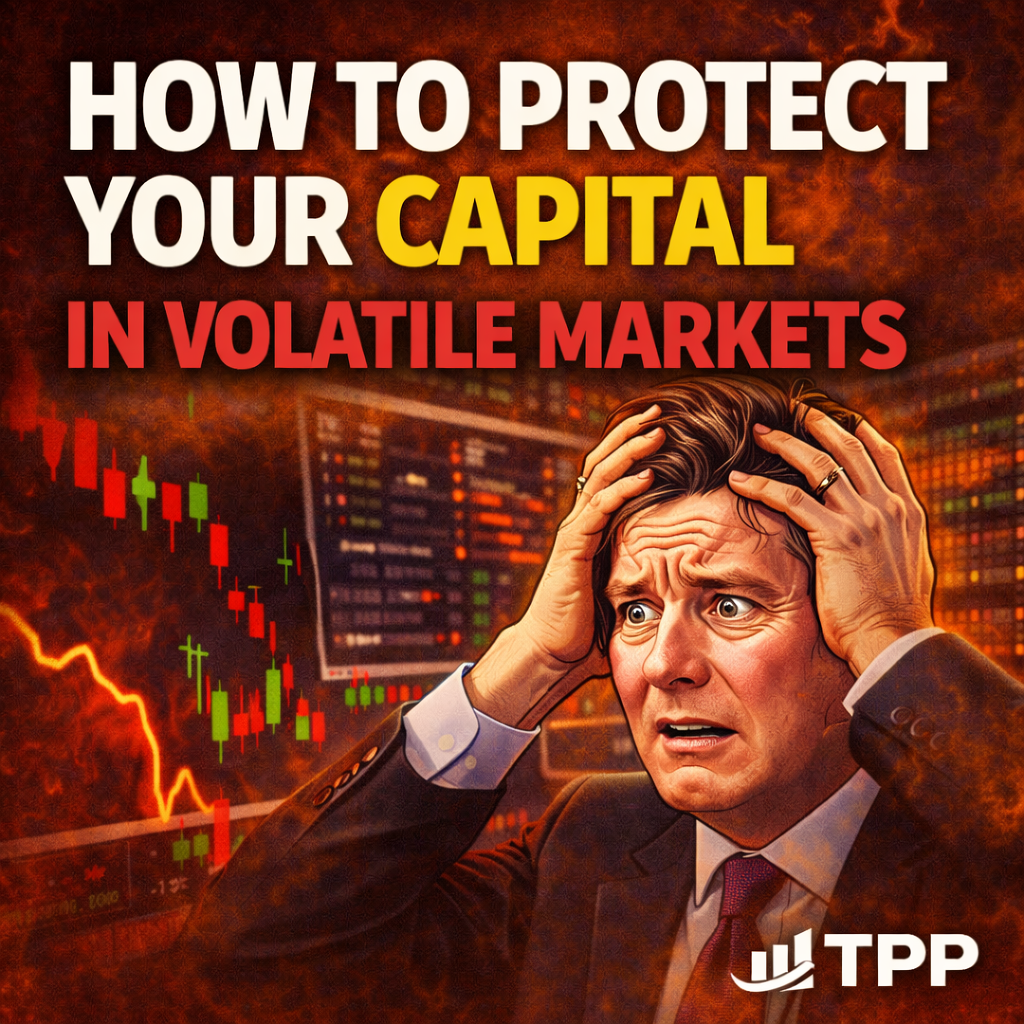
How Do You Protect Capital in Volatile Markets? Learning how to beat benchmarks with Lane Clark of TPP.
Market Activity
Markets are volatile. How does one mitigate risk? Let Lane Clark tell you...
February 11, 2026
Related Links
When markets get choppy, one question dominates investor conversations:
“How do I protect my capital?”
Not:
“How do I maximise returns?”
Not:
“How do I beat the index?”
Just:
“How do I stop losing money?”
Fear changes priorities.
And right now, fear is rising.
Tech sells off.
Gold spikes and crashes.
Crypto swings 10% in a day.
Rate cuts are priced in… then repriced out.
Volatility isn’t coming.
It’s here.
So how do you protect capital without hiding in cash forever?
Let’s be honest first.
Anyone who tells you they can guarantee protection in markets is either naïve or dishonest.
Markets are inherently risky.
Drawdowns happen.
Corrections happen.
Unexpected events happen.
Protection doesn’t mean immunity.
It means intelligent risk management.
And that’s where most traditional wealth management models fall short.
The standard approach is simple:
Buy a diversified portfolio.
Hold it.
Ride out volatility.
When markets fall?
“Stay the course.”
That might work over decades.
But it doesn’t feel great when your portfolio drops 20–30% in months.
It also assumes you can emotionally tolerate large swings, which many investors can’t.
More importantly:
Buy-and-hold does nothing to manage exposure.
It assumes time will solve everything.
Sometimes it does.
Sometimes it doesn’t.
Before we think about upside, we think about:
• Drawdowns
• Exposure
• Probability
• Behaviour in stressed markets
Because protecting capital isn’t about predicting crashes.
It’s about controlling participation.
That distinction matters.
One of the biggest misunderstandings in investing is this:
“If I’m not fully invested, I’m missing out.”
That’s only true if markets rise in straight lines.
They don’t.
Three of our four strategy types actively manage exposure.
Most notably, our Long or Flat strategies.
Here’s how they work conceptually:
• When markets trend positively → we participate
• When markets look extended → we step aside
• When markets pull back → we look to re-enter
We don’t predict tops.
We respond to conditions.
Being flat isn’t failure.
It’s risk control.
Flat exposure reduces drawdowns.
Reduced drawdowns mean:
• Less emotional stress
• Faster recovery periods
• Stronger compounding over time
Avoiding large losses is just as powerful as chasing large gains.
We don’t need to be right 100% of the time.
We don’t try to catch exact tops or bottoms.
We focus on probability.
If we get 70–85% of decisions right over time, and avoid the worst of major pullbacks, we outperform benchmarks.
Not because we’re magicians.
Because we’re disciplined.
Volatile markets punish prediction.
They reward structure.
Capital protection isn’t about one tactic.
It’s about layering risk management.
A typical TPP portfolio blends:
• Long or Flat strategies (high-probability foundation)
• Hybrids (partial exposure + retracement deployment)
• Active strategies (more aggressive, but structured)
• Limited tracker exposure where appropriate
That means no single market event dominates the entire portfolio.
We’re not all-in.
We’re not all-out.
We’re adaptable.
Here’s something counterintuitive:
Volatile markets often create the best opportunities.
But only for those positioned correctly.
If you’re fully invested when markets drop sharply, you’re defensive.
If you’ve reduced exposure and held discipline, you’re prepared.
When fear peaks, disciplined capital gets deployed.
That’s how you turn volatility from threat into advantage.
Investing isn’t just numbers.
It’s behaviour.
When portfolios fall hard:
• Investors panic
• Investors sell
• Investors lock in losses
The biggest long-term damage often isn’t the market, it’s the reaction.
Risk-managed strategies help remove emotional decision-making.
They replace:
“Should I sell?”
With:
“The system will respond.”
That psychological stability is hugely underrated.
Not by hiding in cash forever.
Not by blindly buying every dip.
Not by hoping things bounce back.
You protect capital by:
• Managing exposure
• Reducing drawdowns
• Accepting you won’t get everything right
• Focusing on probability over prediction
• Building portfolios that adapt
That’s what we’ve built at TPP.
Not a hype platform.
Not a crystal ball.
A structured, risk-first investment model.
If you’d like a deeper breakdown of:
• How our Long or Flat strategies operate
• How portfolios are constructed
• How we manage exposure during volatility
👉 Schedule an absolutely FREE portfolio consultation call by clicking here.
Find out exactly how we build benchmark beating portfolios, and how we can assist you. Or:
👉 Set up a FREE demo portfolio and test drive 4 of our strategies by clicking here.
Volatility isn’t the enemy.
Unmanaged risk is.
Let me know how we can assist, and when you're ready to beat benchmarks, you know where I am.
Lane
TPP
“TPP might just be about to revolutionise investment for the retail market.”
- London Stock Exchange 2020


