Market Activity
When markets panic, opportunities emerge. What's your wealth manager doing?
October 9, 2026
Related Links
Something interesting is happening in Europe.
And depending on how your money is being managed, you might be looking at it in two very different ways.
You might see a problem.
We see a potential opportunity.
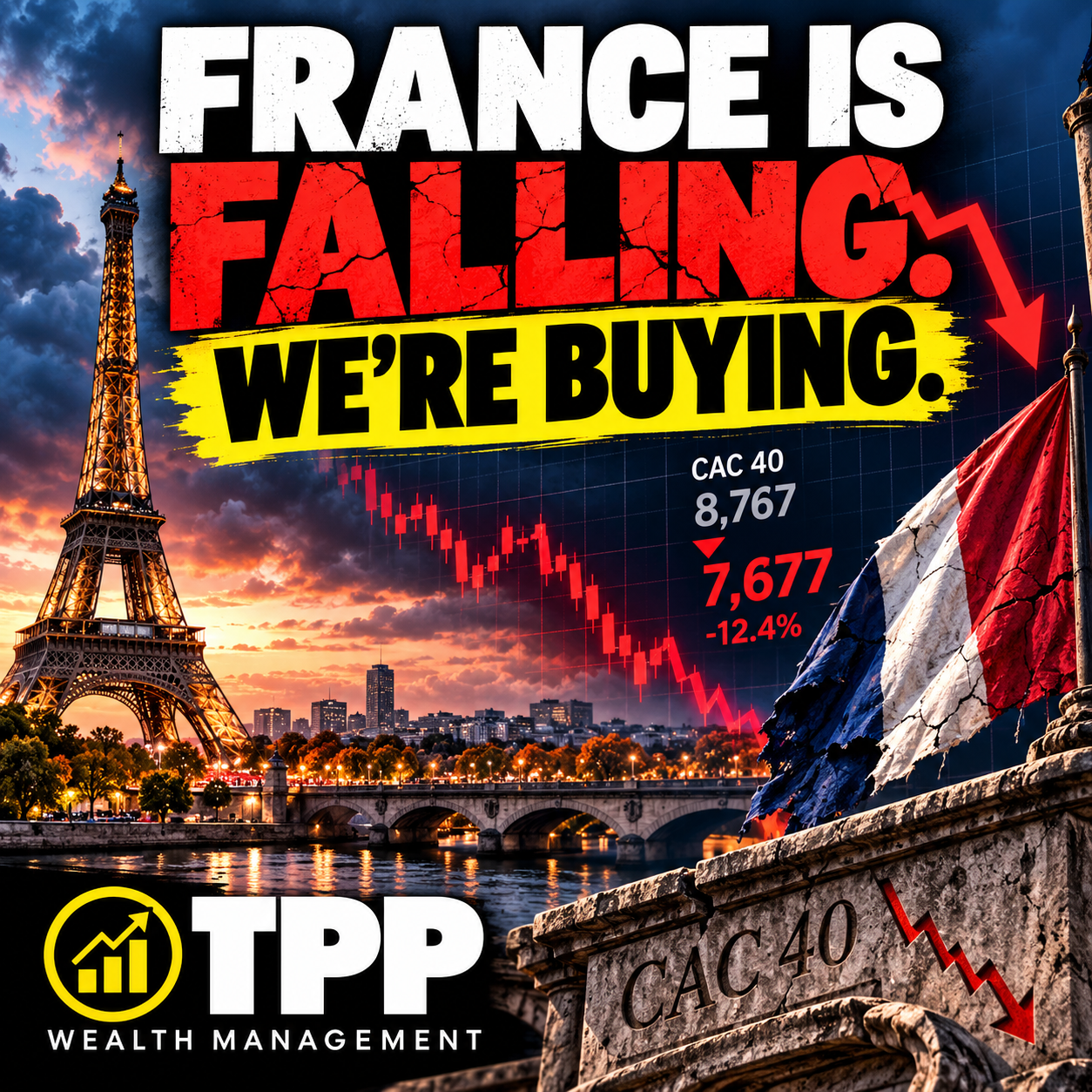
Over the past couple of months, the French CAC 40 has fallen from approximately 8,767 to 7,677.
That's a decline of around 12.4%.
More than a tenth of the market's value wiped away.
Political turmoil.
A growing debt crisis.
Government borrowing costs climbing.
Protests on the streets.
Investors becoming increasingly nervous.
And the headlines are getting worse.
So here's a question.
When markets fall 10%, 12% or 15%, what does your wealth manager actually do?
Do they actively assess the opportunity?
Do they adjust your exposure?
Do they have a strategy for deploying capital into falling markets?
Or do they simply tell you to sit tight, think long term and wait?
Because there's a very big difference.
Let's imagine you've entrusted £500,000 to a traditional wealth manager.
They've constructed a diversified portfolio.
They've explained the importance of long-term investing.
And they're charging you an annual percentage of your assets for their services.
So far, so familiar.
Then markets start falling.
France drops 5%.
Then 8%.
Then 12%.
And you ask what they're doing about it.
The answer?
Markets go up and down. Stay invested. Think long term.
Now, there's nothing inherently wrong with long-term investing.
It's an important principle.
And sometimes doing nothing genuinely is the right decision.
But surely investors are entitled to ask whether they're paying for active investment decisions or simply for somebody to hold their investments?
Because being patient isn't the same thing as being proactive.
And that's one of the reasons we built TPP.
At TPP, we believe meaningful market retracements can create opportunities.
Rather than permanently committing every pound to the market and hoping for the best, several of our strategies are designed to vary their exposure.
Sometimes they're invested.
Sometimes they're partially invested.
And sometimes they're positioned defensively, waiting for more attractive opportunities.
We call one of our core approaches Long or Flat.
The principle is straightforward.
We don't believe you always need to be fully exposed to a market, regardless of valuation, conditions or risk.
Instead, we aim to identify more attractive entry points when markets experience retracements.
And France is a very good example of that philosophy in action.
As the French market has declined, we've been progressively deploying capital.
Our average entry has been approximately 5.5% below the previous market highs.
Has that been the absolute bottom?
No.
The market has continued falling.
And we won't pretend otherwise.
But that's the reality of investing.
You don't need to buy at the exact bottom to benefit from a subsequent recovery.
You need an investment thesis.
You need discipline.
You need an understanding of the risks.
And you need a strategy for managing your exposure if the situation changes.
We believe the current French market retracement offers an interesting medium-term opportunity.
That doesn't mean a recovery is inevitable or imminent.
It means we're prepared to act when prices become more attractive, rather than waiting until everybody is feeling comfortable again.
The headlines tell much of the story.
France is wrestling with political instability and growing concern about its public finances.
Government debt has become a major issue.
Investors are demanding higher yields to hold French government bonds.
Politicians are under pressure to control spending, while voters are pushing back against cuts.
And the resulting uncertainty has unsettled financial markets.
It's a difficult situation.
But here's what investors sometimes forget.
The stock market and the economy are not the same thing.
A country can experience political turmoil while individual companies continue generating revenues, earning profits and conducting business around the world.
Equally, a strong economy doesn't automatically make its stock market attractively priced.
What matters is the price you pay, the risks you're taking and the returns you might reasonably expect.
And when fear drives a market substantially lower, we believe it's worth investigating whether prices have moved further than the underlying investment outlook justifies.
Not every sell-off is an opportunity.
Some are warnings.
The skill lies in assessing the difference.
Consider two investors.
Both have £500,000.
Both want their wealth to grow.
Both understand that markets occasionally experience difficult periods.
The first investor is permanently invested.
Markets rise, they're invested.
Markets fall, they're invested.
Markets recover, they're still invested.
It's simple.
And over long periods, that approach can work.
The second investor uses a strategy that can adjust exposure.
When markets appear stretched, the strategy may reduce exposure.
When meaningful retracements occur, it can look to increase exposure at lower prices.
It won't get every decision right.
Sometimes it will buy too early.
Sometimes it will miss part of a rally.
And sometimes staying invested would have produced a better result.
But it has something the first approach may lack.
The flexibility to respond to changing market conditions.
That's what we believe is so valuable about active portfolio management.
And it's central to what we do at TPP.
Think back to some of the major market scares we've experienced in recent years.
Trade tariffs.
Geopolitical conflict.
Inflation fears.
Interest-rate uncertainty.
Again and again, investors have been confronted by frightening headlines and falling markets.
At TPP, we've used selected periods of weakness to look for opportunities.
Not because we know exactly when the market will turn.
We don't.
But because meaningful retracements can offer more attractive entry points than buying after markets have already enjoyed a substantial rally.
It's much easier psychologically to buy when everything looks wonderful.
Unfortunately, that's not always when the best opportunities are available.
Some of the more interesting opportunities arrive when the headlines look dreadful.
France may be another example.
That's the question we're asking.
Not whether France has problems.
Clearly, it does.
Not whether markets could fall further.
They absolutely could.
But whether the current decline has created an attractive opportunity for investors prepared to accept the risks and wait for conditions to improve.
Our view is that it may have.
And we're positioning accordingly.
Of course, if the debt crisis deepens, political instability worsens or company fundamentals deteriorate, that view may need to change.
That's why we monitor markets and strategies daily.
Active management should mean active decision-making.
Not simply active fee collection.
TPP was built to challenge the traditional wealth management model.
We're former financial traders.
We use multiple investment strategies.
We actively monitor markets.
We manage exposure according to the approach and risk profile of each strategy.
And we operate a subscription-based model rather than charging the traditional percentage-based management fee.
Our ambition is simple.
To give investors a more intelligent, transparent and actively managed alternative, with the objective of outperforming relevant benchmarks over the long term.
There are no guarantees.
But we believe investors deserve a genuine choice.
And situations like the current French market sell-off help explain why.
If the market you were interested in buying suddenly became 12% cheaper, would you automatically run away?
Or would you investigate whether it represented an opportunity?
That's the difference between reacting to headlines and following a considered investment strategy.
At TPP, we've been buying into French weakness.
We haven't caught the exact bottom.
And we may have to be patient.
But we believe the current situation presents an opportunity worth pursuing.
So while much of the market is worrying about France, we're looking at what might happen when the dust settles.
And perhaps you should be asking your wealth manager the same question.
What are you doing to take advantage of opportunities like this?
If you'd like to understand how we manage exposure, identify market retracements and build actively managed investment portfolios, there are two straightforward ways to get started.
Request a FREE demo portfolio — see how our strategies work, how exposure changes and how we monitor performance. Click here.
Book a FREE portfolio consultation — have a conversation about your existing investments, your objectives and whether TPP might be a suitable alternative. Click here.
TPP — A smarter way to invest.
Capital at risk. Investments can fall as well as rise. Past performance is not indicative of future results. Active management does not guarantee outperformance. Market recoveries are uncertain and investments may experience further losses.
TPP's year-to-date average return across participating client accounts is 22.89%*.
Interested in learning more? CONTACT OUR TEAM...
There is a substantial risk of loss in trading financial markets. Past performance is not indicative of future results. The examples in this article are illustrative and do not guarantee that any strategy will outperform a benchmark or avoid losses.
*Results as of 14th September 2026 and refer to the combined average of all client discretionary portfolio accounts (across all strategies), after fees, calculated on a Time Weighted Return basis.
Disclaimer: This document is issued by TPP, being provided for information purposes only. This document does not constitute legal, tax, accounting or investment advice, nor should it be relied upon when making investment decisions. This is not a personal recommendation or an offer or invitation to buy or sell any financial instrument. The market conditions and views expressed are as at the date of publication, which may change without notice. Unless otherwise stated, market data has been obtained from sources believed to be reliable. While believed to be accurate, no representation or warranty is given as to its completeness or accuracy.
TPP strategies invest in leveraged financial instruments, including equity index futures. Leverage can magnify both gains and losses, meaning losses may occur more quickly than in unleveraged investments. Investments involve risk and investors may lose some or all of their invested capital. Your capital is at risk.
Past performance is not necessarily a reliable indicator of future performance. The value of investments, and any income from them, can fall as well as rise, and investors may not recover the amount originally invested. Future returns are not guaranteed. Therefore, you should not assume that the future performance of any specific investment or investment strategy will be profitable or equal to the corresponding past performance.
TPP is a trading name of UCapital Asset Management LLP. UCapital Asset Management LLP is authorised and regulated by the Financial Conduct Authority (FCA No. 477155). 80 Coleman Street, London EC2R 5BJ.
Capital is at risk. Investments can fall as well as rise and you may get back less than you invest. TPP strategies may use leverage and short selling, which can magnify losses as well as gains. Past performance is not a reliable indicator of future results. Nothing above constitutes a personal recommendation.
“TPP might just be about to revolutionise investment for the retail market.”
- London Stock Exchange 2020


