>
Insights>
Market Activity>
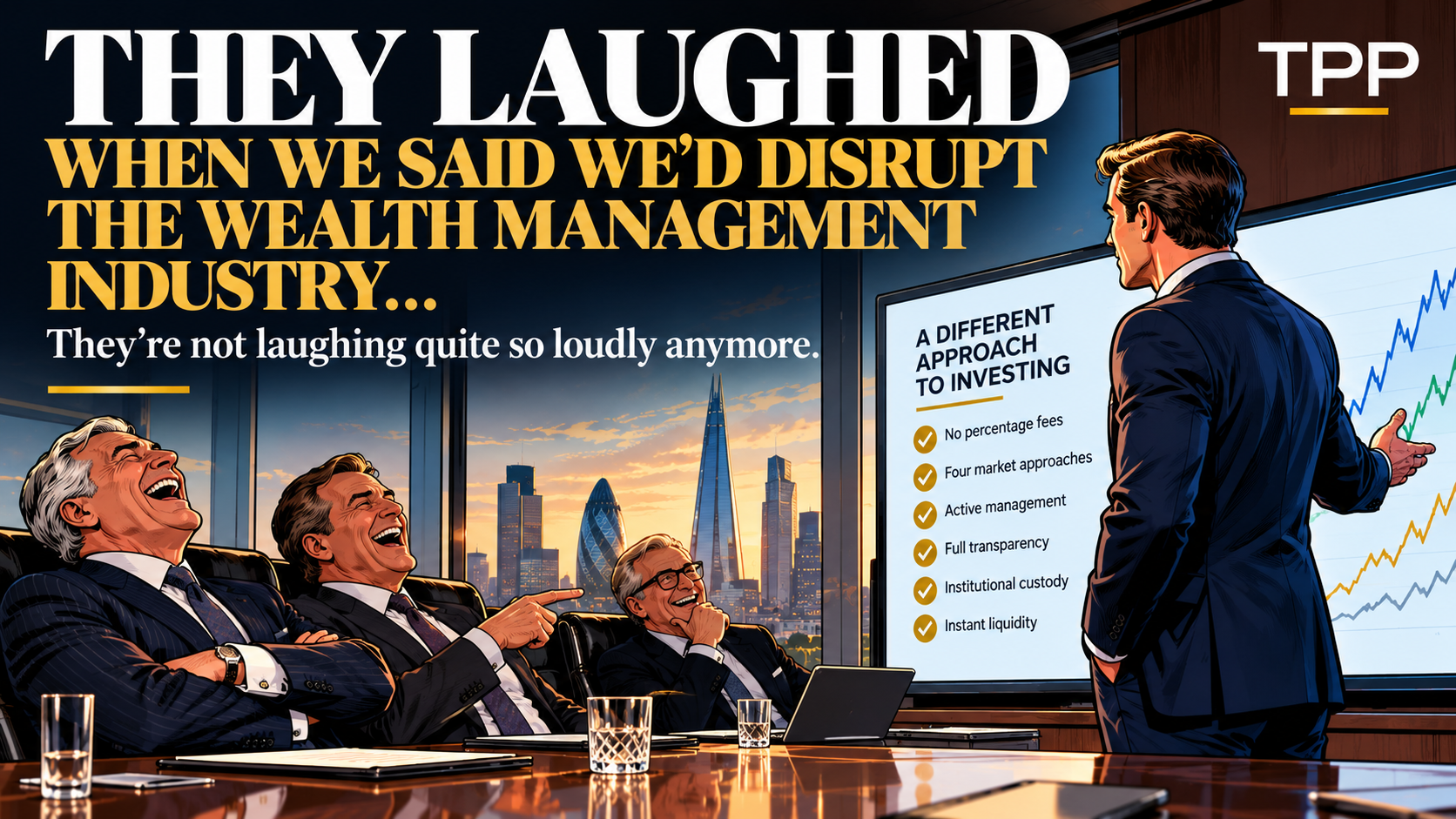
THEY LAUGHED WHEN WE SAID WE'D TAKE ON THE WEALTH MANAGEMENT INDUSTRY…
Market Activity
But they're not laughing quite so loudly anymore.
October 27, 2026
Related Links

Dear Investor,
I still remember the reaction.
The raised eyebrows.
The polite smiles.
The occasional smirk.
You know the sort.
The expression people give you when they think you're being hopelessly naive.
We'd just explained what we intended to do.
We were going to challenge the traditional wealth management industry.
Not with another investment fund.
Not with another expensive financial adviser.
And certainly not with another glossy brochure promising the earth.
We wanted to build something fundamentally different.
An investment management business created by former financial traders.
One that didn't simply buy a portfolio, hold it indefinitely and hope the markets behaved themselves.
One that offered investors multiple ways to approach the markets.
One that didn't charge a percentage of their wealth every year.
And one where investors could actually see what was happening to their money.
They thought we were dreaming.
After all...
Who were we to challenge an industry that had operated largely the same way for decades?
An industry dominated by enormous institutions.
Household names.
Billions under management.
Expensive offices.
Expensive suits.
And very expensive fees.
But there was something they hadn't considered.
What if the industry wasn't quite as good as it thought it was?
We'd spent years working in financial markets.
Trading.
Analysing.
Managing risk.
Making decisions.
And watching how markets behaved in the real world.
Not simply in theory.
We knew markets didn't move in straight lines.
We knew they could become dangerously expensive.
We knew they could collapse when investors least expected it.
And we knew that some of the greatest opportunities appeared when everybody else was frightened.
Yet when we looked at traditional wealth management, we kept seeing the same basic approach.
Build a diversified portfolio.
Buy the investments.
Hold them.
Rebalance occasionally.
And tell the client to remain patient.
Now, there's nothing inherently wrong with long-term investing.
But we had a question.
Surely professional investment management could involve something more?
What about changing exposure when market conditions changed?
What about reducing risk when valuations became stretched?
What about taking advantage of market declines?
What about having different strategies for different environments?
And perhaps most importantly...
Why should investors pay a percentage of everything they own, year after year, for the privilege?
We thought there had to be a better way.
So we decided to build one.
This was the part that really raised eyebrows.
We told people we weren't going to charge traditional percentage-of-wealth management fees.
No management fee calculated as a percentage of your portfolio.
No performance fee.
Instead...
A simple subscription-based model.
Imagine that.
An investor with £500,000.
Another with £1 million.
Another with £2 million.
Rather than automatically charging them more simply because their portfolios were larger, we would charge for access to the investment strategies they selected.
The principle was simple.
Why should your investment manager automatically earn more simply because you've become wealthier?
Of course, subscriptions vary depending on the strategies used, and normal brokerage and other applicable charges still exist.
But we believed the basic principle made sense.
Apparently, questioning an industry's established fee structure was rather amusing.
We weren't particularly amused.
Because we knew what percentage-based fees could mean over a lifetime of investing.
And we thought investors deserved an alternative.
This was where things became even more interesting.
Traditional wealth management often revolves around one central philosophy.
Buy.
Diversify.
Hold.
And remain invested.
We wanted something different.
Four distinct approaches to the market.
Not because one approach is always better than another.
But because markets change.
And different market environments can call for different approaches.
Strategies designed to provide amplified exposure to selected markets when conditions are favourable.
Higher potential exposure also means higher risk, including the possibility of magnified losses.
Strategies that can participate in rising markets but also move towards a market-neutral position when our conditions suggest caution.
The aim is to avoid remaining fully exposed simply because that's what the original portfolio allocation dictated.
Strategies combining longer-term investment exposure with more tactical positioning.
Part invested.
Part flexible.
Designed to balance participation with the ability to respond to changing conditions.
Strategies using more active trading techniques, including long and short positions and spreads, where appropriate.
Different tools.
Different opportunities.
Different risks.
Four approaches rather than relying on one investment philosophy for every market environment.
None guarantees profits or protection from losses.
But together they give us a broader set of tools with which to construct portfolios.
Because it's easy to talk about disrupting an industry.
Anybody can do that.
You can build a website.
Invent a clever slogan.
Produce an impressive presentation.
And declare yourself a revolutionary.
But financial markets have a rather inconvenient habit.
They don't care about your marketing.
They don't care about your ambitions.
They don't care how convincing your presentation looks.
Ultimately, your investment decisions are tested by real market conditions.
And that's where we wanted TPP to demonstrate its worth.
Not through promises.
Through the way our strategies actually operated.
Through daily monitoring.
Through active decisions.
Through risk management.
And through measurable investment results.
Investors started paying attention.
First a few.
Then more.
People who'd spent years using traditional wealth managers began asking questions.
Why am I paying so much?
Why does my fee increase as my portfolio grows?
Why is my portfolio largely static?
What actually happens when markets fall?
Could my money be managed differently?
And perhaps the most important question...
What have I actually been getting for all those fees?
Some decided to give TPP a closer look.
Others opened accounts.
Some added further capital.
Some introduced friends and family.
And slowly, the idea that had once seemed rather ambitious began to look a little more interesting.
Because we weren't simply asking investors to believe in a different philosophy.
We were giving them a different investment management model to evaluate.
Today, TPP has grown into a business serving investors across multiple countries.
We've built a range of actively managed investment strategies.
We've attracted clients who previously relied on traditional wealth management.
And we've developed a business model built around subscriptions rather than percentage-of-wealth management fees.
We've also demonstrated periods of strong investment performance across selected strategies.
But here's something important.
We don't expect you to believe that TPP will outperform every benchmark, every year, in every market.
Nobody can credibly promise that.
Different strategies have different objectives and risks, and past results don't guarantee future performance.
What we can do is show you our approach, explain our results and let you evaluate the evidence.
And that brings us to the part of the story we particularly enjoy.
At TPP, client investment accounts are held with Interactive Brokers.
An established global brokerage and custody provider.
Clients can log in and see their holdings.
They can monitor account values.
They can see their positions.
And through the TPP platform, they can review the performance of individual strategies.
Your money remains visible.
You don't have to rely solely on an occasional statement to understand what's happening.
And unlike products with contractual long-term lock-ins, our model is designed to offer flexibility and access to capital, subject to normal dealing, settlement and account requirements.
Because we believe investors should have visibility and control over their wealth.
Not simply reassurance from somebody sitting behind a very expensive desk.
Perhaps some are.
And that's fine.
We're not expecting the traditional wealth management industry to suddenly declare that its business model needs replacing.
There are excellent professionals working within that industry.
And there are investors for whom conventional diversified portfolios remain entirely appropriate.
But here's what we find interesting.
More investors are beginning to question whether the traditional model is the only model worth considering.
They're questioning fees.
They're questioning performance.
They're questioning what active management really means.
They're questioning transparency.
And they're questioning whether their existing arrangements are delivering what they expected.
That's not a bad thing.
In fact, we think it's long overdue.
Because the wealth management industry shouldn't be immune from the same scrutiny that investors apply to every other major financial decision.
If you have £250,000...
£500,000...
£1 million...
Or considerably more invested...
When was the last time you seriously questioned how your portfolio was being managed?
Not simply checked the balance.
Not simply read the annual report.
Not simply had a pleasant conversation with your adviser over coffee.
I mean really questioned it.
What are you paying?
How has it performed against an appropriate benchmark?
What happens when markets become difficult?
How is risk actually managed?
Could the portfolio be structured differently?
And perhaps most importantly...
If you were starting again today, would you choose exactly the same investment management arrangement?
That's a question worth asking.
Because the financial decisions you made ten years ago don't necessarily have to be the decisions you live with for the next twenty.
We're offering prospective investors the opportunity to schedule a free portfolio consultation with the TPP team.
Not a sales presentation disguised as a conversation.
A proper discussion.
About your investments.
Your objectives.
Your existing fees.
Your current portfolio.
And the alternatives that might be worth considering.
We'll explain how TPP works.
We'll show you our four approaches to the market.
We'll discuss how we manage exposure and risk.
We'll explain our subscription model.
And we'll help you understand whether our approach might be appropriate for your circumstances.
You don't have to transfer anything.
You don't have to open an account.
And you don't have to make a decision.
Just bring your questions.
And perhaps your latest investment statement.
When we first talked about challenging traditional wealth management, the idea was greeted with plenty of scepticism.
And perhaps that was understandable.
After all, challenging an established industry is never easy.
But we didn't set out to win a popularity contest.
We set out to build something we believed investors deserved.
A different charging model.
A wider range of investment approaches.
Active monitoring.
Transparent accounts.
And a serious alternative to the conventional way of managing wealth.
The real question was never whether people would laugh at the idea.
It was whether investors would eventually start asking:
"Why wasn't investment management being offered this way before?"
And now I'd like to ask you one last question.
Could your money be working harder?
There's one way to start finding out.
I look forward to speaking with you.
Best wishes,
Lane
Co-Founder, TPP
A smarter way to invest.
Important information: Capital at risk. Investments can fall as well as rise. Past performance is not indicative of future results. Active strategies, including leveraged and short strategies, involve additional risks and may not be suitable for all investors. Liquidity depends on market conditions and settlement arrangements. Portfolio performance should be evaluated against appropriate benchmarks, over comparable periods, after relevant fees and charges.
Disclaimer: This document is issued by TPP, being provided for information purposes only. This document does not constitute legal, tax, accounting or investment advice, nor should it be relied upon when making investment decisions. This is not a personal recommendation or an offer or invitation to buy or sell any financial instrument. The market conditions and views expressed are as at the date of publication, which may change without notice. Unless otherwise stated, market data has been obtained from sources believed to be reliable. While believed to be accurate, no representation or warranty is given as to its completeness or accuracy.
TPP strategies invest in leveraged financial instruments, including equity index futures. Leverage can magnify both gains and losses, meaning losses may occur more quickly than in unleveraged investments. Investments involve risk and investors may lose some or all of their invested capital. Your capital is at risk.
Past performance is not necessarily a reliable indicator of future performance. The value of investments, and any income from them, can fall as well as rise, and investors may not recover the amount originally invested. Future returns are not guaranteed. Therefore, you should not assume that the future performance of any specific investment or investment strategy will be profitable or equal to the corresponding past performance.
TPP is a trading name of UCapital Asset Management LLP. UCapital Asset Management LLP is authorised and regulated by the Financial Conduct Authority (FCA No. 477155). 80 Coleman Street, London EC2R 5BJ.
Capital is at risk. Investments can fall as well as rise and you may get back less than you invest. TPP strategies may use leverage and short selling, which can magnify losses as well as gains. Past performance is not a reliable indicator of future results. Nothing above constitutes a personal recommendation.
“TPP might just be about to revolutionise investment for the retail market.”
- London Stock Exchange 2020

