>
Insights>
Market Activity>
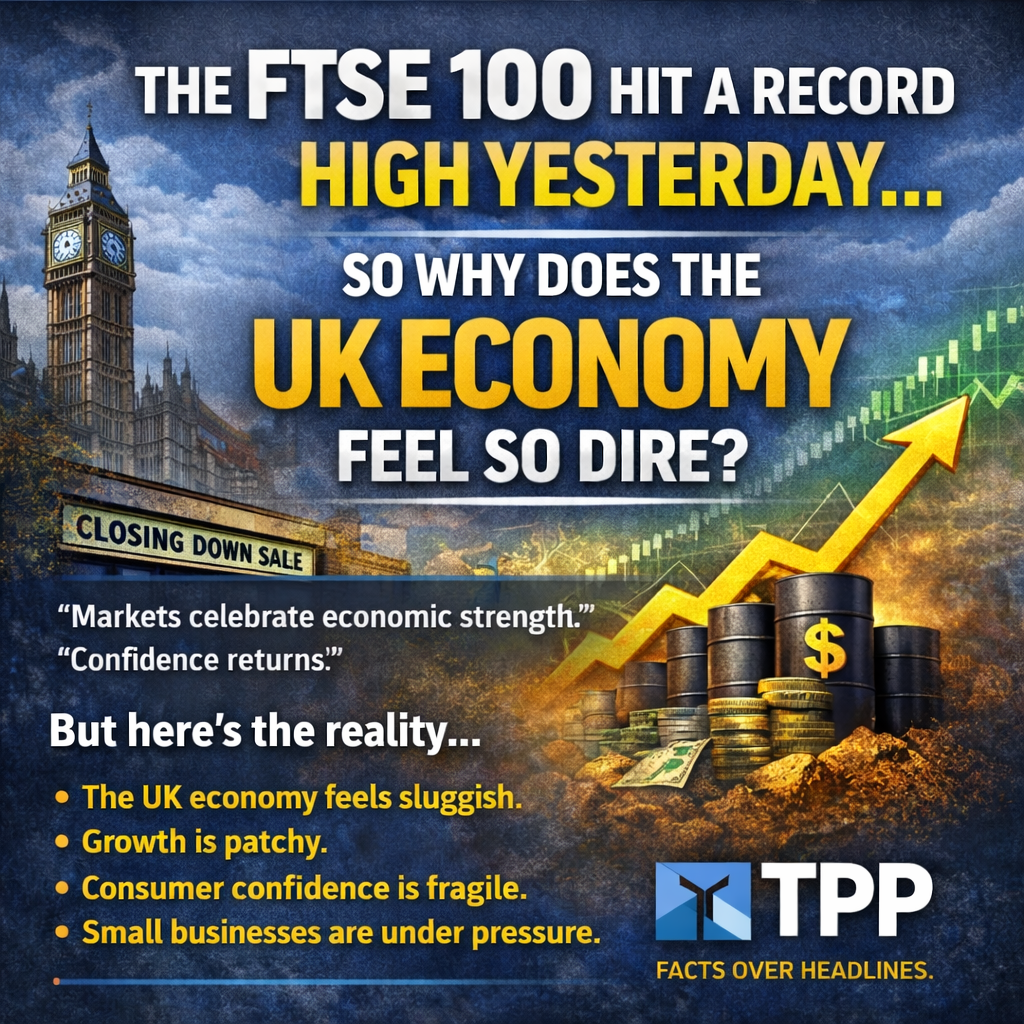
The FTSE 100 Hit a Record High Yesterday…So Why Does the UK Economy Feel So Dire? By Lane Clark of TPP.
Market Activity
Don't get sucked into the narrative.....
February 18, 2026
Related Links
Yesterday the FTSE 100 hit a record high.
Cue the headlines:
“Britain is back.”
“Markets celebrate economic strength.”
“Confidence returns.”
But here’s the reality.....
The UK economy feels sluggish. Growth is patchy. Consumer confidence is fragile. Small businesses are under pressure., and many households feel worse off than they did 3–4 years ago.
So how can both be true?
How can the stock market be booming while the domestic economy feels flat?
Let’s unpack it.
The biggest misunderstanding in British financial media is this:
The FTSE 100 is not a reflection of the UK economy.
It’s a reflection of 100 large companies listed in London.
That’s it.
And the majority of those companies earn most of their money outside the UK.
Take a closer look at the FTSE 100 constituents.
You’ll find global giants like:
These are multinational corporations.
They generate revenue in:
In fact, roughly 70–80% of FTSE 100 revenues come from overseas.
So when oil rises…
When copper rallies…
When the dollar strengthens…
When global growth expectations improve…
The FTSE rises.
Even if your local high street doesn’t.
The FTSE 100 is heavily weighted toward:
This is very different to something like the S&P 500, which is dominated by tech.
When commodities surge, the FTSE often benefits.
When oil spikes, Shell and BP rally.
When iron ore jumps, Rio Tinto climbs.
That has very little to do with:
It’s a global commodities story.
There’s another layer.
When the pound weakens, overseas earnings translate back into higher sterling profits.
So paradoxically:
A weaker UK currency can push the FTSE higher.
Again, that doesn’t signal domestic economic strength.
It signals currency mechanics.
Whenever the FTSE hits a new high, politicians are quick to imply validation.
But the reality is this:
The FTSE 100 could hit new highs during:
Because it simply isn’t a UK-only barometer.
If the global cycle is strong, the FTSE can rise. If global commodities rally, the FTSE can rise. If the dollar strengthens, the FTSE can rise.
Meanwhile, small UK businesses may still be struggling.
Here’s the bigger issue.
Many investors:
• Assume “UK market up = UK economy strong”
• Make allocation decisions based on headlines
• Confuse macro politics with portfolio positioning
• Or sit in stale, overpriced wealth management structures that never explain this nuance
And that’s dangerous.
Because if you misunderstand what drives returns, you misjudge risk.
Let’s be blunt.
Most traditional portfolios:
They don’t adapt to:
They just stay invested and hope.
At TPP, we don’t blindly correlate markets to headlines.
We ask:
Where is the real opportunity? Where is the asymmetry? Where is risk elevated?
Right now, for example, markets are near highs.
Downside risk may outweigh upside potential.
So some strategies sit flat. Patient. Waiting.
Others selectively deploy.
We build portfolios around:
• High-probability Long or Flat foundations
• Tactical hybrids
• Controlled active exposure
• Transparent, net-of-fee performance
• Subscription model (no % AUM drag)
Since inception, we’ve delivered 20%+ per annum on average. Last year north of 30%. All net of fees. Fully transparent.
No management fee. No performance fee. No legacy drag.
Just structured, benchmark-beating architecture.
If the FTSE is at record highs…
But your portfolio isn’t?
Or worse, if it’s barely keeping up?
You need to ask:
Is your wealth manager explaining what’s really driving markets?
Or are they just collecting fees while hugging the index?
The FTSE hitting a record high does not mean the UK economy is booming.
It means global capital flows, commodities and currency dynamics are aligning.
If you understand that distinction, you invest better.
If you don’t, you’re investing blind.
If you’d like a clear, honest assessment of:
• How your portfolio is structured
• Whether you’re overpaying
• Whether you're actually beating benchmarks
• And where risk truly sits
Book a free portfolio consultation call below.
No obligation. No pressure.
Just clarity.
👉 Book Your Free Portfolio Review Here
We would love to assist you to build a benchmark beating portfolio. Because one thing is for sure, The FTSE 100 won't always rise like this!!!
“TPP might just be about to revolutionise investment for the retail market.”
- London Stock Exchange 2020


