Market Activity
In short: Not a lot...
June 22, 2026
Related Links

The political world has moved quickly.
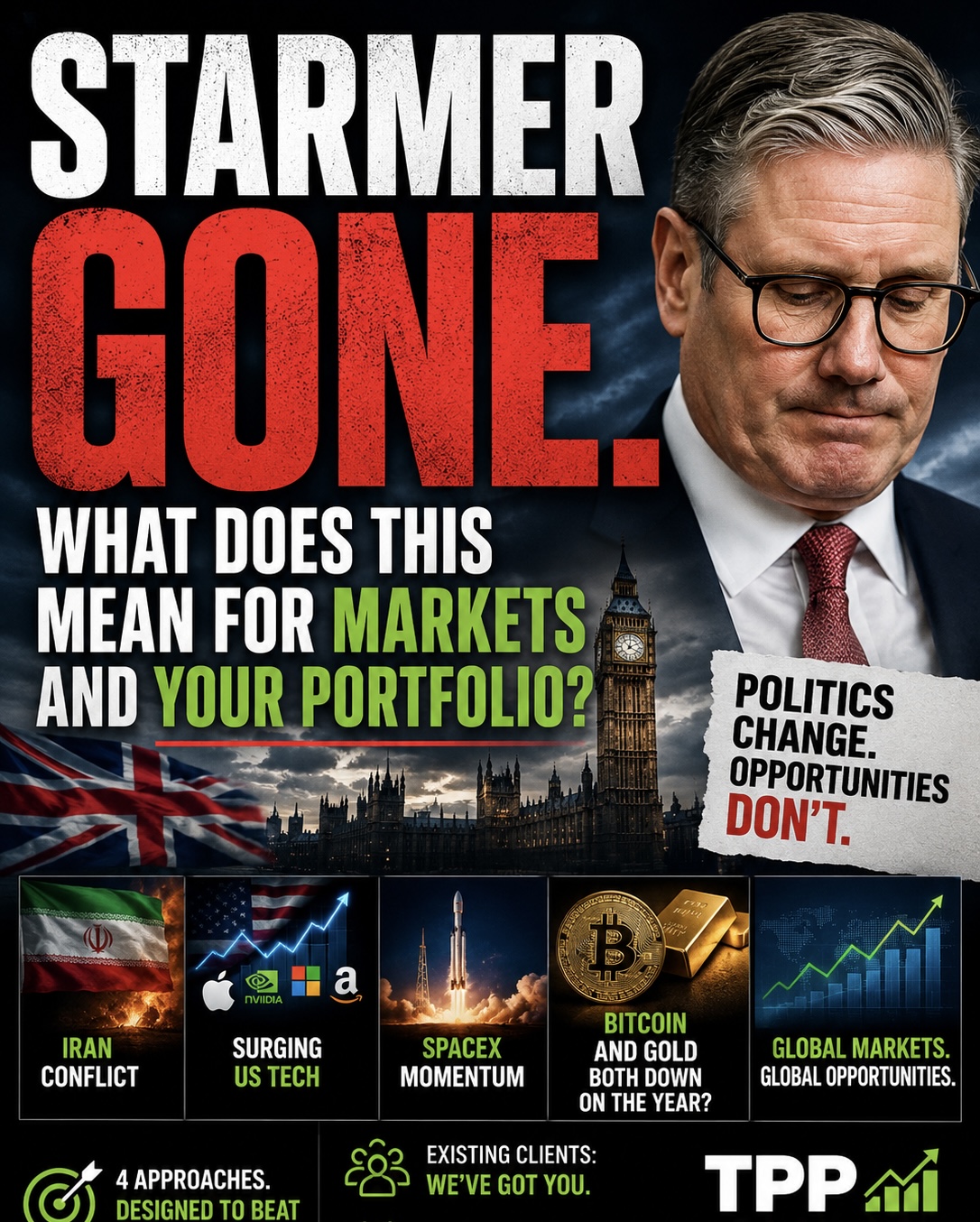
After just two turbulent years, Keir Starmer is gone.
Whether you supported him or opposed him, few would argue his tenure will be remembered as an economic success.
Growth remained sluggish.
Business confidence struggled.
Investment remained under pressure.
And for many hard-working families, entrepreneurs and investors, there was an increasing feeling that aspiration itself had become something to apologise for.
Higher taxes.
More regulation.
More government intervention.
Less confidence.
Less optimism.
Less growth.
For many, it felt like Britain was moving in the wrong direction.
But here's the question investors should really be asking:
What does this actually mean for markets?
The answer is probably a lot less than most people think.
As much as we all love the UK, the reality is that Britain is no longer the dominant force it once was in global markets.
The UK stock market represents only a small fraction of global equity markets.
The largest companies in the world are American.
The largest technology firms are American.
The biggest drivers of global returns over the last decade have overwhelmingly come from outside Britain.
In fact, many FTSE 100 companies generate the majority of their revenues overseas.
Oil majors.
Mining giants.
Pharmaceutical firms.
Consumer brands.
Global banks.
The FTSE is often influenced more by events in Washington, Beijing and the Middle East than by what happens in Westminster.
Which means that despite the dramatic headlines, the departure of a Prime Minister is unlikely to fundamentally change the direction of global markets.
Where things become more interesting is the Chancellor.
Markets care less about political personalities and far more about economic credibility.
The Treasury matters.
The bond market matters.
Government borrowing matters.
Fiscal discipline matters.
And that is where investors will be paying close attention.
If the next Chancellor signals more borrowing, more spending and a further shift towards tax-and-spend economics, UK bond yields could come under pressure.
If investors lose confidence in the UK's fiscal direction, government borrowing costs can rise.
That impacts mortgages.
Businesses.
Consumers.
And ultimately economic growth.
The name generating the most discussion right now is Ed Miliband.
Fairly or unfairly, many investors view his economic philosophy as representing a further move to the Left.
More intervention.
More spending.
More regulation.
More taxation.
Markets tend not to reward that combination.
Meanwhile, figures such as Yvette Cooper may be viewed as a safer pair of hands by investors seeking stability and predictability.
Ultimately, markets don't care about political slogans.
They care about confidence.
While the UK political drama dominates today's headlines, it's not the biggest issue on our radar.
Not even close.
At TPP, we're focused on the events that are genuinely moving global capital.
The Iran conflict.
The continued surge in US technology stocks.
The extraordinary momentum surrounding SpaceX.
Artificial Intelligence.
Global liquidity.
Interest rates.
And some fascinating moves in alternative assets.
For example:
These are the trends shaping portfolios.
Not Westminster headlines.
The good news?
Nothing changes.
TPP wasn't built around political predictions.
It was built around market opportunities.
Our four distinct approaches continue to do exactly what they were designed to do:
Regardless of who occupies Downing Street.
Regardless of who becomes Chancellor.
Regardless of which political party is currently trending on social media.
Markets evolve.
Opportunities emerge.
Capital flows.
And we adapt.
The UK matters.
But perhaps not as much as many investors think.
The next Chancellor may influence bond markets.
Government policy may affect specific sectors.
But long-term investment success is rarely determined by Westminster politics alone.
The world is much bigger than Britain.
And while the UK may be a relatively small player in global markets...
TPP has absolutely no intention of being one.
We've got you.
We'll continue monitoring the opportunities, managing risk and positioning portfolios accordingly.
If you'd like to see how TPP approaches investing differently, and how our four approaches are designed to help investors beat traditional benchmarks, book a free consultation call today.
The political headlines will come and go.
The opportunities won't wait.
Book Your Free Consultation Today
Schedule a FREE consultation call here.
TPP strategies trade leveraged instruments, including equity index futures. Leverage magnifies both gains and losses, and the value of your investment can fall as well as rise. You may get back less than you invest. Capital is at risk.
*TPP client accounts have returned an average of 16.02% year to date, accurate as of 31 May 2026 and referring to the average of all client accounts. Past performance is not a reliable indicator of future results.
Disclaimer: The views expressed in this article are the author’s own and should not be considered to render any legal, business or financial advice. Opinions and estimates offered constitute our judgment and are subject to change without notice, as are statements of financial market trends, which are based on current market conditions.
This material is not intended as an offer or solicitation for the purchase or sale of any financial instrument. This material has been prepared for informational purposes only.
Past performance may not be indicative of future results. Therefore, you should not assume that the future performance of any specific investment or investment strategy will be profitable or equal to the corresponding past performance.
TPP is a trading name of UCapital Asset Management LLP. UCapital Asset Management LLP is authorized and regulated by the FCA - Financial Conduct Authority - with registration number 477155. Registered Company number OC333807..Our past performance may not be indicative of future results. Different types of investments involve varying degrees of risk, and there can be no assurance that the future performance of any investment strategy or product made reference to will be profitable, equal any corresponding historical performance or be suitable for your portfolio. There is a substantial risk of loss in trading financial markets. Past performance is not indicative of future results.
“TPP might just be about to revolutionise investment for the retail market.”
- London Stock Exchange 2020

