>
Insights>
Market Activity>
Burnham's Britain: The First 24 Hours... And What Could It Mean For Your Investments?
Market Activity
A new PM. What now?
July 21, 2026
Related Links
There are moments in politics that matter.
Then there are moments markets pay attention to.
Yesterday, Andy Burnham became Britain's new Prime Minister.
Today, investors got their first real glimpse of the economic backdrop he inherits.
And it isn't exactly an easy hand.
Within hours, the headlines were arriving thick and fast...
Whatever your politics...
Markets don't vote.
They price risk.
And right now, there are plenty of risks for investors to digest.
The biggest issue isn't actually who sits in Number 10.
It's Britain's balance sheet.
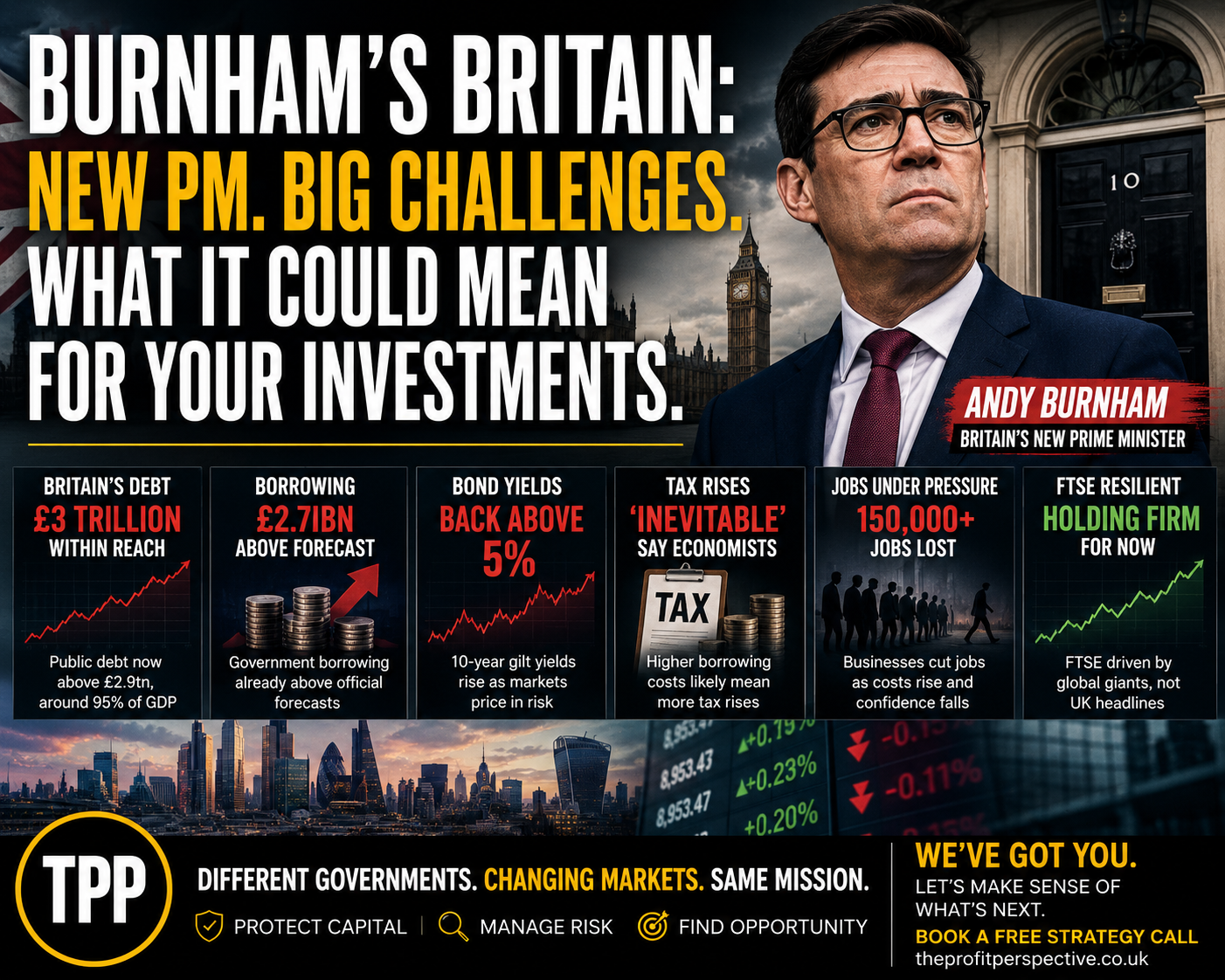
The previous Chancellor borrowed £57.6bn between April and June.
That was lower than last year, but still £2.7bn more than the Office for Budget Responsibility forecast.
Public debt now sits above £2.9 trillion—around 95% of GDP—the highest level seen for decades.
That leaves the new Prime Minister and Chancellor walking an incredibly fine line.
They want economic growth.
They want lower household costs.
They want greater public investment.
But markets also want fiscal discipline.
Those two objectives don't always sit comfortably together.
Most people watch Westminster.
Professional investors watch the bond market.
The reason?
Government borrowing has to be financed.
When investors become nervous, Government borrowing costs rise.
Higher borrowing costs then feed into:
• Mortgage rates
• Business lending
• Corporate investment
• Property valuations
• Government spending flexibility
In many ways, the gilt market has become the UK's biggest opposition party.
And it's one politicians can't ignore.
Nobody knows.
But today's headlines certainly point in one direction.
Several economists now believe additional tax rises this autumn have become increasingly likely.
Not necessarily because governments want higher taxes, but because somebody eventually has to pay for higher spending and rising borrowing costs.
Whether those taxes ultimately fall on businesses, wealth, property, banks or capital remains to be seen.
But investors should at least be aware the conversation has begun.
This is where things become particularly interesting.
If bond yields stay elevated, mortgage costs are unlikely to fall dramatically.
If further tax changes arrive, property investors could face additional pressure.
And if business confidence remains subdued, demand may soften further.
That's not to say property is a bad investment.
It simply means the tailwinds many investors became accustomed to over the last decade may not be there going forward.
Today's headlines also paint a mixed picture.
150,000 jobs have reportedly disappeared as companies adjust to higher employment costs.
Jamie Dimon has publicly warned against additional taxes on banks.
Business groups continue calling for policies focused on investment and growth rather than further taxation.
Confidence matters.
Because investment follows confidence.
And confidence creates jobs.
This surprises many investors.
Despite all these headlines...
The FTSE has actually held up relatively well.
Why?
Because the FTSE 100 isn't really a reflection of the UK economy.
Many of its largest constituents generate the majority of their revenues overseas.
Energy.
Mining.
Pharmaceuticals.
Consumer goods.
Global banks.
The index is often driven far more by the US economy, commodity prices, currencies and international markets than Westminster politics.
That's one reason why negative UK headlines don't automatically translate into falling FTSE markets.
Absolutely nothing., and absolutely everything.
Nothing, because we don't invest based on political ideology.
Everything, because political change creates opportunity.
Volatility creates opportunity.
Fear creates opportunity.
Overreaction creates opportunity.
Our job isn't to predict who wins elections.
Our job is to position portfolios where we believe the probabilities are stacked in our favour, regardless of who's sitting in Downing Street.
Sometimes that means buying.
Sometimes it means taking profits.
Sometimes it means sitting patiently in cash while others become emotional.
The climate changes.
The mission doesn't.
Thank you.
You don't pay us to predict politics.
You trust us to navigate whatever politics throws at markets.
Whether this government succeeds or struggles...
Whether taxes rise or don't...
Whether markets rally or become volatile...
We'll continue doing exactly what we've always done.
Protect capital.
Manage risk.
Look for opportunity.
We've got you.
If the last 24 hours have left you wondering what this could all mean for your investments...
Now is probably a good time to ask the question.
Book a free strategy call with the TPP team below.
We'll explain how we're positioned, how we think about risk, and why successful investing has never been about guessing the next Prime Minister...
It's about adapting to whatever comes next.
SCHEDULE A CALL WITH TPP: CLICK HERE.
TPP's year-to-date average return across participating client accounts is 21.87%*.
Interested in learning more? CONTACT OUR TEAM...
*Results as of 10 July 2026 and refer to the combined average of all client discretionary portfolio accounts (across all strategies), after fees, calculated on a Time Weighted Return basis.
Disclaimer: This document is issued by TPP, being provided for information purposes only. This document does not constitute legal, tax, accounting or investment advice, nor should it be relied upon when making investment decisions. This is not a personal recommendation or an offer or invitation to buy or sell any financial instrument. The market conditions and views expressed are as at the date of publication, which may change without notice. Unless otherwise stated, market data has been obtained from sources believed to be reliable. While believed to be accurate, no representation or warranty is given as to its completeness or accuracy.
TPP strategies invest in leveraged financial instruments, including equity index futures. Leverage can magnify both gains and losses, meaning losses may occur more quickly than in unleveraged investments. Investments involve risk and investors may lose some or all of their invested capital. Your capital is at risk.
Past performance is not necessarily a reliable indicator of future performance. The value of investments, and any income from them, can fall as well as rise, and investors may not recover the amount originally invested. Future returns are not guaranteed. Therefore, you should not assume that the future performance of any specific investment or investment strategy will be profitable or equal to the corresponding past performance.
TPP is a trading name of UCapital Asset Management LLP. UCapital Asset Management LLP is authorised and regulated by the Financial Conduct Authority (FCA No. 477155). 80 Coleman Street, London EC2R 5BJ.
“TPP might just be about to revolutionise investment for the retail market.”
- London Stock Exchange 2020


