>
Insights>
Market Activity>
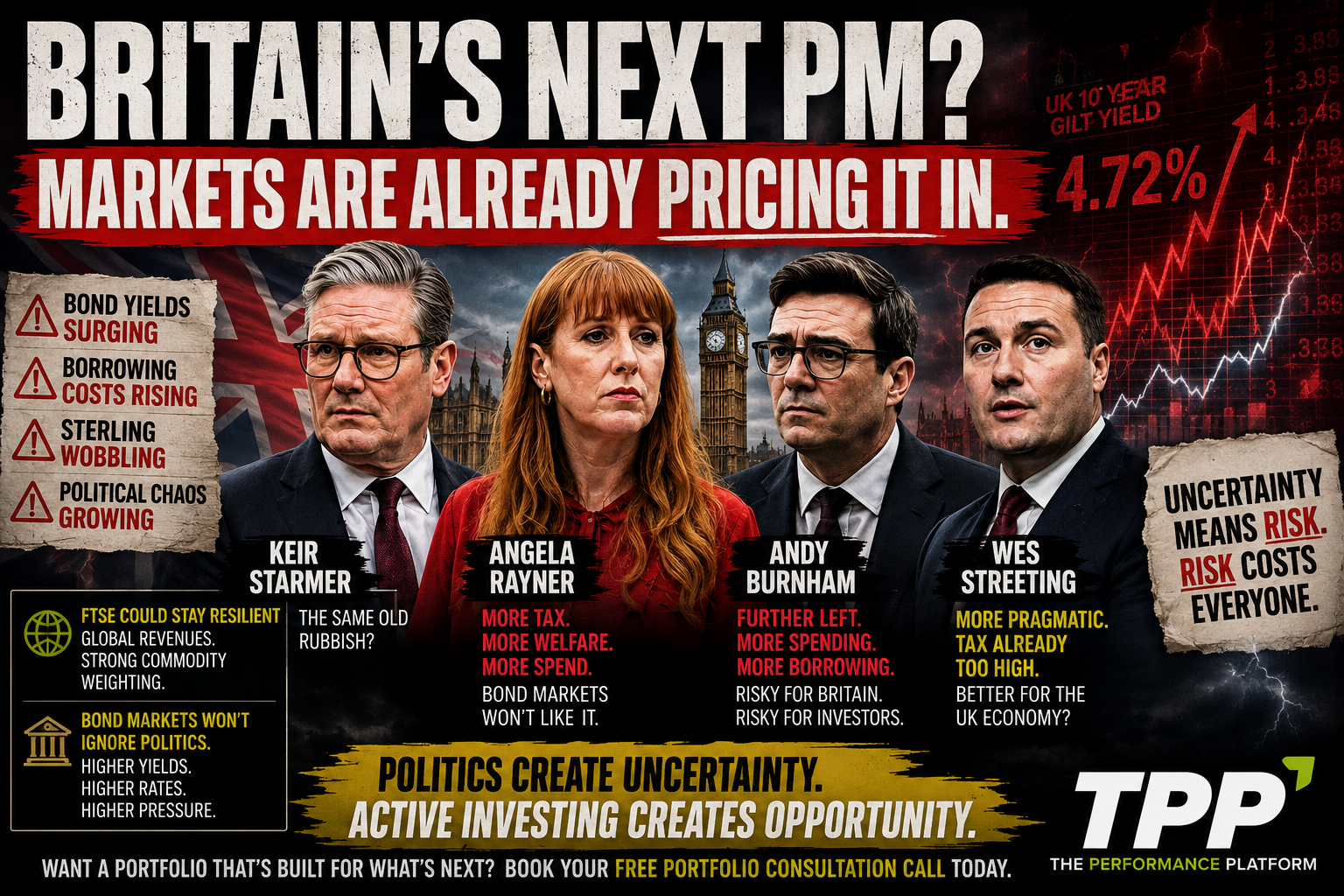
Britain’s Next Prime Minister? The markets are already trying to price it in…
Market Activity
How will the next PM impact the markets?
May 14, 2026
Related Links
Politics and investing have always been linked.
But right now in the UK, they are becoming impossible to separate.
Because while Westminster descends into chaos, markets are quietly asking one very important question:
Who on earth is going to run Britain next… and what does that mean for investors?
At the time of writing:
Meanwhile, the irony?
The latest GDP figures actually came out surprisingly strong.
The UK has just posted the fastest growth in the G7.
Which leaves investors asking:
Is the UK economy actually doing better than expected… or are markets looking through the headlines and focusing on what comes next?
Because one thing is certain:
Markets hate uncertainty.
And right now, uncertainty is everywhere.
If Keir Starmer survives, markets probably breathe a small sigh of relief.
Not because investors are excited…
But because they already know what they’re dealing with.
Higher taxes.
Higher spending.
More regulation.
More redistribution.
In many ways, markets have already priced much of this in.
And despite huge criticism, the UK economy has so far avoided outright disaster.
GDP growth has surprised positively.
Employment has remained relatively stable.
And the FTSE, despite all the doom and gloom, has remained remarkably resilient.
But the problem for Starmer is perception.
Businesses don’t feel optimistic.
Entrepreneurs don’t feel inspired.
And wealth creators increasingly feel like they’re being targeted rather than encouraged.
That matters.
Because economies are built on confidence.
And confidence in Britain still feels fragile.
If markets are nervous now, a further shift to the Left could send bond markets into outright panic mode.
Angela Rayner represents exactly the kind of political direction bond investors traditionally dislike:
And that matters enormously.
Because Britain already has a debt problem.
Government borrowing costs are already near multi-decade highs.
The UK cannot endlessly borrow money without consequences.
Bond investors know this.
And if they begin to believe fiscal discipline is disappearing completely?
They demand higher yields.
That means:
➡️ Higher mortgage rates
➡️ Higher government financing costs
➡️ More pressure on sterling
➡️ More pressure on consumers
➡️ More pressure on businesses
This is where politics suddenly becomes deeply personal for ordinary investors.
Because when bond markets lose confidence, everybody pays for it.
Burnham presents many of the same concerns.
His rhetoric has consistently leaned toward:
Supporters call it fairness.
Markets may call it risk.
Again, the issue is not ideology.
The issue is financing.
Britain cannot continue spending at extraordinary levels forever without investors eventually asking difficult questions.
And the moment bond markets begin demanding significantly higher yields, governments lose flexibility very quickly.
That is the danger.
Because once borrowing costs spiral, governments become reactive instead of proactive.
The UK has already had a preview of this during previous gilt crises.
Markets have long memories.
Ironically, one of the names markets may dislike the least is Wes Streeting.
Why?
Because he has openly acknowledged something most politicians try to avoid:
Tax in Britain is already extremely high.
That matters.
Not because Streeting is suddenly viewed as some free-market revolutionary…
But because investors simply want signs of realism.
Markets want stability.
Markets want fiscal discipline.
Markets want growth.
And perhaps most importantly:
Markets want politicians who understand confidence matters.
Streeting appears, at least relative to others, more aware of the dangers of endlessly squeezing businesses, investors and higher earners.
That could matter enormously if leadership speculation intensifies.
This is where things get interesting.
Because despite all the political noise…
The FTSE has actually held up relatively well.
Why?
Because the FTSE is not a pure reflection of the UK economy.
Far from it.
Many FTSE-listed companies generate huge amounts of revenue overseas.
Oil majors.
Mining giants.
Banks.
Pharmaceutical companies.
Commodity-linked businesses.
In many ways, the FTSE often behaves more like a global portfolio than a domestic UK economy tracker.
And during periods of inflation, geopolitical tension and commodity strength?
That international and commodity-heavy weighting can actually help support the index.
Which is why UK investors need to be careful about assuming:
“Bad UK politics = FTSE collapse.”
Markets are far more nuanced than that.
Equities can sometimes ignore politics for a while.
Bond markets rarely do.
And right now?
Bond markets are flashing warning signs.
Because bond investors are effectively asking:
“Who is going to pay for all this?”
If markets believe Britain is drifting toward:
…then yields likely continue climbing.
And that creates a dangerous feedback loop.
Higher yields increase government borrowing costs.
Which worsens deficits.
Which pressures sterling.
Which increases inflation risks.
Which pressures the Bank of England.
Which pressures households.
This is why the next Prime Minister matters enormously to investors.
At TPP, we have said for years:
The world is changing.
Fast.
Politics is becoming more volatile.
Markets are becoming more reactive.
And the old “buy, hold and hope” model is increasingly outdated.
This is why active portfolio management matters.
This is why flexibility matters.
This is why being able to adapt matters.
Because environments like this create:
…but also opportunity.
At TPP, we are not sitting around hoping politicians get everything right.
We position portfolios for the world as it actually is.
That means:
When markets become emotional, disciplined investing matters even more.
And while politicians argue over Britain’s future…
Our job is simple:
Protect capital.
Find opportunity.
Beat benchmarks.
The next few months could become hugely important for Britain.
Leadership battles.
Bond market volatility.
Tax fears.
Economic uncertainty.
Political infighting.
Investors need to pay attention.
Because the markets already are.
If you’re frustrated with the stale and outdated wealth management model…
If you’re worried about what comes next politically and economically…
Or if you simply want to explore a more active, benchmark-focused approach to investing…
Schedule a FREE portfolio consultation call with the TPP team today. CLICK HERE...
Because uncertainty does not have to mean panic.
With the right strategies, it can create opportunity.
Relax.
This is exactly what we prepare for.
Volatility.
Uncertainty.
Changing market conditions.
It’s what we do.
HAVE A GREAT WEEK EVERYONE. THIS COULD BE ABOUT TO GET INTERESTING....
“TPP might just be about to revolutionise investment for the retail market.”
- London Stock Exchange 2020


